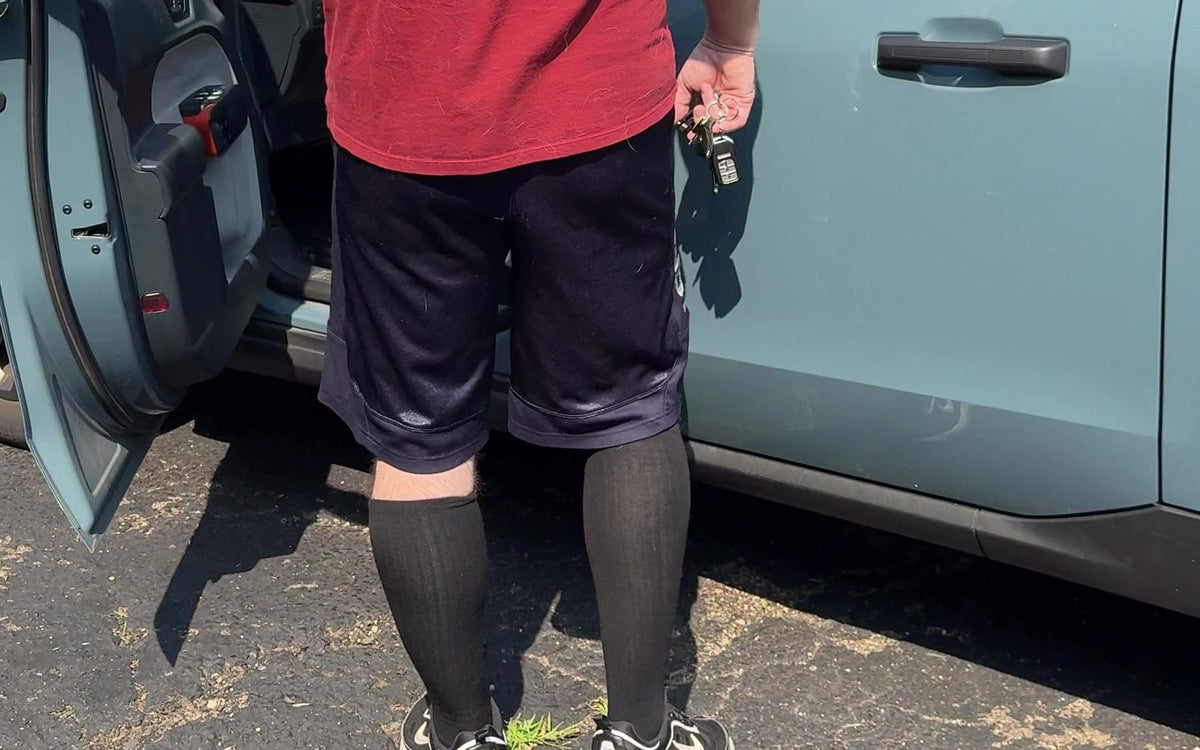
15–20 mmHg is a light-to-moderate level of graduated compression. mmHg stands for millimeters of mercury, the unit used to measure the pressure a sock applies, and 15–20 mmHg is a common choice for everyday wear, long days on your feet and travel. It helps support circulation in the legs.
This is general information, not medical advice. If you have a medical condition, talk with your doctor about the right level for you.
Quick answer
| Question |
Short answer |
| What does 15–20 mmHg mean? |
The pressure the sock applies, tightest at the ankle |
| Who wears it? |
People on their feet or sitting for long periods, and travelers |
| Is it medical grade? |
No, it is a light level; ask your doctor about medical needs |
| How should it feel? |
Snug and supportive, never painful |
What "graduated" means
Graduated compression is strongest at the ankle and eases gradually up the calf. That pattern is designed to help support circulation from the feet back toward the heart. A sock that is just tight all over is not graduated and may not feel as comfortable.
Who typically chooses 15–20 mmHg
- Nurses, teachers, retail and warehouse workers
- Office workers and drivers who sit for hours
- Travelers on flights and long road trips
- Hikers and active people who like calf support
Compression socks do not treat or cure medical conditions. If you have diabetes, a circulation problem, or a history of blood clots, speak with a doctor before wearing them. See the full alpaca compression socks guide for more.
Getting the fit right
Compression socks are sized by shoe size and calf measurement:
| Size |
Shoe size |
Calf |
| Medium |
Men 5–8 / Women 6–9 |
12–16" |
| Large |
Men 8–11 / Women 9–13 |
14–18" |
| X-Large |
Men 11–15 |
16–20" |
Standard and Wide widths are available; choose Wide if regular compression socks feel tight on the calf. Between sizes, choose the larger.
- Put them on in the morning, before swelling.
- Smooth out wrinkles and folds.
- Check that the cuff does not dig in below the knee.
- Stop wearing them and see a doctor if you feel numbness, tingling or pain.
The Suri compression options
The Suri alpaca compression socks offer 15–20 mmHg graduated compression, a 15" heel-to-cuff stay-up calf fit and a cushioned footbed in 56% alpaca, 41% nylon and 3% spandex. Alpaca is breathable, partly hollow so it is warm for its weight, smooth, lanolin-free and naturally odor-resistant. Many compression socks use all-synthetic fabric, which dries fast but can hold odor.
For targeted calf support only, the Compression Calf Sleeve pairs with any sock. For multiple pairs, see the Compression Bundle (4 pairs) or the Summer Bundle (2 Compression + 2 Crew). Browse the full collection.
"I've put about a year (and considerable funds) into finding a compression sock for my needs. I have gout and venous insufficiency. I also hike for my primary pastime. So, I need a compression sock with a decent footbed. I should have tried Suri first, obviously."
– Eric B., verified buyer, Compression
Care
Machine wash cold on gentle, inside out. Hang or lay flat to dry. No dryer, no bleach. Suri socks are knit in North Carolina with a reinforced heel and toe, and each pair is covered by our 1-Year Ironclad Guarantee: if it wears through, tears or loses its shape within a year, we repair, replace or refund.
Bottom line
15–20 mmHg is a light, graduated level suited to everyday support. Choose a stay-up fit with a cushioned footbed in a breathable fiber, and consult your doctor if you have any medical concerns.
FAQs
What does 15–20 mmHg mean on compression socks?
It is the range of pressure the sock applies, measured in millimeters of mercury. It is strongest at the ankle and lighter higher up the leg.
Can I wear 15–20 mmHg socks every day?
Many people do. Take them off if they cause pain, numbness or tingling, and talk with your doctor.
Do I need a doctor's approval?
Check with a doctor if you have a medical condition such as a circulation problem or diabetes.
How do I wash compression socks?
Machine wash cold on gentle, inside out, then hang or lay flat. No dryer or bleach.
Related posts


 Shop best sellers