"I liked saving money buying 4 pairs at a time and the socks are great for what I need. It's unbelievable how they could be made out of this material, yet they are so comfortable and they don't make my feet and legs itch nor do they make them hot or sweaty."
Rick S., Verified Customer
Why Work Socks Fail Fast In Heavy-Duty Boots
Share
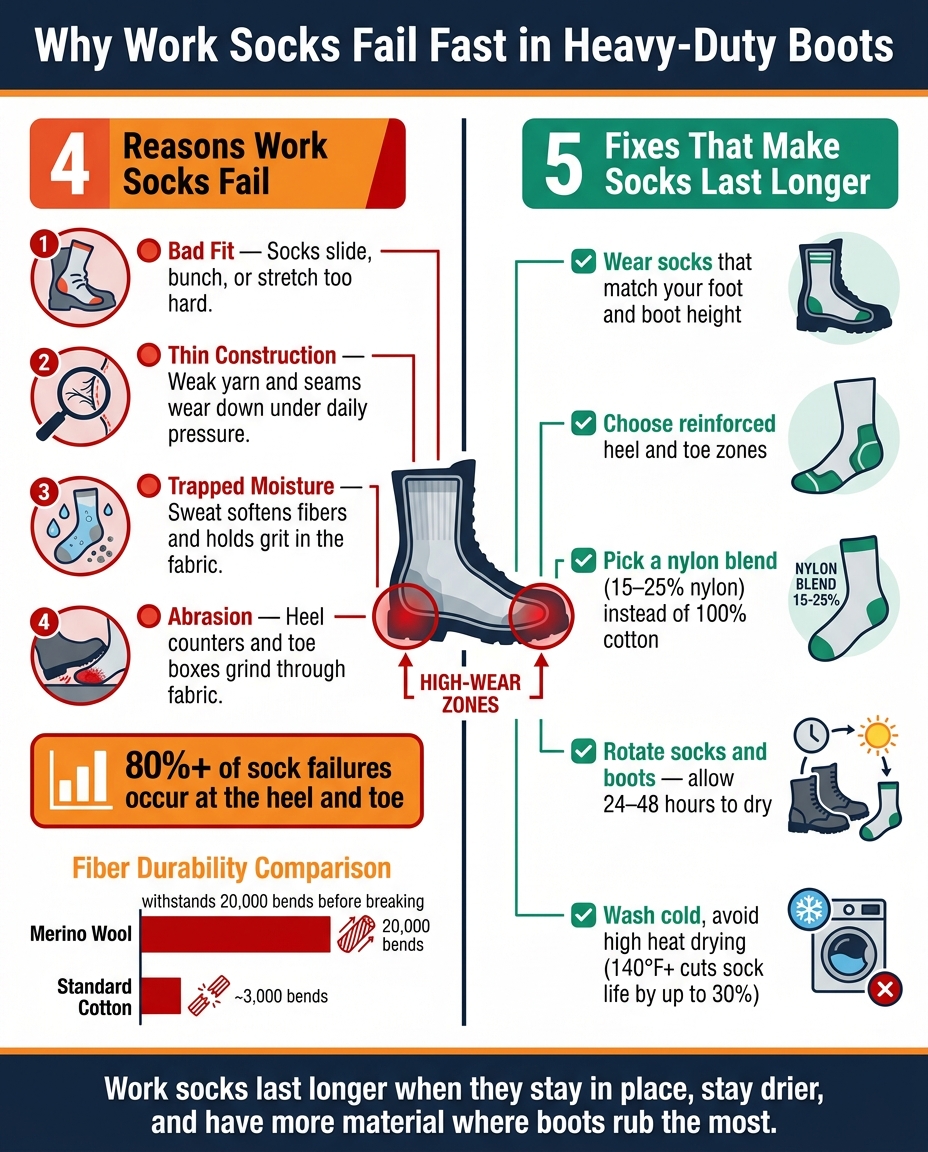
Work socks usually fail for four simple reasons: poor fit, thin construction, trapped moisture, and constant rubbing inside stiff boots. If your socks get heel wear, toe holes, or loose cuffs after a few weeks, that is not random. In heavy-duty boots, the heel and toe take most of the damage, and more than 80% of failures show up in those two spots.
Here’s the short version of what I’d want to know right away:
Bad fit makes socks slide, bunch, or stretch too hard
Thin yarn and weak seams wear down under daily pressure
Rotate socks and boots so they can dry for 24–48 hours
Wash cold and avoid high heat drying
If I had to sum up the whole article in one line, it would be this: <u>work socks last longer when they stay in place, stay drier, and have more material where boots rub the most.</u>
Why Work Socks Fail: 4 Causes & 5 Fixes
5 Best WORK BOOT SOCKS | Tough Socks for Steel Toe Boots
sbb-itb-855989e
Poor fit makes socks slide, bunch, and tear faster
Fit is often where sock failure starts. If a sock doesn’t match the foot well, it moves inside the boot and wears down at the heel, toe box, and forefoot.
Tight socks and tight boots put too much stress on fibers and seams
A sock that’s too small has to stretch just to cover the foot. And once fabric is stretched out, it gets thinner and weaker. That means the fibers are under strain before the boot even goes on. Then every step adds more pressure.
Over time, those repeated flex points start to break down. The toe seam and arch usually take the hit first.
Tight toe boxes in steel-toe or composite-toe boots make the problem worse. The big toe does a lot of the work during push-off, and it also takes side-to-side rubbing. If the sock is already pulled tight across that area, the seam can scrape against the toenail. That’s a quick way to wear a hole.
If you see wear in the arch or calf, the sock is too tight.
Loose socks and loose boots create friction hot spots
Too much fabric can be just as rough on a sock as too little. When extra material gathers at the heel or toe, it folds and bunches against the boot lining. Then that folded fabric rubs back and forth with every step.
Think of it like a tiny sawing motion. Bit by bit, it wears down one small area until you get bald spots or a sudden hole.
Even a few millimeters of heel slip can wear through fabric.
Heel lift is one of the clearest warning signs. If your heel lifts away from the boot’s heel counter with each step, the sock gets dragged against the lining again and again. Fit is the first layer in the problem, and then build quality and moisture make the damage worse, especially in heavy-duty boot socks.
Fit adjustments that reduce sock movement inside work boots
Getting the fit right comes down to a few simple checks.
Heel cup position: The heel cup should sit right over the heel bone. If it rides up toward the Achilles tendon, the sock is too large. If it pulls below the heel bone, it’s too small.
Toe room: You want about 0.5 inches of fabric beyond the longest toe. Less than that, and the seam presses on the toenail. More than 1 inch, and the fabric starts to bunch.
Sock height: This matters more than most workers think. For 6-inch boots, a crew-height sock usually works well. For 8-inch boots, an over-the-calf sock helps keep the cuff from sliding down and rubbing at the boot collar.
It also helps to skip broad sizing like “fits 6–12.” Narrower size ranges do a better job of keeping the heel and toe where they belong.
Fit cuts down on movement, but thin yarn and weak seams can still wear out fast under hard use.
Thin yarn and weak construction fail under jobsite pressure
Once the fit is dialed in, construction is usually the next place things go wrong.
Low-density knit and thin yarn wear through at the heel and toe
The heel and toe take the hardest hit. Every step pounds those spots, and open knit made with thin yarn starts to wear down fast. First the fabric gets fuzzy, then pills form, and then holes show up.
Cheaper socks often use short fibers. Those fibers slip loose and bunch into little balls on the surface. The problem is that the pills don’t just sit there. They catch on the inside of the boot and yank out even more fiber with each step, so the sock thins out faster than normal abrasion alone would cause. Once pilling starts, the fabric is already on its way out.
And even a dense knit can wear early if the toe seam creates a hard spot that keeps rubbing.
Weak toe seams and under-reinforced zones break down early
A raised toe seam sits right where the toes press and rub. In safety-toe boots, that becomes a wear point fast. Low stitch density makes it worse. When the knitting gauge is too open, the loops spread apart more easily under pressure and leave less material to handle abrasion. Safety-toe boots also squeeze the toe box, so the seam ends up taking the pressure until the stitching starts to fail.
The fix is pretty simple: thicker yarn and reinforced zones hold up better under the same boot pressure.
Construction details that improve sock durability
Three things matter most here: reinforced zones, stronger yarn, and proper care.
Reinforced heel and toe zones matter most. Good work socks don’t use the same thickness from top to bottom. They put denser knitting or extra yarn plies in the areas that take the beating. You can test this by hand. Pinch the heel, then pinch the mid-foot. The heel should feel thicker and firmer.
Yarn composition matters just as much. A nylon blend gives the sock the structure heavy-duty wear calls for. Look for at least 15% to 25% nylon. That range helps the sock stand up to abrasion even after the outer surface starts to wear. For comparison, when you compare cotton, wool, and alpaca fibers, merino wool can bend back on itself more than 20,000 times without breaking, while standard cotton fibers break after about 3,000 bends. Suri Performance Alpaca Socks use reinforced zones and targeted cushioning for high-contact wear.
Moisture and wet boots speed up sock damage
Wet fabric increases rubbing and weakens sock fibers
Even a sock that fits well wears out faster when it stays wet. Heavy boots hold in sweat and outside moisture, and that damp environment breaks down fibers sooner.
Wet socks get softer, hold onto grit, and rub harder against the boot liner. That means the fibers wear down faster. Moisture can also push fine grit and silt deeper into the knit, which is a big issue in outdoor work. At that point, the sock starts wearing out from the inside. In sealed boots, moisture has almost nowhere to escape except out the top, so socks stay damp for longer.
Moisture also flattens the cushioning. When that happens, the heel and toe lose padding sooner. Once the fibers soften, friction does the rest.
Rotating boots and socks helps both last longer
The fix is pretty simple: let everything dry all the way between wears. A three-pair rotation works well: one on your feet, one drying, and one ready to use. If you work in very wet conditions, changing socks halfway through a shift can cut down on moisture buildup over time.
One small care step matters more than people think: skip high heat when drying socks. Temperatures around 140°F can cut a sock's lifespan by up to 30% and weaken the elastic that helps the sock stay in place. When that elastic starts to fail, the sock can bunch up and create new friction spots.
Suri Performance Alpaca Socks' Boot Socks use moisture-wicking alpaca fiber to help move sweat away from the skin inside sealed work boots.
Repeated abrasion is what finally opens holes - and reinforced alpaca socks help slow it down
How abrasion inside heavy-duty boots leads to holes
Once fit and moisture issues weaken a sock, abrasion usually does the rest. Different causes, same result: the fabric gets worn down until it gives out.
The heel and toe take the biggest beating. With every step, the heel hits the boot’s rigid heel counter and absorbs repeated body-weight force in a small contact area. Up front, the toe box rubs the fabric during each push-off. Add moisture, and things get worse. Wet fibers soften and tear sooner, and a loose boot lets the foot slide just enough to grind the sock between skin and liner on every step.
By the time a hole appears, the sock has been failing quietly for weeks.
How reinforced alpaca work socks hold up better
That’s why the fix needs to focus on the highest-wear zones, not spread material evenly across the whole sock. Reinforced alpaca socks use denser heel and toe sections to slow thinning. In those areas, the knitting machine tightens needle spacing so more material is packed into the exact spots that take the most friction. More material means more wear cycles before the fabric breaks through.
Nylon adds another line of defense. Many performance socks blend 15–30% nylon into the heel and toe zones, wrapping the natural fiber core with a structural layer that helps resist thinning. Alpaca also helps the fibers stay drier, which helps the knit stay firmer under friction. Drier fibers keep their shape longer and are less likely to soften in ways that speed up abrasion damage.
Reinforced alpaca work socks slow this wear by keeping the heel and toe denser, drier, and better supported under load. Suri Performance Alpaca Socks are built for durability and performance, with moisture-wicking properties that help keep the knit drier and more resistant to abrasion.
Conclusion: What destroys work socks first and what to do about it
Work socks usually wear out for a few clear reasons. Poor fit leads to movement, moisture weakens fibers, and abrasion tears through the heel and toe - the two areas tied to more than 80% of all sock failures.
So the fix isn't complicated. Cut down movement, keep feet drier, and add strength where socks wear out first.
Get the fit right. If a sock bunches up or slides around, friction builds fast.
Rotate boots and socks. Give each pair 24–48 hours to dry out.
Wash cold and dry on low. That helps protect fibers and elastic.
Skip 100% cotton. It holds moisture and increases friction.
Pick reinforced heel and toe zones with a nylon blend.
These small changes usually cost a lot less than buying new socks every few weeks. Suri Performance Alpaca Socks Boot Socks use moisture-wicking alpaca fiber and reinforced construction made for daily wear in heavy-duty boots.
The best work socks last longer for a simple reason: they stay in place, stay drier, and handle abrasion where boots hit hardest.
FAQs
How do I know if my work socks fit correctly?
A properly fitting work sock should stay put and feel snug and secure without bunching, slipping, or rubbing your skin raw.
If the sock starts wearing thin at the arch or calf instead of the heel or toe, that’s often a sign it’s too tight. Aim for a fit with even tension that stays comfortable without cutting off circulation.
Why do my socks keep getting holes in the heel or toe?
Holes in the heel and toe usually show up first because those spots take the most rubbing and pressure every time you walk. Your heel hits the ground over and over, and the toe box bends with each step. After a while, the fibers start to wear out and snap.
The problem gets worse when your boots let your foot slide around inside. That extra movement creates more rubbing. Rough toenails and calluses can also speed things up by catching on the fabric or grinding against it from the inside.
What sock material lasts longest in heavy-duty boots?
For heavy-duty boots, the socks that tend to last the longest usually blend alpaca fiber or merino wool with nylon or polyester. That mix helps the sock stand up to friction while still helping with moisture control and temperature balance.
Build quality matters too. High-density knitting and reinforced heel and toe areas make a big difference, since those spots usually wear out first. Suri Performance Alpaca Socks use this kind of durable blend to help keep their shape and cushioning over time.