"I liked saving money buying 4 pairs at a time and the socks are great for what I need. It's unbelievable how they could be made out of this material, yet they are so comfortable and they don't make my feet and legs itch nor do they make them hot or sweaty."
Rick S., Verified Customer
Ultimate Guide to Choosing Work Socks for Extreme Cold
Share
If your feet sweat, then get cold, your sock setup is failing. For work below 20°F, I’d focus on moisture control, proper fit, and the right thickness for your boot, not just the thickest pair on the shelf.
Here’s the short version:
Skip cotton. It holds sweat and loses warmth fast.
For 0°F to 20°F, I’d start with a midweight merino or alpaca-blend sock.
For below 0°F, a heavier sock or a liner + outer sock can work if your boots have enough room.
If your socks make your boots tight, your feet can feel colder, not warmer.
For long shifts, a dry backup pair can help more than extra bulk.
If you work 5 to 7 days a week, plan on 5 to 10 pairs so socks can dry between wears.
Higher-priced performance socks, often $20–$45 per pair, may last 12–18 months, while basic cotton pairs at $3–$5 may wear out in 2–4 months.
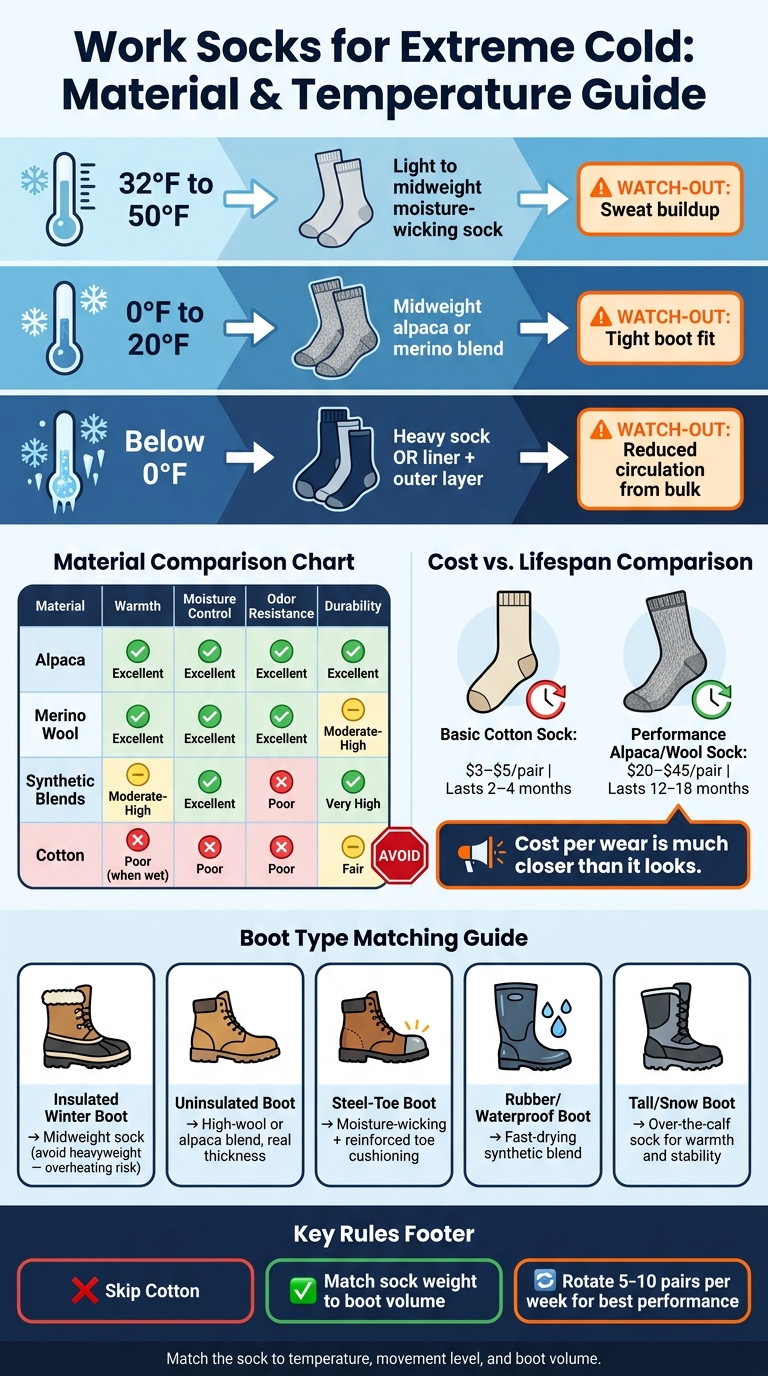
Work Socks for Extreme Cold: Material & Temperature Guide
How to Layer Socks in Extreme Cold (−19°C Tested) ┃ Joe Price Bushcraft & Wilderness Skills
Put simply: I’d match the sock to the temperature, movement level, and boot volume. That’s what keeps feet warmer, drier, and more comfortable through an 8- to 12-hour shift.
What Extreme Cold Does to Your Feet on the Job
Even with insulated boots, frozen ground and concrete can pull heat from your feet in a hurry. And when you're on your feet for an 8- to 12-hour shift, that heat loss keeps stacking up over time.
A lot of workers miss one big point: the temperature band changes the problem.
At 32–50°F, the main issue is moisture. Your feet sweat, that sweat stays in the boot, and damp skin starts to feel cold fast. At 0–32°F, standing in one place makes heat loss worse. Below 0°F, frostbite is a real danger.
The kind of work you do also changes how fast cold gets to your feet. Moving all day is one thing. Standing on cold concrete for hours is another.
Steel-toe boots can also feel colder on the job because metal transfers outside temperatures faster than leather or composite materials.
U.S. Work Conditions That Require Cold-Weather Socks
Cold-weather jobs don't all hit your feet the same way. Movement level and time in the cold both shape what kind of sock works best.
Road work and logging tend to bring more sweat. Freezer work and winter hunting often mean long stretches of exposure with less movement. Same season, different problem.
That's why sock choice isn't just about warmth. It's also about how the sock handles sweat and moisture, long hours, and periods of stillness.
Why Damp Feet Get Cold Faster Than Dry Feet
Feet sweat all the time, and hard physical work makes that worse. Inside a sealed work boot, that moisture has little room to escape unless your sock is pulling it off your skin.
Here's the problem in plain terms: water moves heat away from the body much faster than air. Once sweat soaks the sock fibers, the tiny pockets of air that help keep feet warm start to disappear. Wet socks lose insulation fast, especially when the fibers get pressed down under body weight.
Fit plays a big part too. If a sock is too thick for your boot, it squeezes the toe box, cuts down blood flow, and flattens the insulation you're depending on.
That sets up the next choice: sock weight, fit, and material.
Key Sock Features to Look for in Extreme Cold Work Conditions
Once you know what cold and moisture do to your feet, the next step is picking sock features that keep warmth, fit, and wear life working together. In harsh cold, one bad pick can throw off everything else.
Use these features to match sock warmth to your boots, how hard you’re moving, and how long you’ll be out there.
Choosing Sock Weight for 20°F, 0°F, and Sub-Zero Work
Sock weight should match the temperature, your activity level, and how much room you have inside the boot.
Sock Weight
Use For
Boot Space
Lightweight
Warm conditions / indoor work
Fits all boots
Midweight
Cold shifts (0°F to 20°F)
Fits most work boots
Heavyweight
Sub-zero exposure / low movement
Requires roomy or sized-up boots
Here’s the catch: if the sock packs the boot too tightly, it can squash insulation and limit blood flow. After you lace up, you should still be able to wiggle your toes without effort. If you can’t, go thinner. A leaner merino or synthetic performance sock can keep your feet warmer than a bulky sock that slows circulation.
Once you dial in thickness, fit becomes the thing that makes or breaks the sock over a full shift.
Fit, Height, and Light Compression Inside Work Boots
A sock that slides down, bunches up, or leaves space around the heel creates hot spots fast. And once your boots are on, you’re stuck with it. Look for arch support bands and a well-made elastic cuff that keeps the sock in place.
For height, crew length should be the starting point for work boots. It helps keep the boot collar off your skin. If you wear taller boots or spend time in snow, over-the-calf is a smart step up. It adds warmth to the lower leg and tends to stay in place better when you’re moving hard.
Light compression can help limit swelling and keep the sock stable through long hours on the job.
After fit, cushioning and reinforced zones decide how well the sock holds up under daily work.
Cushioning and Reinforced Heel and Toe
Cushioning should take the edge off impact and protect the spots that get hit the most. If you work on concrete or wear steel-toe boots, look for padding under the heel, ball of the foot, and toe box instead of the same thickness everywhere.
Reinforced heel and toe areas matter just as much. Nylon in those spots helps the sock stand up to rubbing and lowers the risk of blisters. Alpaca’s smooth fiber may also help cut down friction and irritation.
Seamless or flat toe construction can help stop rubbing and blisters during long shifts.
Best Materials and Layering Options for Extreme Cold
After fit, material has the biggest impact on how a sock handles warmth, sweat, and daily wear.
Alpaca, Merino, Synthetic Blends, and Why Cotton Falls Short
Alpaca does a lot of the heavy lifting in cold conditions. It insulates well, moves moisture away from the skin, and still feels warm when damp. That’s why alpaca and merino blends are the top pick for long shifts in extreme cold. Suri Performance Alpaca Socks use alpaca fiber, moisture-wicking yarns, odor resistance, and targeted cushioning for long shifts.
Merino brings its own strengths too. It helps with breathability, warmth, and odor control. Then you have nylon, polyester, and spandex, which help with stretch, shape, and wear resistance in high-friction areas. Cotton, on the other hand, is the one to avoid. It holds moisture and loses insulation fast, which makes it a poor pick for extreme cold.
Here’s how the main materials compare:
Material
Warmth
Moisture Control
Odor Resistance
Durability
Alpaca
Excellent
Excellent
Excellent
High
Merino Wool
Excellent
Excellent
Excellent
Good (better in blends)
Synthetic Blends
Moderate–High
Good (dries fast)
Poor
Very High
Cotton
Poor (when wet)
Poor
Poor
Fair
Single-Sock vs. Liner-and-Outer-Layer Systems
For most work in the 0°F to 20°F range, one well-made alpaca or merino sock works better than doubling up. Wearing two socks can create more friction, bump up blister risk, and squeeze the foot inside the boot. That tighter fit can cut circulation, which is the last thing you want in the cold.
A liner-plus-outer setup makes more sense for sub-zero, low-movement work, and only if the boot has enough room for it.
Boot volume is what decides whether this system works or backfires.
Match Sock Material and Thickness to Your Boot Type
Boot type changes everything a bit. An insulated winter boot already gives you thermal protection, so pairing it with a heavyweight sock can lead to overheating and extra sweat buildup. An uninsulated boot asks more from the sock, so a high-wool or alpaca blend with real thickness is the better match.
Steel-toe boots bring a separate issue because metal pulls cold into the toe box. In that case, moisture control and reinforced toe cushioning matter more. Rubber boots and other non-breathable footwear tend to trap sweat, so a moisture-wicking liner or fast-drying blend helps a lot.
Work Environment
Temp Range (°F)
Recommended Material
Layering Approach
Cold Warehouse / Logistics
20°F to 40°F
Merino / Synthetic Blend
Single Sock
Outdoor Construction
0°F to 20°F
Alpaca / Heavy Merino
Single Sock or Thin Liner
Sub-Zero / Static Work
Below 0°F
Alpaca / High-Loft Synthetic Blend
Liner + Heavy Outer
Rubber / Waterproof Boots
Variable
Synthetic-Heavy Blend
Single Sock (Quick-Dry)
Steel-Toe / Composite Boots
0°F to 32°F
Alpaca or Merino Blend
Single Sock (Reinforced Toe)
Once the material and layering setup are dialed in, care and rotation play a big role in how long the socks keep working well.
Sock Care, Cost, and Building a Cold-Weather Rotation
Once you pick the right fiber and thickness, care and rotation decide how well those socks hold up over time.
How to Wash and Dry Performance Socks Without Damaging Them
If you want performance socks to keep their fit, moisture control, and lifespan, wash them the right way.
Use cold water on a gentle or wool cycle with a mild detergent. Skip fabric softener, since it coats the fibers and weakens wicking.
Turn socks inside out before washing. After that, air dry them or use the dryer on the lowest heat setting.
Durability and Cost per Wear in Real Use
Good care means fewer replacements, and that's where the value starts to make sense.
At first glance, performance socks can seem expensive. But the sticker price doesn't tell the whole story. A basic cotton work sock that costs about $3 to $5 per pair often lasts only 2 to 4 months with heavy daily use. A well-made alpaca or merino blend can last 12 to 18 months with proper care.
That means cost per wear is often much closer than it looks.
Feature
Low-Cost Cotton Socks
Performance Alpaca/Wool Socks
Upfront Cost
$3–$5 per pair
$20–$45 per pair
Expected Lifespan
2–4 months (heavy use)
12–18 months (with proper care)
Replace socks when the cuff starts to loosen or the cushioning gets packed down. Once that happens, the sock can't give the same level of thermal protection or friction reduction.
How Many Pairs You Need for a 5-Day or 7-Day Workweek
Even a good pair won't last as well if you keep wearing it before it has time to dry out fully.
For a standard workweek, 5 to 7 pairs is the practical minimum. If you work closer to seven days a week or sweat a lot, 7 to 10 pairs is a better buffer. That extra rotation gives each pair more time to dry fully and regain its shape between wears.
And in many cases, a dry backup pair halfway through the shift does more for comfort than simply wearing thicker socks.
Conclusion: The Right Material, Fit, and Care Make the Best Work Socks for Extreme Cold
Put simply, the best cold-weather sock comes down to three things: warmth, fit, and moisture control.
Material is where it starts. It sets the base for how warm your socks feel and how well they move sweat away from your skin. From there, fit matters just as much. The best work sock gives you warmth, helps manage moisture, and still leaves enough toe room so your feet don’t feel cramped inside your boots.
Thickness matters too, but it has to match your day. If you’re moving a lot, one level of thickness may work better. If you’re standing still in harsh cold, you may need more. And if your socks are too bulky for your boot volume, even warm socks can make your feet feel worse.
Care plays a part as well. Proper washing and rotating pairs helps your socks last longer and perform better over time.
When material, fit, and care line up, your feet stay warmer, drier, and more comfortable through the shift.
FAQs
How do I know if my socks are too thick for my boots?
Your socks are probably too thick if your boots feel uncomfortably tight. That kind of fit can limit blood flow, tire your feet out, and leave them feeling colder instead of warmer.
When you try your boots on, your feet should still be able to move with ease. The right fit feels snug, not squeezed. In very cold weather, moisture-wicking fabric and cushioning in the right spots matter more than piling on extra thickness.
Should I change socks during a long cold-weather shift?
Yes. Changing your socks midway through a long shift in cold weather can make your feet feel a lot better and help lower the chance of blisters.
Even if you're wearing moisture-wicking socks made from alpaca or merino wool, swapping in a dry pair can still help a lot in cold or wet conditions. If your feet tend to sweat, stash an extra pair in your bag.
What sock setup works best for sweaty feet in freezing weather?
For sweaty feet in freezing weather, focus on moisture-wicking socks instead of just going thicker. Cotton is a bad bet here because it holds moisture and can make your feet lose heat faster. Fibers like alpaca or merino wool do a much better job of pulling sweat away from your skin.
Fit matters too. Socks should feel snug, but not tight enough to cut into circulation. If your socks are too thick, they can cram your boots, lower insulation, and make blood flow worse. It also helps to bring a dry spare pair and switch halfway through your shift.