"I liked saving money buying 4 pairs at a time and the socks are great for what I need. It's unbelievable how they could be made out of this material, yet they are so comfortable and they don't make my feet and legs itch nor do they make them hot or sweaty."
Rick S., Verified Customer
Ultimate Guide to Alpaca Socks for Outdoor Gear
Share
If your feet get cold, wet, or blistered outside, your socks are part of the problem. I’d sum this up in one line: alpaca socks are a strong pick for hiking, work boots, waders, winter boots, and trail use because they stay warm when damp, manage sweat well, help with odor, and feel softer on sensitive skin than many wool socks.
Here’s the short version:
Warmth without much bulk: alpaca fiber has a hollow core that helps trap heat
Moisture control: it can absorb up to 30% of its weight without feeling wet
Less odor over long wear: alpaca fiber can help slow odor buildup
Good for sensitive skin: it has no lanolin, which can help if wool bothers your skin
Best fit matters: the right height, cushion, and shoe or boot match matter as much as the fiber
Look for smart build details: reinforced heel and toe, mesh zones, arch support, and flat toe seams
Care is simple: cool wash, mild detergent, and flat air dry
If I were buying a pair today, I’d match them like this:
Trail runners: ankle or 1/4 crew, light cushion
Hiking shoes: 1/4 crew or crew, light to mid cushion
Mid-height boots: crew, mid cushion
Work boots: mid-calf or over-the-calf, heavy cushion
Waders and winter boots: over-the-calf or tall crew, heavy cushion
Quick Comparison
Fiber
Warmth When Damp
Odor Control
Skin Feel
Best Use
Alpaca
High
High
Soft, low itch
Cold, wet, long days out
Merino wool
Good
Good
Soft, but may itch for some
General hiking and all-season use
Synthetics
Medium
Low
Smooth
Fast-drying, high-sweat use
Cotton
Low
Low
Soft at first
Skip for most outdoor trips
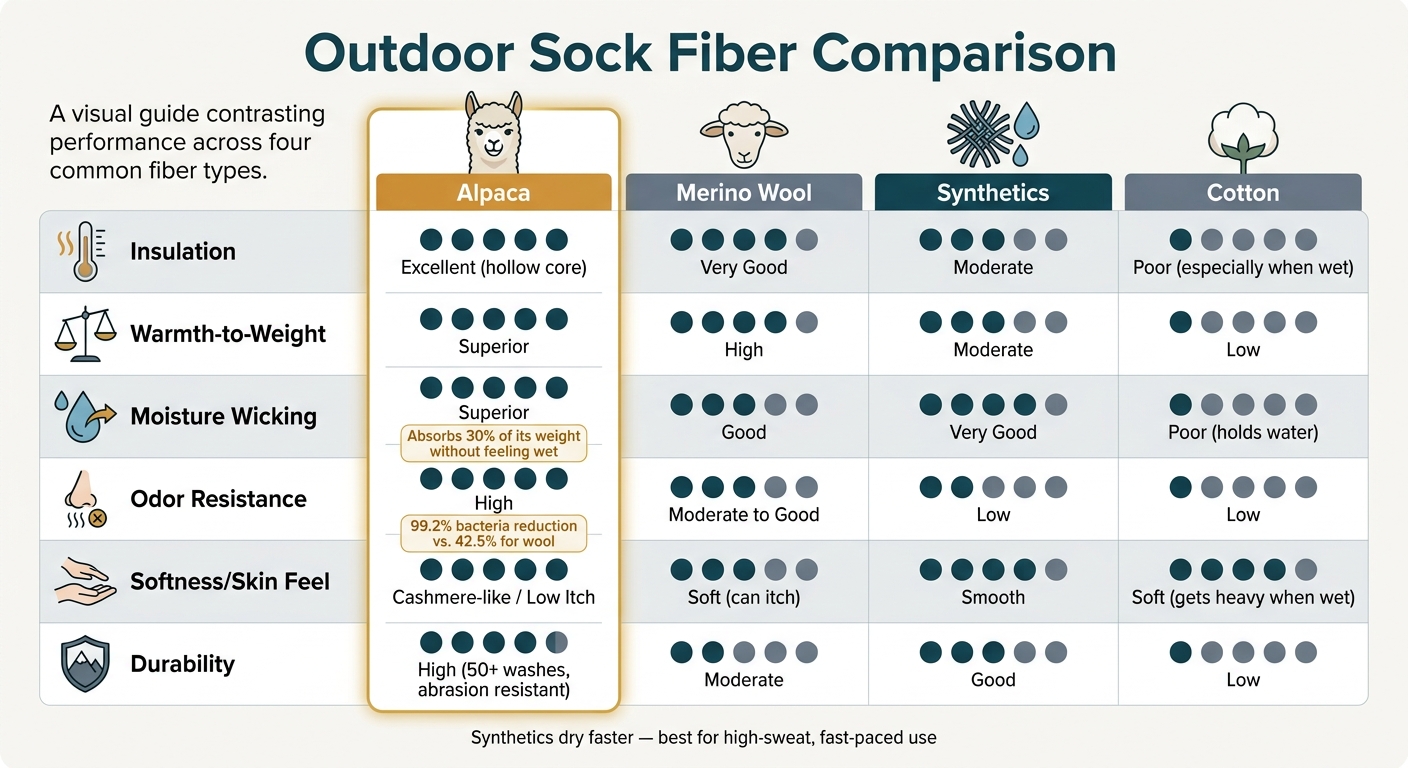
One stat stands out to me: alpaca can stay insulating even when damp, acting as superior moisture-wicking socks, and that’s a big deal on wet trails, stream crossings, and cold mornings. The rest comes down to picking the right sock shape, cushion level, and care routine so your whole setup works better.
sbb-itb-855989e
How Alpaca Socks Hold Up Outdoors
Alpaca vs. Merino vs. Synthetics vs. Cotton: Outdoor Sock Fiber Comparison
Warmth, moisture control, and comfort in changing weather
Out on the trail, alpaca socks do a nice job of keeping feet warm early in the morning without feeling too hot later in the day. Alpaca is a temperature-regulating fiber, so it lets excess heat escape as the air warms up or as you start working harder. That makes a difference on days that begin cold and end warmer or damp. It’s most useful when the weather shifts fast and your effort level changes with it.
Moisture control is just as important. Alpaca can absorb up to 30% of its own weight in moisture without feeling wet against your skin, and unlike cotton, it still insulates when damp. On wet trails, during stream crossings, or on steep climbs where sweat builds fast, that edge is hard to ignore.
Odor resistance, sensitive-skin comfort, and durability
Odor control becomes a bigger deal on multi-day trips. Alpaca fiber has natural antimicrobial and antibacterial properties that help limit odor-causing bacteria. In laboratory testing, alpaca fiber reduced Staphylococcus aureus bacteria by 99.2%, compared to only 42.5% for sheep wool. So if you’re backpacking for a few days, you can often wear the same pair back-to-back without the smell buildup common in other sock materials.
Alpaca is also lanolin-free, which means it skips the compound in sheep’s wool that often leads to irritation. That makes it a solid pick for people with sensitive skin or eczema. And when it comes to wear life, quality alpaca socks can keep their shape and softness for 50+ washes. If your socks spend a lot of time inside boots and on rough trail miles, that kind of staying power counts.
Synthetics may dry faster than alpaca, and that can help in some conditions. But alpaca stands out for warmth-to-weight, odor control, and comfort for sensitive skin. Those are often the traits that matter most on long days outside and on multi-day trips.
Next, match sock height and cushioning to your boots, shoes, and activity.
Matching Alpaca Socks to Your Boots, Shoes, and Activities
Sock setups for hiking shoes, boots, and trail runners
Sock fit matters just as much as fiber. If the fit is off, alpaca’s warmth and moisture control can’t do their job the way they should. After you’ve picked the right fiber, the next step is to match sock height and cushioning to your footwear. Too much bulk inside a tight shoe can limit circulation, which may leave your feet feeling colder. Too little cushioning in a heavy boot means less protection from impact on rough ground.
For trail runners, stick with lightweight or light-cushion socks in ankle or 1/4 crew heights. Low-bulk socks with mesh-backed panels work well in tighter shoes. In snug trail shoes, light cushioning helps keep the fit trim without taking away comfort.
Mid-height hiking boots work best with crew or 3/4 crew socks and medium cushioning. That extra height helps stop rubbing around the cuff. If you’re wearing heavy backpacking boots, go with crew or boot-height socks with heavyweight cushioning for added padding and insulation.
Using alpaca socks with work boots, waders, and winter footwear
Work boots and tall outdoor footwear ask more from a sock. If you’re on your feet all day, your heel and forefoot take a steady beating. That’s why it helps to look for socks with dense terry-loop cushioning and reinforced heel and toe zones. Mid-calf or over-the-calf heights with ribbed cuffs also help keep socks from slipping or bunching inside tall boot shafts.
For waders, heavyweight over-the-calf socks make a strong thermal layer. Alpaca can absorb up to 30% of its own weight in moisture without feeling wet, which is a big plus in cold water. In ski and snowboard boots, dense cushioning adds warmth without turning the fit bulky.
Sock height and cushioning by gear type
Sock height and cushioning should line up with your footwear’s height and internal volume. A simple rule works well here: the sock should rise at least 1 inch above the boot collar to help prevent friction.
Use the chart below to match sock height and cushion to common gear.
Footwear Type
Sock Height
Cushion Level
Key Benefit
Trail Runners
Ankle / 1/4 Crew
Light
Low bulk, breathability
Hiking Shoes
1/4 Crew / Crew
Light to Mid
Day hike comfort, warm-weather use
Mid-Height Boots
Crew / 3/4 Crew
Mid
Collar protection, impact absorption
Work Boots
Mid-Calf / OTC
Heavy
Reinforced zones, all-day standing
Waders
Over-the-Calf (OTC)
Heavyweight
Thermal insulation
Winter Boots
Crew / Mid-Calf
Heavyweight / Thermal
Maximum heat retention
Ski / Snowboard Boots
Over-the-Calf (OTC)
Mid to Heavy
Dense warmth without excess bulk
If you deal with blisters a lot, pay close attention to the toe seam. Flat or seamless toe construction removes a common friction point and can help cut down on hot spots during long, high-mileage days. Next, the focus shifts to fit and care so the whole setup keeps working the way it should.
How to Choose the Right Alpaca Socks
Construction details that affect performance
Once you’ve picked height and cushioning, construction is the next big thing to check. The fiber blend and the way the sock is built have a direct effect on comfort, wear, and how it performs over time.
Most performance socks use a blend of 60% to 80% alpaca with nylon, elastane, or merino wool. That mix helps with stretch, durability, and fit retention.
Reinforced heels and toes help guard the parts that take the most abuse inside boots and can slow early wear
Dense cushioning in the footbed adds shock absorption and warmth; heavier cushioning works better for cold weather or high-impact use, while lighter cushioning fits trail runners better
Breathable mesh zones on the top of the foot let heat escape during hard effort
Elastic arch bands or light compression help keep the sock from slipping or bunching up
Seamless toe closure can cut down on hot spots and chafing in a spot where friction often shows up first
The next step is simple: match those features to your weather, activity level, and footwear.
Choosing by climate, activity length, and footwear
The right sock for a July trail run isn’t the right sock for a long, cold day in boots. Here’s a quick way to line things up:
Summer hikes and high-output days: a lightweight ankle sock with mesh ventilation
Shoulder-season trails in the Pacific Northwest: a medium-cushion crew sock for damp, changeable weather
Winter in the Northeast: a heavyweight boot sock with dense cushioning for stationary cold and long hours outside
For a fast product snapshot, use the styles below.
Suri Performance Alpaca Socks offers ankle, crew, and boot styles for hiking, work, and cold-weather use.
Style
Best For
Ankle Socks
Trail runners, warm-weather hikes
Performance Crew Socks
Day hikes, light boots
Boot Socks
Work boots, colder conditions
Fit, Care, and Getting the Most Out of Your Alpaca Socks
Proper fit, layering, and blister prevention
Once you've matched sock height and cushioning to your footwear, fit and care are what shape how alpaca socks feel on the trail.
Inside boots, trail shoes, and waders, fit can either cut down friction or make it worse. Alpaca stretches less than wool, so sizing needs to be precise. Go with a snug fit, a secure heel cup, and enough room in the toe box so your toes aren't rubbing with every step.
If you're wearing cold, roomy boots or using them for more stationary time, layering can help. A thin alpaca sock under a heavier sock adds warmth and gives you one more barrier against friction.
Blister Area
Common Cause
Alpaca Sock Fix
Ball of foot
High impact on rugged terrain
Terry-loop or dense cushioning
Side of foot/arch
Skin softening from trapped moisture
Choose socks with strong moisture management
Ankle/shin
Boot cuff friction
Match sock height to your footwear
How to wash, dry, and store alpaca socks
After fit, maintenance is what helps these socks hold up trip after trip.
Wash them in cool to lukewarm water with a mild, wool-safe detergent. If you're using a machine, place the socks in a mesh laundry bag and use a delicate cycle. Skip bleach and fabric softener. After washing, gently press out the water without wringing, then lay the socks flat to air dry.
For storage, fold socks flat instead of balling them up. On multi-day trips, rotating between two pairs gives each pair time to dry fully and regain its shape before you wear it again.
Conclusion: Key points for buying alpaca socks for outdoor gear
Match the fit, height, and cushioning to your footwear. Then wash alpaca socks gently so they keep their shape and perform the way you expect.
FAQs
Are alpaca socks too warm for summer hiking?
No. Alpaca socks help regulate temperature, so your feet stay comfortable instead of feeling trapped in heat. In warm weather, they let excess heat escape.
They’re also breathable and moisture-wicking, which helps keep feet dry and cuts down on overheating that can lead to blisters. If you want even more airflow, go with lightweight styles that have mesh ventilation.
Should alpaca socks fit tighter than wool socks?
No. Alpaca socks do not need to fit tighter than wool socks.
Alpaca fiber has natural stretch and keeps its shape well, so it can stay in place without extra squeeze. Some sock styles are made to fit more snugly for certain activities, but that comes down to the sock’s design, not the material itself.
Do alpaca socks work well in waterproof boots?
Yes. Alpaca socks work very well in waterproof boots because alpaca fiber pulls sweat away from your skin and helps that moisture dry off, which cuts down on the clammy feeling that less-breathable boots often cause.
And if sweat starts to build up or snow sneaks into your boots, alpaca fiber still insulates well and tends to stay drier than many other materials. Suri Performance Alpaca Socks also add reinforced durability and strong moisture control, which makes them a solid pick for long days outside or on the job.