"I liked saving money buying 4 pairs at a time and the socks are great for what I need. It's unbelievable how they could be made out of this material, yet they are so comfortable and they don't make my feet and legs itch nor do they make them hot or sweaty."
Rick S., Verified Customer
Thermal Regulation in Alpaca Socks Explained
Share
Alpaca socks are designed to keep your feet comfortable in all conditions by managing temperature and moisture effectively. The secret lies in alpaca fiber's semi-hollow structure, which traps warmth in cold weather and releases heat during activity. Unlike cotton or synthetic materials, alpaca absorbs very little moisture (10–11% of its weight) and dries faster than merino wool, ensuring your feet stay dry and blister-free.
Key Benefits of Alpaca Socks:
Temperature Control: Hollow fibers insulate in cold and release heat in warmth.
Moisture Management: Absorbs less moisture and dries 20–30% faster than merino wool.
Durability: Retains warmth even when wet and resists compression inside boots.
Socks like Suri Performance Alpaca Socks combine these features with thoughtful designs, such as cushioning, mesh zones, and seamless toes, to maximize comfort. They’re ideal for hiking, outdoor work, or unpredictable weather. Proper care, like washing in cold water and air-drying, ensures long-lasting performance. Whether you're in freezing temperatures or high-activity scenarios, alpaca socks offer reliable comfort and functionality.
The Science Behind Alpaca Fiber's Thermal Regulation
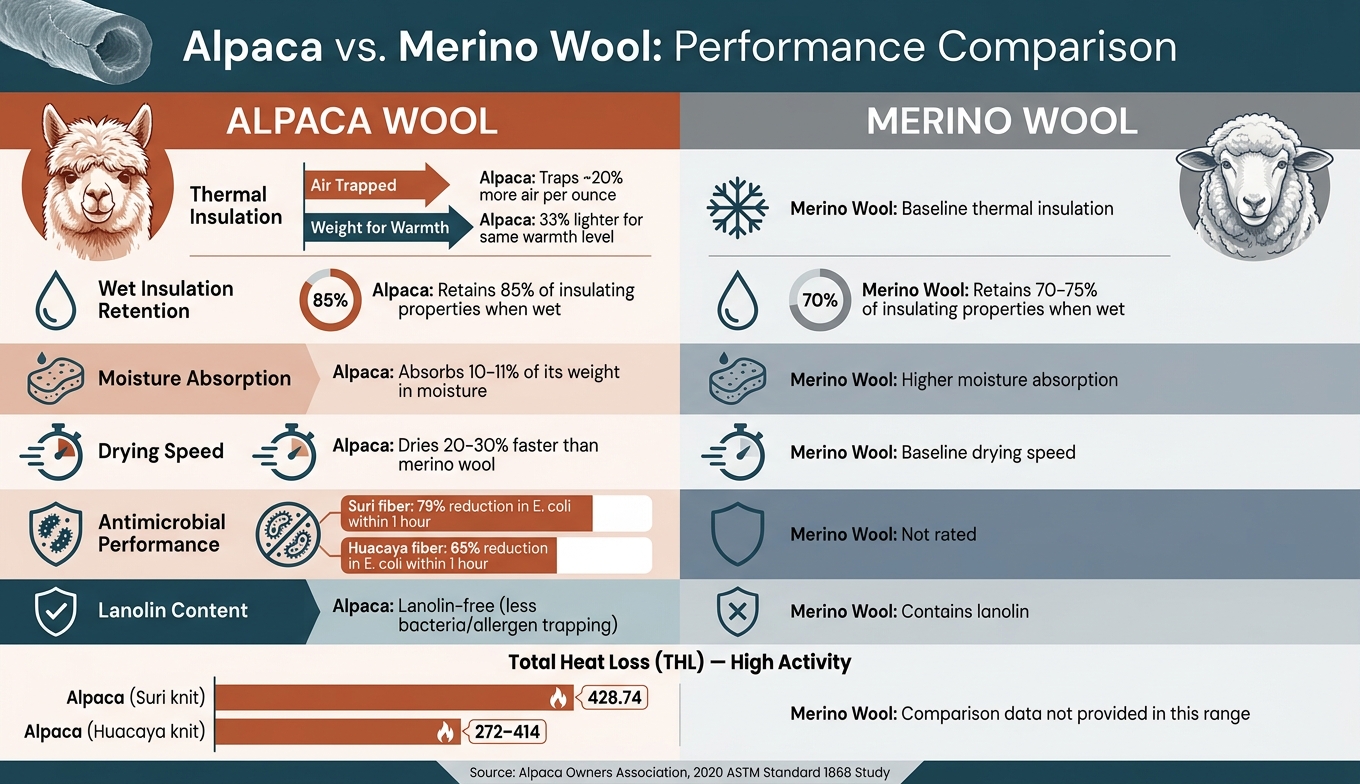
Alpaca vs. Merino Wool Socks: Performance Comparison
The Hollow Core Structure of Alpaca Fiber
What sets alpaca fiber apart is its internal design. Each strand contains a microscopic air channel running through its core, known as a medullated core. This trapped air acts like a natural insulator, slowing down heat transfer in both directions.
"Alpaca fibers are hollow or semi-hollow, which helps trap warm air efficiently. In real terms, you get noticeable warmth without needing a thick sock." - Nikolaj van den Berg, Danish Endurance
Thanks to this built-in insulation, alpaca fiber holds about 20% more air per ounce than merino wool while being 33% lighter for the same warmth level. So, even though alpaca socks might feel thin, their warmth comes from the fiber's structure, not the bulk.
How Alpaca Fiber Performs in Cold Conditions
Alpaca fiber truly shines in cold or damp environments. Its hollow core retains body heat even when wet, preserving about 85% of its insulating properties, compared to 70–75% for merino wool. This difference can be a game-changer when you're trudging through slush or standing in wet snow for hours.
Another advantage? Alpaca fiber resists compression. Even when packed tightly inside a boot, it maintains its insulating properties. Plus, it dries 20–30% faster than merino wool, so you spend less time stuck with cold, damp socks. Whether you're hiking or just dealing with winter weather, alpaca adapts well to the challenge.
How Alpaca Fiber Performs in Heat and High Activity
Alpaca fiber isn't just for the cold - it handles heat and high activity just as effectively. The same hollow structure that traps warmth in low temperatures also allows excess heat and moisture to escape during intense activity, keeping you from overheating.
"The fiber responds to what the body is doing rather than simply holding a fixed thermal state. That is precisely what the human thermoregulatory system needs from the clothing layer closest to the body." - Vladimir J. Costa, Curator, From The Andes
In a 2020 study by the Alpaca Owners Association, alpaca fabrics were tested using ASTM Standard 1868. Results showed Total Heat Loss (THL) levels ranging from 272 to 428, proving the fiber's ability to support high-energy activities like hiking or shoveling without causing overheating.
These findings highlight why alpaca fiber continues to be a top choice for thermal performance, whether you're battling extreme cold or staying active outdoors.
How Alpaca Socks Manage Moisture
How Alpaca Fiber Absorbs and Wicks Moisture
Alpaca fiber works differently from many other materials when it comes to handling moisture. It absorbs moisture without becoming overly saturated. Compared to merino wool, alpaca fiber holds much less moisture, meaning your skin stays drier.
The secret lies in its hollow core, which creates tiny channels that efficiently wick sweat away from the skin through capillary action. As ALPACORE explains:
"When feet perspire, moisture wicking socks made from alpaca pull sweat away from skin through capillary action within the hollow fibers." - ALPACORE
This process keeps your skin drier, reducing the chances of friction and blisters. Once the moisture is drawn away, it sets the stage for quick evaporation.
How Alpaca Socks Stay Dry Through Evaporation
After pulling sweat away from the skin, alpaca socks excel at drying quickly. The fiber's smooth, flat surface - unlike the crimped texture of wool - makes it easier for moisture to move outward. Once on the surface, body heat helps drive evaporation.
"The hollow structure within each alpaca fiber actively works to push moisture away from your body. This natural mechanism uses your own body heat as an engine to drive sweat outward to the garment's exterior." - Socks Insider
This efficient evaporation means alpaca socks can dry 20% to 30% faster than merino wool socks. This quick-drying feature is particularly handy for long hikes, cold-weather jobs, or extended time spent in boots.
Odor Resistance and Bacterial Control
Alpaca socks don’t just dry quickly - they also help keep odors in check. Because the fibers retain minimal moisture, they create an environment less favorable for bacteria to grow. This naturally reduces odor-causing conditions. Plus, unlike sheep's wool, alpaca fiber is lanolin-free, which means it doesn’t trap bacteria or allergens.
In fact, research backs up alpaca's antimicrobial properties. A 2020 study revealed that alpaca fiber reduced E. coli presence by 65% in Huacaya fibers and 79% in Suri fibers within an hour. Ruth Fuqua and Wini Labrecque from the Fiber and Fiber Products Committee noted:
"These results clearly show that alpaca fiber does indeed contain a degree of antimicrobial characteristics... Socks with this type of antimicrobial action are a benefit when wearing them for long periods of time." - Ruth Fuqua and Wini Labrecque, Fiber and Fiber Products Committee
Because of these properties, alpaca socks - like those from Suri Performance Alpaca Socks - can often be worn multiple times between washes without developing noticeable odors, even after a full day outdoors.
Alpaca Socks in Extreme Weather
Cold and Wet Conditions
When the weather turns cold and damp, most traditional socks fall short. Alpaca fiber, however, stands out due to its unique structure. Its semi-hollow core traps tiny air pockets that help retain heat, even when compressed inside snug boots. Unlike typical socks that become cold and soggy, alpaca socks stay light and functional, keeping your feet warm and comfortable.
As Socks Insider explains:
"Alpaca's natural moisture-repelling qualities combined with its superior wicking capabilities create a double advantage in adverse conditions."
This combination of insulation and moisture control helps keep feet warm and dry, even in freezing or wet environments. Plus, it minimizes the clammy feeling that often leads to blisters and discomfort. And alpaca socks aren’t just built for the cold - they shine in warmer conditions too.
Heat and High Humidity
While alpaca socks are often praised for their cold-weather performance, they’re equally impressive in the heat. The same hollow fibers that retain warmth in the cold allow excess heat to escape when temperatures climb. This prevents overheating during strenuous activities. Alpaca fiber efficiently wicks away sweat, allowing it to evaporate quickly and carry heat away from your skin. This fast-drying feature ensures comfort during long hikes or extended work in humid conditions. It’s a reliable choice for active days, especially in environments where the weather can change in an instant.
High-Altitude and Rapid Temperature Changes
Alpaca fiber’s adaptability truly shines in high-altitude environments, where temperatures can swing dramatically. Alpacas evolved in the Andean altiplano, at elevations between 14,000 and 16,000 feet, where daily temperature shifts can exceed 40°F. Vladimir J. Costa, Curator from The Andes, highlights this remarkable adaptation:
"The alpaca did not develop a thermoregulating fiber by accident. It developed one because the alternative was extinction at 15,000 feet."
This natural ability to regulate temperature in both directions makes alpaca socks a smart choice for hikers, climbers, and anyone dealing with unpredictable weather. Products like Suri Performance Alpaca Socks’ boot socks combine this fiber’s adaptability with thoughtful design, ensuring all-day comfort in even the most challenging outdoor conditions.
sbb-itb-855989e
Design Features That Improve Thermal Performance
Alpaca fiber has incredible insulating properties, but it’s the design - fiber blends, yarn construction, and knit patterns - that transforms its potential into real-world performance.
Fiber Blends and Yarn Construction
While pure alpaca fiber insulates exceptionally well, it lacks elasticity. To address this, performance alpaca socks often incorporate 5–15% nylon or elastic materials. This addition helps the socks maintain their shape and fit without compromising their warmth.
Another popular approach is blending alpaca with merino wool, typically in ratios like 50/50 or 70/30. This combination takes advantage of alpaca's superior insulation - it traps about 20% more air per ounce than merino wool - while benefiting from merino’s elasticity and cushioning. However, blending alpaca with synthetic materials like acrylic is not ideal, as these can clog the fiber’s air channels, reducing its insulating ability. For the best thermal performance, look for socks containing at least 60–70% alpaca fiber.
Knit Patterns, Cushioning, and Airflow Zones
The knitting technique plays a major role in a sock’s warmth and breathability. For instance, a terry loop construction - where small loops are knitted on the inside - creates extra air pockets that enhance insulation without adding bulk.
Strategic knit designs can also include mesh zones in areas prone to heat buildup, allowing moisture and excess heat to escape. These features help keep your feet dry and comfortable during activity. Additional structural details, like ribbed cuffs, arch support bands, and seamless toe closures, improve both fit and thermal efficiency. Ribbed cuffs retain heat at the sock’s opening, arch bands keep the sock in place to avoid bunching, and seamless toes eliminate cold spots and pressure points.
Design Feature
What It Does
Why It Matters
Terry loop cushioning
Creates insulating air pockets
Adds warmth without extra weight
Mesh/airflow zones
Releases heat and moisture
Prevents overheating during intense activity
Ribbed cuffs
Seals heat at the sock’s opening
Maintains a consistent thermal environment
Arch support bands
Keeps the sock securely in place
Avoids circulation issues and bunching
Seamless toe closure
Removes pressure points and cold spots
Ensures even warmth across the forefoot
These thoughtful design elements are showcased in products like Suri Performance Alpaca Socks.
Suri Performance Alpaca Socks bring these advanced features to life. With targeted cushioning zones and breathable mesh panels, they combine insulation where it’s needed with ventilation in areas prone to heat buildup. This careful balance ensures effective temperature regulation.
Their boot socks, priced at $44.99 per pair (or as low as $22.50 per pair with the Buy 3 Get 3 Free deal), are designed for extended outdoor use. They excel in scenarios requiring precise temperature and moisture control. Notably, Suri alpaca fiber demonstrates a higher Total Heat Loss (THL) value (428.74 vs. 414.19) in knit form, meaning it delivers better temperature regulation during high-intensity activities. By combining fiber science with smart design, these socks meet the demands of extreme conditions with ease.
How to Choose the Right Alpaca Socks
Matching Sock Weight to Activity and Temperature
Getting the right sock weight is key to staying comfortable, especially in extreme weather. Alpaca fiber shines when you match the sock's weight to your activity and the temperature.
Lightweight alpaca socks are perfect for warm weather or high-energy activities like running or gym workouts. They focus on breathability rather than insulation.
Midweight socks are the go-to for versatility. They’re great for hiking, cycling, or daily wear across three seasons, keeping your feet comfortable without overheating or getting too cold.
Heavyweight socks are your best friend in freezing conditions or low-activity scenarios. Think ice fishing, hunting, or standing outdoors in sub-zero temperatures - these socks prioritize keeping you warm.
One thing to keep in mind: alpaca fiber is naturally warm but light. This means you can often choose a lighter sock weight than you’d expect and still stay cozy.
Sock Weight
Best For
Conditions
Lightweight
Running, gym, summer wear
Warm weather, high heat
Midweight
Hiking, cycling, daily use
Variable, 3-season
Heavyweight
Hunting, winter hiking, stationary work
Extreme cold, sub-zero
For the best results, look for socks with at least 60% alpaca fiber. This ensures you’ll get the full benefit of its thermal regulation properties.
Once you’ve chosen the right weight, think about sock length, fit, and how they work with your shoes.
Length, Fit, and Footwear Compatibility
Sock length should match your footwear and activity. Crew and boot socks are ideal for hiking boots or work boots, providing extra coverage and reducing friction. On the other hand, ankle and no-show socks pair better with sneakers, trail runners, or low-cut shoes where less coverage is needed.
Fit is just as important as weight or length. A sock that’s too loose can bunch up, leading to moisture buildup and pressure points - exactly what alpaca fiber is designed to avoid. The sock should fit snugly around your arch and heel without feeling tight. If your toes feel numb, the problem is likely the fit, not the insulation.
Your choice of footwear matters too. Alpaca socks work best with breathable shoes or boots that let moisture escape. If you wear non-breathable boots, heat and moisture can get trapped, reducing the fiber’s effectiveness. For heavily insulated boots, opt for lightweight alpaca socks. The boots already provide insulation, and a heavyweight sock might cause too much compression.
Getting the right fit and pairing your socks with the right footwear helps maintain their performance. To keep your alpaca socks in top shape, follow these care guidelines.
Washing and Care Tips for Long-Term Use
With proper care, high-quality alpaca socks can last 3–5 years thanks to their impressive tensile strength of 50 N/ktex. Preserving their thermal regulation abilities is all about how you wash and store them.
Wash in cold water on a gentle cycle using mild detergent.
Air dry flat to prevent damage. High heat from dryers or radiators can felt the fibers, permanently reducing their insulating ability.
Avoid fabric softeners. These coat the fibers and block the hollow channels that make alpaca socks breathable and moisture-wicking.
Rotate your socks between uses to allow them to fully dry. When storing, fold them loosely instead of compressing them. Flattened fibers can lose their natural loft over time, which reduces their insulating power.
Taking care of your socks ensures they deliver comfort and performance for years to come.
Conclusion: The Performance Case for Alpaca Socks
Alpaca fiber, developed in the harsh Andean altiplano at elevations as high as 16,000 feet, is uniquely suited to manage extreme temperature swings - sometimes up to 40°F in a single day. Its semi-hollow medullated core traps air for insulation during cold conditions while allowing heat to escape when temperatures rise. This natural adaptation forms the backbone of modern high-performance alpaca socks, keeping wearers comfortable from chilly mornings to warm afternoons.
What sets alpaca socks apart is their exceptional performance. They absorb very little moisture, retain 85% of their insulating properties when wet, and boast impressive tensile strength. These qualities make them outperform traditional materials, especially in extreme weather. Suri Performance Alpaca Socks embody these attributes, delivering drier feet, fewer blisters, and consistent warmth, even in challenging conditions.
"The alpaca did not develop a thermoregulating fiber by accident. It developed one because the alternative was extinction at 15,000 feet." - Vladimir J. Costa, Curator, From The Andes
Adding to their practicality, antimicrobial testing in 2020 revealed a 79% reduction in viable E. coli within just one hour, making alpaca socks an excellent choice for extended wear.
Whether you’re dealing with cold, heat, moisture, or heavy activity, Suri Performance Alpaca Socks are designed to handle it all. Available in crew, boot, ankle, and no-show styles, they are built to meet the demands of outdoor adventures and active lifestyles. Experience dependable, all-day comfort with Suri Performance Alpaca Socks, no matter the conditions.
FAQs
How do hollow alpaca fibers regulate both heat and cold?
Alpaca fibers are fascinating because they feature a microscopic hollow core that works as a natural insulator. When it's cold, these tiny channels trap heat, keeping you warm. On the flip side, during warmer weather or physical activity, they release excess heat and moisture. Thanks to this breathable, moisture-wicking design, Suri Performance Alpaca Socks offer comfort by maintaining the perfect balance between insulation and airflow, no matter the temperature.
Will alpaca socks still keep my feet warm if they get wet?
Alpaca socks are excellent at keeping your feet warm, even when wet. This is thanks to the hollow-core structure of alpaca fiber, which traps air to maintain heat. Unlike many other materials, alpaca fiber absorbs only a small amount of moisture - around 8–11% of its weight - so it stays lightweight and doesn’t feel soggy. Even in damp conditions, alpaca socks hold onto about 85% of their insulating properties, ensuring your feet stay warm and cozy.
What’s the best way to wash and dry alpaca socks without damaging them?
To keep your Suri Performance Alpaca Socks in great shape, wash them in cool water on a gentle cycle using a mild detergent. Skip the dryer - lay them flat to air dry. This preserves the hollow alpaca fibers, helping your socks retain their moisture-wicking and temperature-regulating abilities for lasting comfort and performance.