"I liked saving money buying 4 pairs at a time and the socks are great for what I need. It's unbelievable how they could be made out of this material, yet they are so comfortable and they don't make my feet and legs itch nor do they make them hot or sweaty."
Rick S., Verified Customer
Steel-Toe Boot Socks: What to Look For
Share
When wearing steel-toe boots, your socks are just as important as the boots themselves. The right socks can prevent blisters, reduce fatigue, and keep your feet dry and comfortable during long workdays. Here's what you need to know:
Fit: Choose socks that fit snugly without slipping or bunching. Use size charts for accuracy.
Height: Socks should cover the boot collar to prevent rubbing - mid-calf for 6–8 inch boots, over-the-calf for taller boots.
Cushioning: Look for targeted padding in the heel, forefoot, and toe box to absorb impact and reduce pressure.
Durability: Reinforced heel and toe areas help socks last longer under tough conditions.
Key Tip: High-quality socks, like those made with alpaca blends, offer better moisture-wicking, temperature regulation, and longevity compared to cheaper cotton options. They may cost more initially but save you money in the long run by lasting longer and improving comfort.
For example, Suri Performance Alpaca Socks ($44.99/pair) are highly rated for their durability, moisture-wicking, and cushioning. They even offer a "Buy 3 Get 3 Free" deal, reducing the cost to $22.50 per pair.
Don’t underestimate the impact of good socks - they’re essential for comfort and foot protection in steel-toe boots.
Fit, Height, and Comfort Features
Getting the Right Fit
A properly fitting sock can make all the difference in avoiding blisters, heel slippage, or circulation issues during a demanding workday. Features like elastic fibers (about 2% Lycra) and an integrated arch band help maintain a snug fit, ensuring the sock stays in place no matter how much you move. Instead of relying on general sizes, always refer to the manufacturer’s size chart. For instance, a "Large" size in one brand might fit Men's shoe sizes 7–10, while another brand's "Large" could accommodate sizes 8–11. Once you've nailed the fit, selecting the right sock height becomes the next step in maximizing comfort and protection.
Choosing the Right Sock Height
When it comes to steel-toe boots, sock height is more than just a style choice - it's a functional necessity. Socks that don't extend above the boot collar leave your skin vulnerable to constant rubbing, which can lead to painful irritation over time.
Mid-calf socks are a great match for 6–8 inch work boots, offering enough coverage to shield your ankles from boot collar friction. For taller boots, over-the-calf socks provide added warmth and stability while staying securely in place. A great example is the Suri Field Boot Sock, which is specifically designed to endure long shifts in work and outdoor boots, keeping your feet comfortable and protected.
Construction Details That Reduce Friction
Fit and height are crucial, but the sock's construction is what really minimizes friction. A deep heel pocket ensures the sock stays anchored, preventing it from bunching up at the toes. Flat or seamless toe seams eliminate irritating ridges, which is especially important when wearing rigid steel-toe caps. Ribbed cuffs hold the sock securely in place, reducing the risk of lower-leg chafing from the boot collar, while terry loop cushioning in the sole and leg adds an extra layer of protection against friction.
"Stays locked in place under heavy boots - no slipping, sagging, or friction." - Suri Performance Alpaca Socks
Each feature works together to create a sock that performs under tough conditions. For instance, a seamless toe won't help much if the sock slides forward, and a deep heel pocket is ineffective if the cuff doesn't stay up. It's the combination of these elements that ensures your steel-toe boot socks can handle the demands of a long, grueling day.
sbb-itb-855989e
5 Best WORK BOOT SOCKS | Tough Socks for Steel Toe Boots
Material and Fiber Performance
Once you've nailed down a secure fit and a design that minimizes friction, the next factor to focus on is the sock's fiber composition. This plays a huge role in how well the sock performs under demanding conditions.
Moisture Control and Breathability
Cotton, while common, tends to hold onto moisture, which can lead to blisters - a major no-go for anyone in steel-toe boots. Alpaca, on the other hand, has a hollow-core structure that actively wicks sweat away, keeping your feet drier. If you're looking for socks that can handle the job, blends with 47% to 78% alpaca are a smart choice. Add nylon for durability and around 2% Lycra for that essential stretch, and you've got a sock designed to handle tough days.
Odor Resistance and Temperature Regulation
Alpaca fibers naturally combat odor by reducing sweat accumulation, which helps curb bacterial growth. This is something users in demanding jobs consistently highlight:
"No odor either, even after multiple days hoofing it. I've also been wearing them to work where I'm on my feet all day, and they hold up just as well." - Chad S.
Another standout feature of alpaca fiber is its thermo-regulating ability. Instead of trapping heat, it adjusts to your body temperature, keeping you comfortable whether it’s -20°F or 60°F. This makes alpaca socks a reliable option year-round. Plus, they’re naturally lanolin-free and hypoallergenic, which means less risk of irritation, even after hours of wear. These qualities make alpaca an excellent base, but synthetic reinforcements are what truly enhance durability.
Durability Through Reinforced Fibers
While natural fibers like alpaca are great, they need a bit of help to hold up to the wear and tear steel-toe boots dish out. That’s where synthetic reinforcements come in. A mix of 15% to 20% nylon and about 2% Lycra adds the abrasion resistance needed in high-stress areas like the heel and toe. A blend of 78% alpaca, 20% nylon, and 2% Lycra offers the perfect balance of moisture control, odor resistance, and long-lasting durability.
For example, Suri Performance Alpaca Socks uses this reinforced construction in their boot sock lineup. Their Suri Field Boot Sock ($46.99/pair) has earned a 4.9/5 star rating from 323 reviews. Users frequently praise its ability to keep feet dry and hold up under tough job site conditions.
Cushioning and Steel-Toe Protection
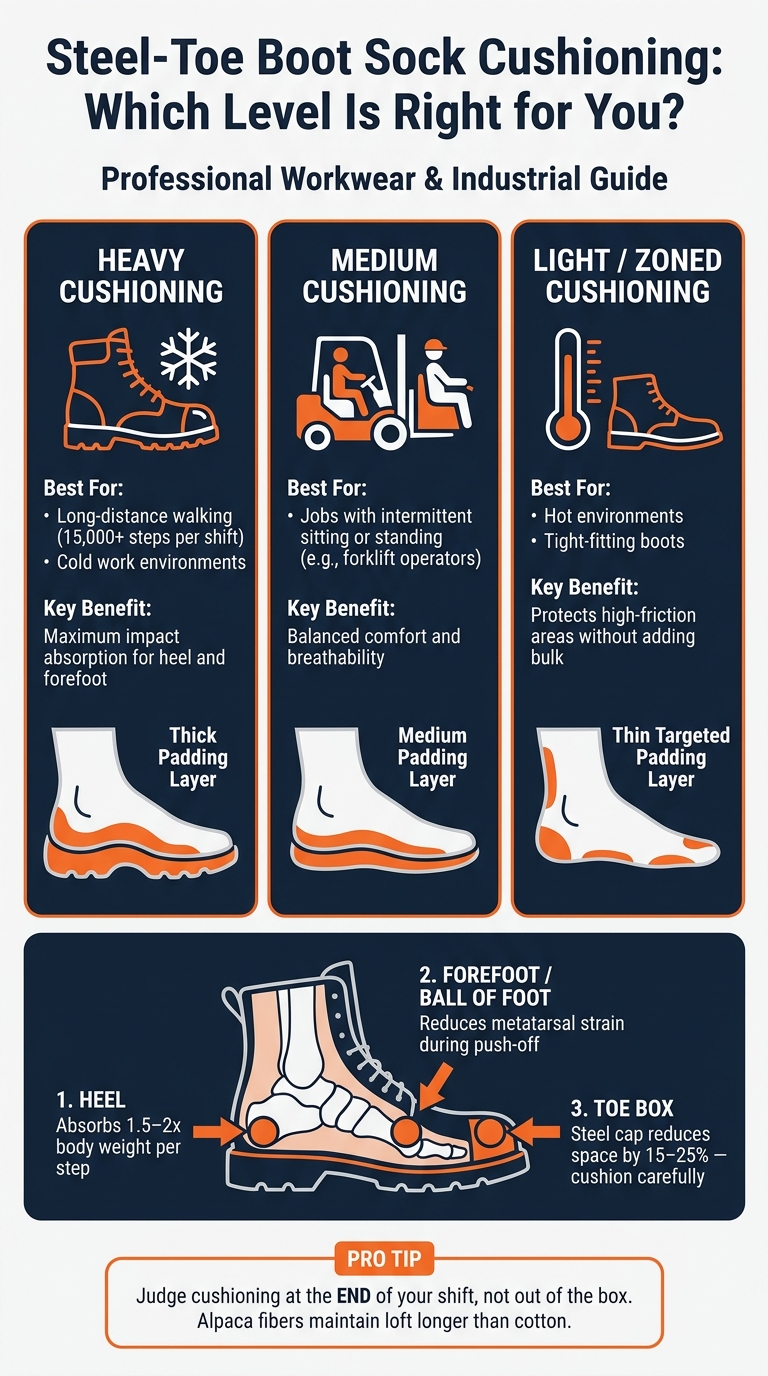
Steel-Toe Boot Sock Cushioning Guide: Which Level Is Right for You?
When it comes to steel-toe boots, cushioning is the unsung hero. Even with the best materials, your feet need proper cushioning to handle the daily grind. This isn't just about comfort - it's the final layer of defense, working alongside moisture control and reinforced fibers to protect your feet. Steel-toe boots create unique pressure points, so cushioning needs to be carefully placed to address these areas.
Where Cushioning Should Be Placed
Three zones demand special attention: the heel, forefoot, and toe box.
The heel: This area absorbs the most impact - about 1.5 to 2 times your body weight with every step. For someone walking 15,000 to 20,000 steps per shift, that’s a lot of stress. Heavy cushioning here acts as a shock absorber, softening the blow between your heel and the hard sole of the boot.
The forefoot: Specifically, the ball of your foot (metatarsal heads) takes the brunt during push-off and long periods of standing. Padding here reduces strain and keeps you comfortable.
The toe box: Steel caps already reduce space in the forefoot by 15–25% compared to regular shoes. Cushioning in this area needs to be just right - enough to prevent friction against the steel cap but not so thick that it cramps your toes.
Arch Support and Toe Box Fit
Proper arch support can make or break your day in steel-toe boots. Integrated arch compression bands help maintain your foot’s natural shape, preventing the arch from flattening and avoiding strain on the plantar fascia during long shifts. This is especially crucial because steel-toe boots often have rigid soles with minimal flexibility.
In the toe box, flat-seam or linked-toe construction is essential. Raised seams can quickly turn into painful pressure points under the steel cap’s weight. Low-bulk fabrics are a must, allowing your toes to move freely while still providing a layer of protection.
Picking the Right Cushion Level
Choosing the right cushioning depends on your daily routine and work environment.
Jobs with intermittent sitting or standing (e.g., forklift operators)
Balanced comfort and breathability
Light/Zoned
Hot environments, tight-fitting boots
Protects high-friction areas without adding bulk
If your boots are already snug, consider Performance Terry cushioning. It’s designed for long hours on your feet without cutting off circulation. For extreme cold, Maximum Density Terry adds warmth and durability without excessive bulk. Suri Performance Alpaca Socks offers both options: the Suri Field Boot Sock ($44.99/pair) uses Performance Terry, while the Ultra Boot Sock ($54.99/pair) is built for heavy-duty winter use.
A quick tip: don’t judge cushioning by how it feels right out of the box. The real test is how it performs at the end of your shift. Cushioning that feels great at the start of the day can lose its bounce after hours of wear. Pro-grade alpaca fibers excel here, maintaining their loft and support much better than cotton.
Durability and Sock Care
Reinforced Zones That Handle Daily Wear
Steel-toe boots can be brutal on socks. The constant friction at the heel, toe box, and ball of the foot often leads to rapid wear. Whether a sock lasts a few months or survives a full year of heavy use often depends on how it’s made.
Interestingly, about 80% of sock failures happen at the heel and toe areas. The first clue? A sheer spot - where the knit becomes thin and almost see-through - often appears before a full-blown hole. To combat this, socks reinforced with extra synthetic threads in high-wear zones are better equipped to handle the abuse. Alpaca fibers, known for their durability, also hold up under repeated friction, extending the life of the sock. For example, Suri Performance Alpaca Socks incorporate these reinforced zones into their boot socks to endure the daily grind.
These thoughtful design features mean your socks can keep up with demanding workdays - provided you care for them properly.
Washing and Drying Tips
Taking care of your socks is just as important as their design. High heat is the enemy, often leading to lost elasticity and reduced cushioning. To keep them in top shape, machine wash your socks in cold water using a gentle cycle. Turning them inside out helps protect the outer fibers and preserves the cushioning loops on the inside.
When it comes to drying, air-drying or laying them flat is ideal. If you have to use a dryer, stick to the lowest heat setting. Avoid bleach or dry cleaning for alpaca or wool-blend socks, as these methods can damage the natural fibers and shorten their lifespan.
When to Replace Your Socks
Even the toughest socks have their limits. Premium reinforced socks generally last over 12 months with regular use, compared to just 3–6 months for unreinforced budget pairs. But how do you know it’s time to replace them?
Watch for thinning in reinforced areas, visible skin through the knit, or cuffs that lose their stretch. Flattened terry loops are another sign - they indicate reduced cushioning and impact absorption.
It’s a good idea to periodically turn your socks inside out to check for wear. Pay close attention to the heel and toe zones. If these areas look thinner than the rest, it’s a clear sign they’re nearing the end of their lifespan.
"Replace socks when the reinforced heel area becomes noticeably thinner than surrounding fabric, when you can see skin through the knit, or when elastic in the cuff no longer holds the sock in position." - DeadSoxy
Also, take note of how your socks wear out. If you’re seeing thinning in areas like the arch or calf instead of the heel or toe, it might mean you need a larger size rather than stronger reinforcement.
Conclusion: What to Check Before You Buy
When it comes to choosing the right socks for your steel-toe boots, focus on four key factors: fit, material, cushioning, and durability. These elements can help you avoid blisters, reduce fatigue, and extend the life of both your socks and boots.
Here’s a quick checklist to guide you:
Does the sock fit your U.S. shoe size and sit at the correct height (crew or boot) to cover the boot collar?
Is it made from high-performance fibers like alpaca, merino wool, or a technical synthetic blend instead of basic cotton?
Does it include targeted cushioning in areas like the heel, ball of the foot, and toe box?
Are the heel and toe zones reinforced for durability, as mentioned in the product description?
By ticking these boxes, you ensure your socks meet the demands of tough workdays while enhancing both comfort and boot performance.
If you're looking for a standout option, consider Suri Performance Alpaca Socks. Made from moisture-wicking, odor-resistant, and thermo-regulating alpaca fibers, these socks also feature reinforced high-wear zones. Customers have praised their performance:
"No blisters, no stink, even after a day on the job site." - John H.
These socks are priced at $44.99 per pair, but with their Buy 3 Get 3 Free deal, the cost drops to about $22.50 per pair. While they may seem like an investment, their longevity and performance far outshine basic cotton socks.
Don’t underestimate the importance of quality socks - they keep your feet dry, comfortable, and ready to tackle long, demanding days.
FAQs
How do I stop steel-toe boots from rubbing my ankles?
To keep steel-toe boots from irritating your ankles, opt for over-the-calf socks that completely cover the area between your skin and the boot collar. A snug, secure fit is essential to prevent the fabric from bunching up, which can lead to friction and blisters. Suri Performance Alpaca Socks are a great choice, thanks to their light compression zones and stay-put design. These features help the socks stay in place during long workdays, minimizing chafing and discomfort.
What sock material keeps feet driest in steel-toe boots?
Alpaca fiber works wonders for keeping feet dry in steel-toe boots. Thanks to its hollow-core structure, it wicks moisture away up to three times better than cotton or wool, allowing sweat to evaporate faster. Unlike cotton, which can hold onto moisture, alpaca absorbs only 8–11% of its weight in water. This means your socks stay dry even during long, demanding shifts. The result? Less chance of blisters, reduced bacterial growth, and greater comfort throughout the day.
How often should I replace work boot socks?
When it comes to replacing work boot socks, there’s no hard-and-fast rule. However, opting for durable, high-quality socks can help them last longer. Look for features like reinforced heels and toes, which are designed to withstand heavy wear.
To keep your socks in good shape, proper care is key. Wash them in cold water and let them air dry instead of using a dryer. This helps preserve their structure and cushioning, ensuring they stay comfortable and supportive for longer.