"I liked saving money buying 4 pairs at a time and the socks are great for what I need. It's unbelievable how they could be made out of this material, yet they are so comfortable and they don't make my feet and legs itch nor do they make them hot or sweaty."
Rick S., Verified Customer
Softness of Alpaca Fiber: What Makes It Unique?
Share
Alpaca fiber is celebrated for its softness, which comes down to three key factors: its smooth microscopic structure, fine fiber diameter, and lanolin-free composition. Compared to cotton or wool, alpaca fibers have flatter scales, reducing skin irritation and creating a silky feel. Its fibers typically measure between 15-36 microns, with finer grades like baby alpaca (18-22 microns) offering even greater comfort. Additionally, alpaca lacks lanolin, making it hypoallergenic and easier to process without harsh chemicals. These qualities make alpaca fiber ideal for sensitive skin and long-lasting comfort in clothing and performance wear.
Microscopic Structure of Alpaca Fiber
Smooth Surface and Reduced Friction
When viewed under a microscope, alpaca fibers reveal a fascinating feature: their scales are smaller, shorter, and flatter compared to sheep's wool. This unique alignment creates a smoother surface that glides effortlessly against the skin, reducing irritation. As PAKA® explains:
"The scales on alpaca fibers are smaller and lie flat against the surface of the fiber, resulting in a smooth texture that minimizes the prickly sensation."
Ruth Fuqua, a researcher specializing in alpaca fibers, adds:
"Alpaca fiber scales are at a lower angle from the main shaft."
These microscopic details play a crucial role in delivering the softness and comfort alpaca fiber is known for. The smooth texture ensures a silky feel, making it ideal for next-to-skin wear. But the fiber’s comfort doesn’t stop there - its internal structure adds even more to its appeal.
Hollow Core and Lightweight Texture
Beyond its smooth exterior, alpaca fiber hides an incredible secret inside: a hollow core filled with air-filled medullary channels. This structural feature, known as medullation, sets alpaca apart. It makes the fiber about three times lighter than merino wool while delivering exceptional thermal insulation. Spirit of the Andes highlights this advantage:
"The hollow structure of alpaca fiber gives it an advantage over cashmere, as this allows for better airflow."
This hollow design not only improves airflow but also helps regulate temperature effectively. Its lightweight, airy composition ensures alpaca garments feel soft and breathable, adapting seamlessly whether you're braving the cold outdoors or staying active on the go. The result? Clothing that feels as luxurious as it performs.
sbb-itb-855989e
The Science of Soft: Micron Count
Fiber Diameter: How Fineness Affects Softness
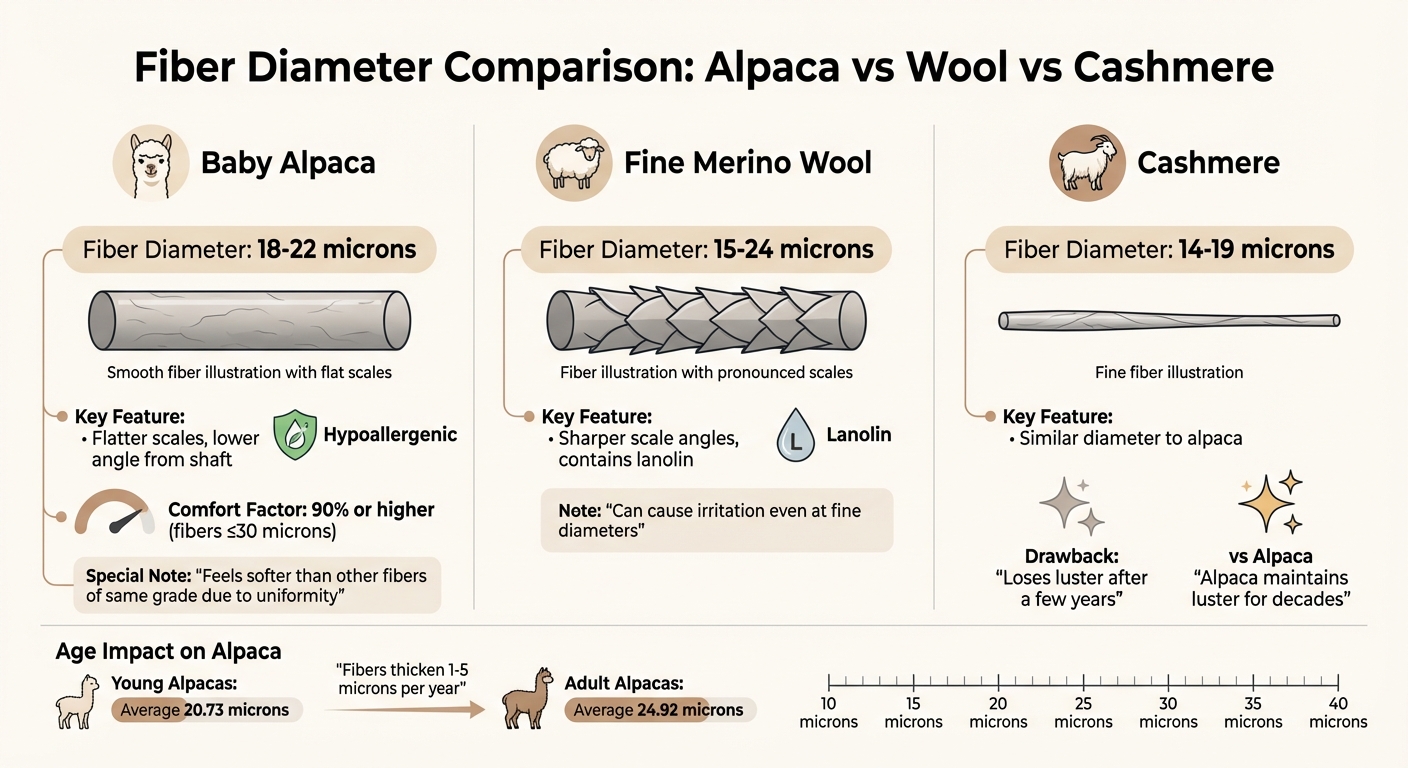
Alpaca Fiber vs Wool vs Cashmere: Diameter and Softness Comparison
The softness of alpaca fiber largely depends on one key factor: fiber diameter. The thinner the fiber, the more flexible it becomes, allowing it to bend without irritating the skin. Alpaca fiber typically ranges from 15 to 36 microns, with the finest grades offering the exceptional softness alpaca is known for.
To gauge comfort, the textile industry relies on two important metrics: the Comfort Factor (CF) and the Prickle Factor (PF). The Comfort Factor measures the percentage of fibers that are 30 microns or less, while the Prickle Factor counts those exceeding 30 microns. High-quality alpaca has a Comfort Factor of 90% or higher, meaning it contains fewer coarse fibers, which helps reduce irritation. This fineness is what allows the fiber to feel gentle against the skin, as explained in more detail below.
Baby Alpaca vs. Regular Alpaca
The term "baby alpaca" refers to the finest grades of alpaca fiber, not the age of the animal. Baby alpaca fibers typically measure between 18 and 22 microns. These fibers may come from an alpaca's first shearing or from carefully selected parts of an adult's fleece. In contrast, regular alpaca fiber can reach up to 36 microns, resulting in a coarser texture. This distinction is crucial for understanding what makes baby alpaca so much softer.
Studies show that young alpacas produce fibers averaging around 20.73 microns, while adult alpacas average approximately 24.92 microns. As alpacas age, their fibers naturally thicken by about 1 to 5 microns per year. This gradual change highlights why younger or finer-selected fibers are prized for their softness.
Alpaca Compared to Wool and Cashmere
In the world of luxury fibers, alpaca stands out. Baby alpaca, with a diameter of 18 to 22 microns, fits neatly between fine merino wool (15 to 24 microns) and cashmere (14 to 19 microns). However, alpaca often feels softer than wool, even when the fibers have the same micron measurement. Alpaca fiber researcher Ruth Fuqua explains:
"When properly sorted, alpaca can feel softer than other animal protein fibers of the same grade because of the uniformity of micron and the lower scale structure."
This smoother scale structure reduces friction, making alpaca less itchy than wool of similar thickness. Additionally, while alpaca and cashmere share similar diameters, strength, and flexibility, alpaca has a natural luster that lasts for decades, whereas cashmere tends to lose its shine after just a few years. The combination of fine diameter and a smoother surface gives alpaca a silky, luxurious texture that can rival - and often surpass - other high-end fibers. These qualities make alpaca a standout choice for unmatched softness and comfort.
Lanolin-Free Properties and Hypoallergenic Benefits
One standout feature of alpaca fiber is what it doesn't have: lanolin. Found naturally in sheep's wool, this waxy substance is a frequent culprit behind allergic reactions. Since alpaca fiber is completely free of lanolin, it provides a true hypoallergenic alternative for those who struggle with sensitivities to traditional wool products. This absence not only makes it gentler on the skin but also simplifies the fiber's processing.
Because alpaca fiber lacks lanolin, it doesn't require high temperatures or harsh chemicals during washing. Ruth Fuqua, an expert with the Alpaca Owners Association, highlights this advantage:
"Alpaca is free of lanolin, and thus can be processed without the need for high temperatures or harsh chemicals in washing. The lack of lanolin also minimizes the likelihood of allergic reactions to those who are sensitive to wool, which contains lanolin."
Additionally, alpaca fiber has an adsorbent quality, meaning oils cling to its surface rather than soaking in deeply. This makes alpaca garments easier to clean without relying on strong detergents.
Benefits for Sensitive Skin
The lanolin-free nature of alpaca fiber makes it especially appealing to those with sensitive skin. For individuals prone to irritation, alpaca fiber offers a soothing alternative by eliminating the triggers associated with lanolin.
Another key factor is its naturally smooth texture. Unlike traditional wool, which has more pronounced scales that can cause itching, alpaca fiber features flatter scales along its shaft. This helps reduce the "prickle factor" often associated with wool. Kristina Näsemann from Nugget Nielsen explains, "Compared to regular wool the fiber is smooth and avoids itching or skin irritations". Together, the lack of lanolin and the smooth surface make alpaca fiber an excellent choice for unparalleled comfort.
Flatter Scales and Prickle-Free Feel
Alpaca fiber owes its smooth, itch-free comfort to its flatter scales. Unlike sheep's wool, which has scales that protrude at sharper angles, alpaca fiber's unique structure creates a soft and pleasant wearing experience without the itchiness.
Lower Prickle Factor
The angle of fiber scales plays a big role in how fibers feel against the skin. Ruth Fuqua from the Alpaca Owners Association explains that alpaca fiber's lower scale angle significantly reduces the prickle sensation often associated with sheep wool. This is because fewer microscopic edges come into contact with the skin during wear. As Applewood Lane Alpacas aptly puts it:
"The lower the relief, the smoother the hand. This is where alpaca fiber shines."
When sorted by micron grade, alpaca fiber feels consistently softer than other animal fibers of the same thickness. Its combination of flatter scales and uniform fiber diameter minimizes any scratchy sensation, making it ideal for extended wear.
Laboratory and Consumer Testing Results
Scientific studies back up these claims about alpaca fiber's structure and comfort. Microscopic analyses conducted between 2009 and 2012 showed that both Huacaya and Suri alpacas share the same beneficial flat scale structure.
In June 2022, researchers led by Rubén Pinares from the Universidad Nacional de San Antonio Abad del Cusco studied 118 Huacaya and Suri alpacas at livestock events in Peru. Using the OFDA 2000 device, they found that high-quality colored alpacas produced fiber with an average diameter of 22 µm and a comfort factor of 90%. This means only 10% of the fibers exceeded the 30 µm threshold, where prickling typically begins.
Another study from 2006, which analyzed 585 Huacaya alpacas in the U.S., found that alpaca fiber has lower compression resistance compared to wool of similar diameter. This quality further enhances its softness, making it a standout choice for performance crew socks and other comfort-focused apparel. Together, these findings highlight why alpaca fiber is celebrated for its luxurious softness and prickle-free feel.
Softness in Performance Socks and Active Wear
Alpaca fiber isn't just luxurious; its unique microscopic and structural traits make it a top-tier material for performance wear. Thanks to its smooth surface, hollow core, and flatter scales, alpaca fiber delivers practical benefits like reduced friction, moisture management, and sustained comfort during long periods of activity.
Its silky texture dramatically reduces skin irritation during activities such as hiking or long work shifts, helping to prevent chafing and blisters. Unlike cotton, which can become coarse when wet, alpaca fiber wicks moisture away, keeping feet dry and soft even during high-intensity activities.
The hollow core of alpaca fiber adds another layer of functionality by providing lightweight insulation. It traps heat to keep feet warm in cold conditions while staying breathable enough to prevent overheating during strenuous activity. This balance of warmth and breathability creates an ideal environment that minimizes excessive sweating and friction.
Suri Performance Alpaca Socks take full advantage of alpaca fiber's natural qualities, offering four styles tailored to specific needs:
Performance Crew: These mid-calf socks provide light compression and moisture control, making them ideal for everyday use and moderate activity.
Boot Socks: Designed for heavy-duty use, these socks feature dense cushioning and reinforced construction, perfect for work boots where softness and protection are essential.
Ankle Socks: With a low-cut design and breathable mesh zones, these are great for summer hikes or high-intensity activities.
No-Show Socks: Offering strategic cushioning and odor resistance, these minimal-profile socks are perfect for casual wear.
Each style is built with reinforced high-wear zones and breathable mesh panels, ensuring durability without sacrificing softness. Whether you're working long hours in boots or tackling multi-day hikes, these socks provide the comfort and functionality needed for extended wear.
Conclusion
The softness of alpaca fiber comes from its unique structure: smooth scales, a hollow core, fine diameter, and its lanolin-free makeup. The smooth, low-angled scales reduce friction and irritation, making it gentle on the skin. With a fine diameter - typically between 18 to 25 microns in high-quality fibers - and hypoallergenic properties, alpaca fiber offers a silky texture that's perfect for sensitive skin.
"Alpaca fiber scales are at a lower angle from the main shaft, which reduces the prickle or itchy feel often encountered with sheep wool." – Ruth Fuqua
Beyond its softness, the hollow core of alpaca fiber provides lightweight insulation and excellent breathability, while its moisture-wicking properties help keep skin dry even during extended wear. Whether you're tackling long workdays or enjoying outdoor activities, alpaca fiber ensures comfort without adding bulk or causing irritation. These qualities make it an ideal choice for active wear.
Thanks to these benefits, alpaca fiber truly shines in performance wear, particularly for those with sensitive skin. Products like Suri Performance Alpaca Socks take full advantage of these features, delivering durable, comfortable, and high-performing active wear.
FAQs
Is alpaca fiber soft even for sensitive skin?
Alpaca fiber is naturally gentle on the skin because it’s hypoallergenic and free of lanolin. This makes it an excellent choice for those with sensitive skin. Plus, its unique structure adds to its softness, offering a comfortable, irritation-free experience.
What micron range should I look for to avoid itch?
If you want to avoid itchiness, look for alpaca fiber with a micron range of 18-20. Fibers within this range are generally softer and gentler on the skin, reducing the chances of irritation and making them a great choice for comfort and everyday wear.
How does alpaca stay warm yet breathable in socks?
Alpaca fiber offers a rare combination of warmth and breathability, thanks to its hollow-core structure. This design traps heat during cold weather while releasing it in warmer conditions, providing excellent temperature regulation. Compared to merino wool, alpaca fiber is up to four times warmer, yet it remains lightweight. Its breathability also helps prevent moisture buildup by allowing airflow, keeping feet dry and reducing discomfort caused by sweat or dampness.