"I liked saving money buying 4 pairs at a time and the socks are great for what I need. It's unbelievable how they could be made out of this material, yet they are so comfortable and they don't make my feet and legs itch nor do they make them hot or sweaty."
Rick S., Verified Customer
How Alpaca Socks Reduce Noise for Hunters
Share
Quiet steps often start inside your boots, not under them. If your socks hold sweat, bunch up, or let your heel slide, each step can make small squeaks, rubs, and creaks that game may catch fast.
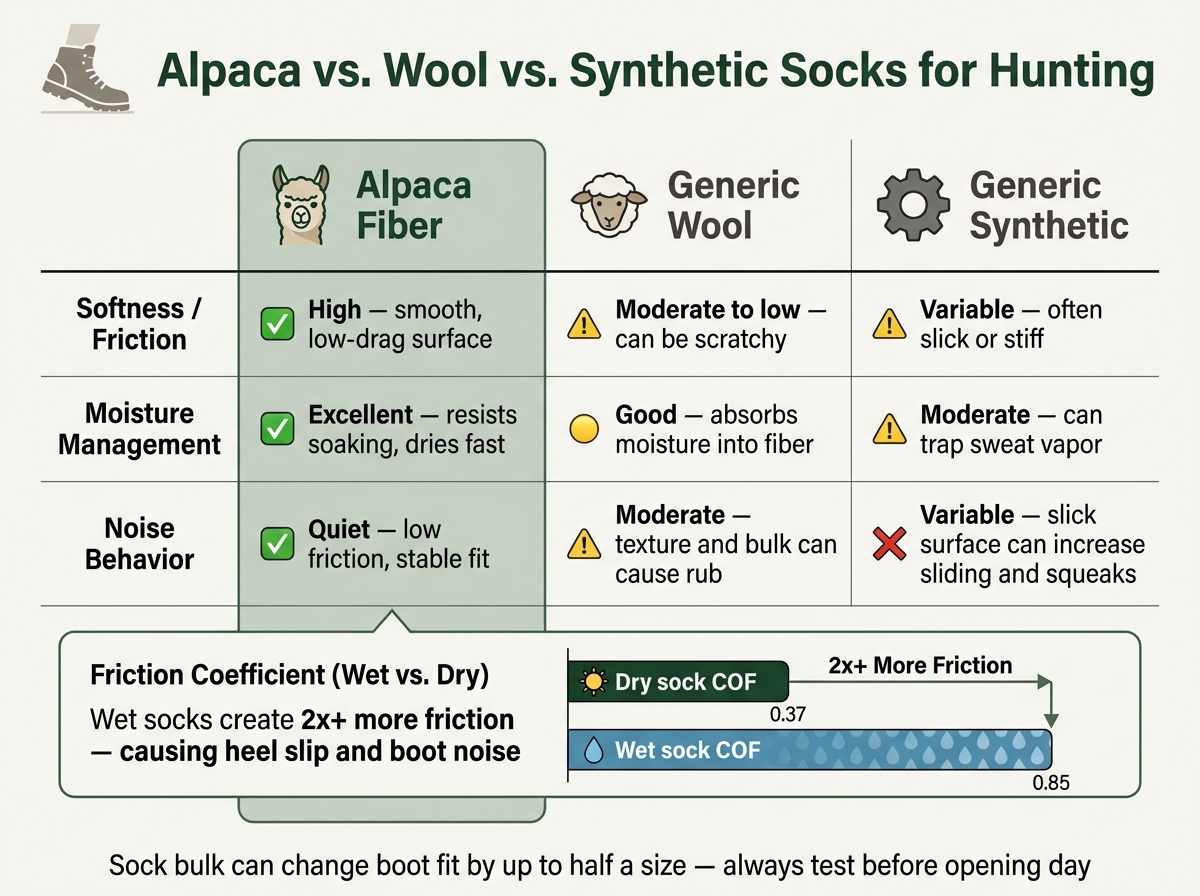
I’d sum it up like this: alpaca socks can help keep hunting steps quieter because they lower sock-to-boot friction, help feet stay drier, and improve fit by taking up the right amount of space. The article’s key stat says wet socks can hit a friction coefficient near 0.85, versus about 0.37 when dry - more than 2x higher. That matters because extra moisture often means extra foot movement.
Here’s the short version:
Noise often starts from heel slip inside the boot
Moisture makes sliding worse
Sock thickness changes fit and can affect boot space by up to half a size
Crew or boot-height socks can cut rubbing around the collar and hardware
Testing on hard floors or stairs before opening day can catch problems early
If I were picking one takeaway, it’s this: quiet feet come from the mix of fiber, fit, and moisture control - not just the boot sole.
Where Hunting Footwear Noise Comes From
A lot of boot noise starts inside the boot, not from the ground under it.
Internal Friction, Heel Slip, and Stiff Materials
When a boot fits a little loose, your foot slides around with each step. That motion creates friction between the sock and the boot lining, and that can lead to faint squeaks or rubbing sounds. Sweat makes it worse because it adds slip and lets the heel move more.
Stiff materials can add noise too. New leather boots often squeak because the leather fibers are still breaking in and flexing as you move, and as the temperature shifts. Stiff boot collars can rub against the ankle and calf with every stride. Even the sock can be part of the problem. If it pills or bunches up, it creates uneven pressure points inside the boot.
The fix is often simple: match sock thickness to the space inside the boot. Thicker socks can take up extra room in a slightly loose boot. Thinner socks work better in a snug fit. That cuts down on internal sliding and the noise that comes with it. That’s why the sock layer matters just as much as the sole.
Why Some Hunters Stalk in Socks
For hunters trying to make the quietest step possible, some take it one step further.
They remove their boots for the final approach on soft, safe ground because socks cut sole noise and reduce creaks. Socks also let them feel small sticks and rocks underfoot before they snap. That extra feel can help them avoid sharp crunches and sudden noise. It’s a good reminder that stealth isn’t just about the outsole - it’s also about what sits between your foot and the boot.
Why Alpaca Fiber Helps Reduce Noise
Alpaca vs. Wool vs. Synthetic Socks for Hunting: Noise, Moisture & Fit
Alpaca fiber cuts down on friction, heel slip, and moisture where those problems start: inside the boot.
Soft Fibers Reduce Rubbing and Friction Sounds
Alpaca fiber has a smoother surface than most common sock materials. That smoother surface creates less drag than standard wool, so it snags less against boot linings as you move. The result is simpler: less scraping and less rustling when you flex, crouch, or pivot.
Alpaca also adds soft cushioning. Its hollow fibers create a thin buffer between your foot and the boot. That small layer helps absorb minor impacts from your heel and forefoot against hard insoles or stiff boot counters, which can cut down faint creaks and other subtle contact noise.
Drier Feet Move Less Inside the Boot
Sweat is one of the biggest drivers of internal boot noise. When moisture builds up inside a boot, your foot starts to slip. Then the heel lifts and re-seats, the ankle shifts against the collar, and the sock bunches up. Each of those movements can make noise.
Lab data on sock friction shows that wet socks can reach a coefficient of friction (COF) near 0.85, compared with roughly 0.37 when dry. That’s more than double. And it means a wet foot moves much less predictably inside the boot.
Alpaca fiber handles moisture differently than synthetics or standard wool. It resists soaking up moisture, so it dries faster. Its hollow core also helps cut sweat buildup. Drier feet shift less, which helps them stay quieter.
Those fiber traits matter most when the sock also matches the boot fit.
Fiber Traits Comparison Table
Trait
Alpaca Fiber
Generic Wool
Generic Synthetic
Softness
High - smooth, low-drag surface
Moderate to low - can be scratchy
Variable - often slick or stiff
Moisture Management
Excellent - resists soaking up moisture, dries fast
Good - absorbs moisture into fiber
Moderate - can trap sweat vapor
Noise Behavior
Quiet - low friction, stable fit
Moderate - texture and bulk can cause rub
Variable - slick surface can increase sliding and squeaks
For hunters focused on stealth, the noise behavior column says the most. Alpaca’s mix of softness and moisture control helps keep the foot quieter at the heel, ankle collar, and forefoot.
Next, fit and layering decide whether those quiet fibers stay quiet in the field.
sbb-itb-855989e
How Alpaca Socks Work With Boots and Hunting Layers
Quiet gear doesn't come from one item alone. It comes from how your sock, boot, and outer layers work together as one system.
Better Fit Means Less Creaking and Less Foot Movement
Once the fiber stays quiet, fit is the next piece. That's what stops that quiet from turning into boot noise.
The empty space inside your boot decides how much your foot can move around. And when your foot shifts, it makes noise. A well-chosen alpaca sock fills extra room in the heel and midfoot, so your foot stays planted instead of floating. That closer fit cuts foot movement and the squeaks that come with it.
Alpaca socks come in light, midweight, and heavyweight options, so you can match sock volume to your boots. For example, a midweight crew alpaca sock in a big-game leather boot can help fill heel space and cut the small up-and-down motion that leads to heel-lift creaks during slow stalks. The fit rule is simple: snug, with no sliding. Leave enough heel room to keep the foot seated, but not enough for it to move around. Its stable loft also helps hold that fit without bunching.
Quiet Lower-Body Layering Reduces Noise
The same idea applies above the boot, where cuffs, gaiters, and collars can create noise of their own.
Pant cuffs, gaiters, and boot collars can all add noise around the ankle. A steady boot-sock fit helps cut that down because the boot moves with the leg instead of lagging behind or shifting under the cuff.
Stiff outer fabric can rustle or scrape against boot collars and alert game well before you're in range. Pairing a stable alpaca sock with soft-fabric hunting pants and properly adjusted gaiters leads to smoother movement. A crew-length or taller alpaca sock that fully covers the ankle bone also keeps metal eyelets and lace hooks from touching exposed skin or thin baselayers, which helps reduce the small “tick” sounds hardware can make while you move.
Boot and Sock Issue Table
The main boot-and-sock problems break down like this:
Issue
Typical Cause
Alpaca Sock & Boot Fix
Heel slip creaks
Excess space in heel pocket; loose lacing
Thicker, cushioned alpaca sock; retension laces for lockdown
Wet-foot slippage
Foot sliding on damp insole or liner due to sweat buildup
Moisture-wicking alpaca sock to keep feet drier; match sock weight to boot volume
Pant-cuff friction
Loose cuff catching on boot collar or hardware
Taller sock height to cover hardware; tuck or blouse cuff to reduce contact
Ankle chafing and collar squeak
Boot top rubbing bare skin or thin synthetic layers
Crew or boot-height alpaca sock as a soft buffer between leg and collar
The big point here is simple: these aren't separate problems. They're parts of the same setup. When you adjust sock thickness, sock height, and boot lacing together, you cut noise from the ankle down.
Choosing Alpaca Socks for Hunting and Field Use
Match Sock Weight and Height to Terrain, Boots, and Season
Once you've dialed in fit and moisture control, the next move is simple: pick the right sock weight and height for the hunt.
For warm, high-movement hunts, a lightweight alpaca crew sock helps limit sweat buildup and keeps your foot from sliding inside the boot. For most hunting setups, a midweight alpaca crew or boot sock is the best all-around pick. Alpaca delivers more warmth for the weight than many wool options, so a midweight sock can often do the job of a thicker pair without giving up warmth.
If you're sitting through cold mornings or hunting late in the season, go with a heavyweight alpaca boot sock. That extra insulation matters most when you're not moving much.
Pay close attention to thickness. Sock bulk can change boot space by as much as half a size. That's not a small detail. A sock that feels fine in the house can turn a well-fit boot into a cramped, noisy one fast. Match the sock weight to your boot volume before opening day.
With 8–10 inch hunting boots, most hunters will want crew or boot socks that sit just above the cuff. That extra height helps stop rubbing at the collar and can cut down on noise when you're stepping over logs or climbing a ladder.
Test for Noise Before Opening Day
Before opening day, test the whole setup - socks, boots, and pants - on hard floors and stairs.
Walk at a brisk pace across a hard floor and listen for squeaks from the insole or upper. Then try stair edges or a practice ladder if you hunt from a treestand. Each step should feel planted, with no heel lift and no fabric scraping against the boot. If you hear noise on stairs, it'll stand out even more on dry leaves.
A sock that's too thick - or too slick against the liner - will often show the problem on hard flooring before it turns into a field issue.
Conclusion: Quiet Feet Come From Fit, Fiber, and Moisture Control
Get the weight, height, and fit right, and alpaca socks can help make each step quieter. Suri Performance Alpaca Socks offers boot socks and performance crew socks made for that exact job - soft fiber, steady fit, and moisture control from the first step to the last.
FAQs
Do alpaca socks help with new boot squeaks?
Yes. Alpaca socks can help cut down the friction that often comes with new boot squeaks, while also making your feet feel better overall.
Their smooth fibers, reinforced heels and toes, and targeted cushioning help create a snug, stable fit inside the boot. They also wick moisture and keep their shape under pressure, which helps limit internal movement and rubbing that can lead to noise and irritation.
How do I know if my socks are causing heel slip?
Check for loose fabric that bunches or slides against your skin. A good fit should hold your heel and arch snugly, with no extra material getting in the way.
If you feel rubbing or notice the sock shifting inside your boots, it’s probably too loose. Check your size against the official Suri Performance Alpaca Socks sizing chart, then try the socks on with your footwear before you head out.
What alpaca sock weight is best for my hunting boots?
For hunting boots, Suri Performance Alpaca boot socks are the best pick. They have dense cushioning that holds up well and helps move moisture away from your skin, which matters when you’re on your feet outdoors all day.
Alpaca fiber helps hold warmth in cold weather and lets off excess heat when you’re active. So you get light insulation without extra bulk. That means your boots can still fit well while your feet stay dry, warm, and odor-free.