"I liked saving money buying 4 pairs at a time and the socks are great for what I need. It's unbelievable how they could be made out of this material, yet they are so comfortable and they don't make my feet and legs itch nor do they make them hot or sweaty."
Rick S., Verified Customer
Why Cushioning Matters for Sock Durability
Share
Socks wear out quickly in high-impact areas like the heel and toe due to constant friction and pressure. Cushioning plays a key role in extending their lifespan by:
Absorbing Impact: Reduces stress on fabric during activities like walking or running.
Minimizing Friction: Protects high-stress areas (heel/toe) from wear caused by rubbing against shoes.
Even Pressure Distribution: Full-sole padding spreads force evenly, preventing localized damage.
Moisture also weakens sock fibers, especially in materials like cotton. Using moisture-wicking fabrics and reinforced cushioning in critical zones can significantly improve durability. Socks made with alpaca fibers, for example, last 2–3 times longer due to their strength and resilience.
For long-lasting socks, look for features like terry loop construction, reinforced heels/toes, and materials designed to manage moisture and reduce friction.
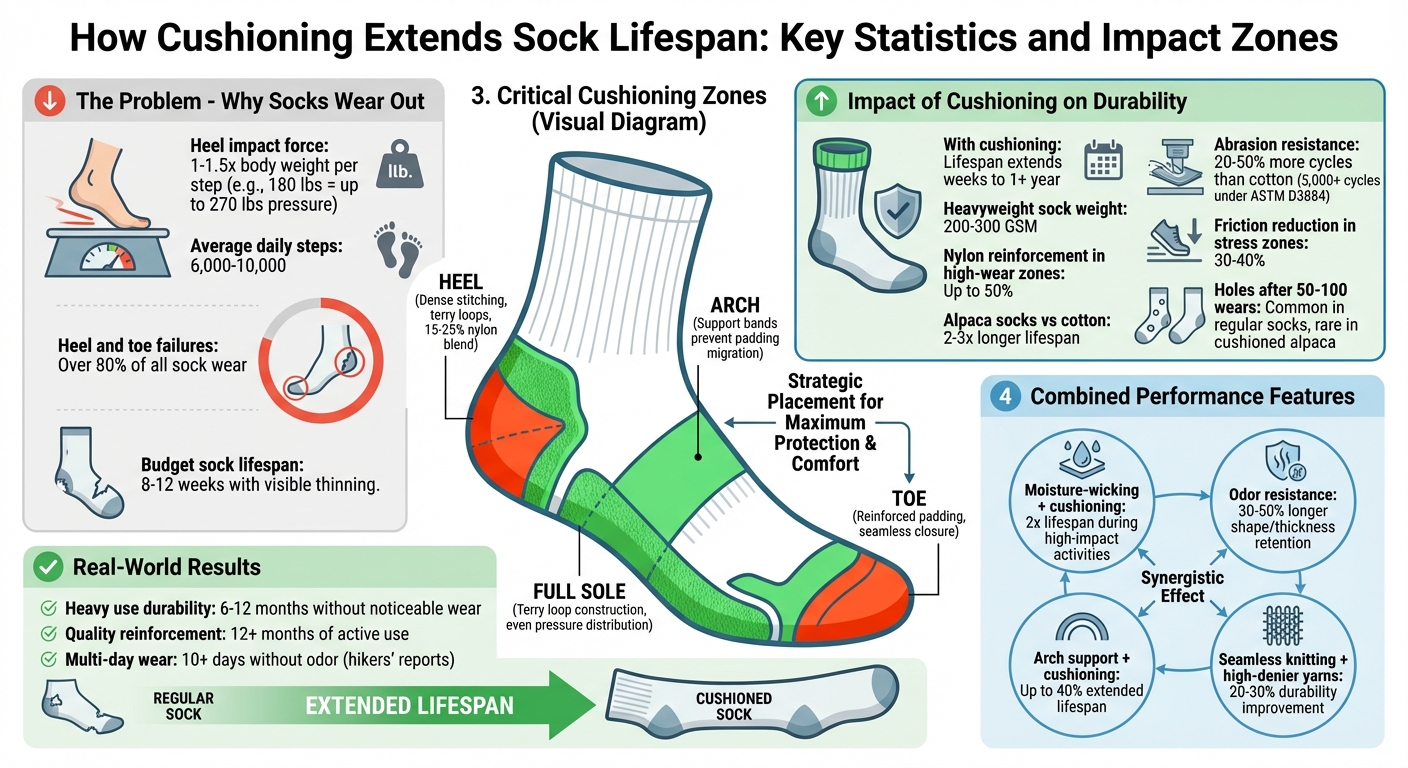
How Cushioning Extends Sock Lifespan: Key Statistics and Impact Zones
Why Socks Wear Out Quickly
Holes and Thinning in High-Impact Zones
Every step you take puts a surprising amount of stress on your socks. When your heel strikes the ground, it absorbs 1–1.5 times your body weight in force. For someone weighing 180 pounds, that's up to 270 pounds of pressure focused on an area about the size of a tennis ball - every single step. Multiply that by the 6,000–10,000 steps the average person takes daily, and you can see why your heels take such a beating.
It's no surprise that the heel and toe areas are where most socks fail - accounting for over 80% of wear and tear. The heel grinds against the abrasive heel counter of your shoe, while your toes flex and rub against the toe box with every movement. Tight-fitting shoes only make things worse, pressing the fabric tightly against your skin and increasing friction. Budget socks without reinforced heels or toes often show visible thinning in as little as 8–12 weeks of regular use. Beyond this mechanical wear, environmental factors like moisture also speed up the breakdown process.
Fabric Breakdown from Moisture and Stress
While friction and impact cause physical damage, moisture plays a sneaky role in weakening your socks. Cotton, for instance, absorbs sweat and holds onto it, creating a damp environment that amplifies stress on the fibers. Dr. Marisa Garshick, a board-certified dermatologist, explains:
"Cotton, on the other hand, while it can absorb sweat and moisture from the skin, it is more likely to hold onto the moisture and not dry as quickly, leaving the sweat in prolonged contact with the skin".
Natural fibers like cotton, bamboo, and silk are particularly vulnerable to wear and tear compared to synthetic materials like polyester or nylon. When moisture combines with constant compression - whether from shoe insoles, rough skin, or the ground - it accelerates the breakdown of the fabric. Ill-fitting socks add to the problem: socks that are too small stretch thin and rip easily, while oversized socks slip around, increasing friction and wear. While targeted cushioning can help absorb some of the impact, managing moisture is key to extending the life of your socks.
sbb-itb-855989e
How Cushioning Protects Against Wear and Tear
Impact Reduction Through Padding
Cushioning plays a crucial role in reducing the stress placed on fabric during high-impact activities. By compressing and spreading force across a broader area, it prevents concentrated pressure that could lead to quick deterioration. One effective method is terry loop construction, which incorporates an internal padding layer to disperse the energy from each step. This design helps protect fibers from breaking down during activities like running or hiking. As DeadSoxy puts it, "Terry loops inside a sock provide cushioning and absorb shocks from repetitive impacts, reducing wear from friction". With proper cushioning, the lifespan of socks can stretch from just a few weeks to over a year.
Friction Reduction in High-Stress Areas
Beyond absorbing impact, cushioning also minimizes friction in areas prone to wear, such as the heel and toe. These zones endure the most intense rubbing during movement and, therefore, require denser padding to withstand the stress. DeadSoxy highlights this by stating, "Reinforced heel and toe zones use denser knitting patterns and blended nylon fibers specifically in the areas that experience the most friction during athletic movement. Without reinforcement, these high-wear zones develop thin spots and holes within weeks of regular use".
Heavyweight socks, typically ranging from 200 to 300 GSM, help evenly distribute pressure, reducing localized damage. To further enhance durability, some manufacturers use up to 50% nylon in reinforced areas, allowing socks to last several years instead of just a few months.
The Hard Truth About Expensive Hiking Socks
Targeted Cushioning: Where Placement Matters Most
Cushioning plays a big role in extending the life of socks, but where that cushioning is placed can make all the difference. Socks that last a few months versus those that survive over a year often owe their durability to strategic padding. Reinforcing high-impact zones helps protect the fabric from the constant stress your feet endure.
Reinforced Heel and Toe Areas
The heel and toe take a beating every day. These areas experience the most friction and impact, which is why over 80% of sock failures happen here.
The solution? Dense stitching and engineered padding in these high-stress zones. Manufacturers use techniques like increasing stitch density, adding extra yarn plies for thickness, and incorporating terry loop construction. This creates cushioned loops between stitches, enhancing durability. Jason Simmons, Founder of DeadSoxy, explains:
"Reinforced heels and toes are zones within a sock where denser knit patterns, additional yarn plies, or nylon-blend reinforcement threads are used to resist the concentrated abrasion that shoe interiors generate".
Material choice also plays a critical role. By blending high-strength fibers like nylon or polyamide - typically in the 15–25% range - into the heel and toe, manufacturers improve abrasion resistance without compromising comfort. This targeted reinforcement helps these areas endure the constant grinding against your shoe's heel counter and toe box, preventing those dreaded holes from forming after just a few wears.
While heel and toe reinforcement tackles the most vulnerable spots, full-sole cushioning provides an added layer of protection.
Sole Cushioning for Even Pressure Distribution
Beyond the heel and toe, full-sole cushioning is essential to keeping socks intact over time. Terry loops in the sole absorb shock and spread pressure evenly, reducing friction in high-impact areas.
Advanced knitting techniques ensure that pressure is distributed across the entire sole. For example, in the forefoot - where your toes flex with every step - targeted padding helps manage the constant rubbing against your shoe's toe box. When shopping for long-lasting socks, look for features like "terry loop construction" in the sole. Paired with seamless toe closures to eliminate bulky seams, this design protects the sock's integrity even during high-impact activities.
At Suri Performance Alpaca Socks, this attention to cushioning placement is central to our design. By combining alpaca, cotton, and wool fibers with innovative techniques, we create socks that deliver exceptional durability and all-day comfort.
How Alpaca Fiber Socks Improve Durability
Alpaca fibers are a game-changer when it comes to sock durability. Thanks to their natural strength and resilience, alpaca fibers stand up to wear and tear far better than traditional materials. This durability comes from their hollow fiber structure and impressive tensile strength, which allows them to resist breaking under repeated stress. When combined with well-placed cushioning, alpaca socks can last 2-3 times longer than standard cotton options.
Reinforced Durability with Alpaca Fibers
One standout feature of alpaca fibers is their ability to handle daily wear without breaking down. Unlike sheep wool, alpaca fibers are less prone to degradation under pressure. When paired with cushioning in high-impact zones like the heels and toes, the result is a sock that absorbs shock while resisting tears.
Lab tests back this up: alpaca socks with cushioning endure 20-50% more abrasion cycles than cotton, often surpassing 5,000 cycles under the ASTM D3884 standard. For example, Suri Performance Alpaca Socks use targeted cushioning to reduce friction by 30-40% in stress-prone areas, significantly decreasing the chances of holes forming after just 50-100 wears - common with regular socks. Many users report 6-12 months of heavy use without noticeable wear, even during tough activities like hiking or outdoor labor. This combination of fiber strength and strategic cushioning creates a durable sock that stands up to demanding conditions.
Added Comfort and Performance Features
Alpaca fibers bring more than just durability - they also enhance comfort and performance. The natural keratin in alpaca fibers has antimicrobial properties, which help prevent bacterial growth. This not only keeps odors at bay but also protects the fabric from weakening over time. In fact, hikers using Suri Performance Alpaca Socks report no odor even after wearing them for 10+ days straight.
Temperature regulation is another factor that contributes to their longevity. Alpaca fibers feature a hollow core that provides insulation without adding bulk. This ensures the cushioning performs consistently, whether you're braving freezing temperatures or sweating through a summer hike. By preventing the material from stiffening or softening due to thermal changes, alpaca socks avoid stress tears caused by expansion and contraction. Together, these features allow alpaca socks to maintain their structure and cushioning across a variety of conditions, making them a reliable choice for everything from construction work to mountain adventures.
Combining Cushioning with Other Performance Features
Cushioning not only reduces impact and friction but can also work alongside other performance features to improve durability. When combined with moisture-wicking, odor resistance, and arch support, cushioning creates a synergy that helps socks last longer. These elements work together to tackle major sock wear-and-tear culprits: moisture buildup, bacterial growth, and structural distortion. Let’s break down how each feature complements cushioning to protect your socks.
Moisture-Wicking and Odor Resistance
Sweat in cushioned areas can increase friction and speed up fabric breakdown. By pairing cushioning with moisture-wicking fibers, socks can draw sweat away from the skin, keeping the padding dry. This combination is especially effective during high-impact activities like hiking, potentially doubling the lifespan of your socks.
Odor resistance also plays a critical role in maintaining sock integrity. Moist, cushioned areas are breeding grounds for bacteria, which can weaken fabric over time. Adding antimicrobial fibers, such as alpaca, helps inhibit bacterial growth and preserve the sock’s structure. Research shows that odor-resistant socks maintain their shape and thickness 30–50% longer than untreated alternatives, even after repeated use. For instance, Suri Performance Alpaca Socks combine targeted cushioning with natural odor resistance, making them ideal for multi-day outdoor adventures when washing isn’t an option.
Arch Support for Structural Stability
Beyond managing moisture, proper support is essential for sock durability. Arch support works in tandem with cushioning to prevent common issues like fabric distortion in the midfoot. Without adequate support, cushioning can shift, leading to uneven pressure and eventual tears. Reinforced arch zones help keep the padding in place, ensuring even pressure distribution across the foot.
Experts suggest that combining reinforced arch zones with cushioning can extend sock lifespan by up to 40%. The American Apparel & Footwear Association highlights the importance of using seamless knitting for cushioning zones, elastic arch bands over padded midsoles, and terry-loop cushioning with depths of 0.08–0.16 inches (2–4 mm). When paired with high-denier yarns, these features can improve durability by 20–30%. This structured design prevents "padding migration", which often leads to uneven wear and tear.
Conclusion
We've explored how engineered cushioning can significantly improve sock durability. By absorbing impact, reducing friction between your foot and shoe, and evenly distributing pressure, targeted cushioning helps extend the lifespan of socks from just weeks to over a year.
When combined with features like moisture-wicking, odor resistance, and structural support, cushioning becomes even more effective. These elements work together to combat fabric breakdown caused by moisture and stress. As Jason Simmons, Founder of DeadSoxy, explains:
"Without reinforcement, these high-wear zones develop thin spots and holes within weeks of regular use. Quality reinforcement extends sock lifespan to 12+ months of active use".
This combination not only protects the fabric but also improves the overall performance of the sock.
A great example of this is Suri Performance Alpaca Socks. Made from a proprietary superfine alpaca fiber blend, these socks naturally wick away moisture and resist odors. Dense cushioning in high-wear areas prevents thinning and sagging, while reinforced heels and toes, light compression zones for arch support, and seamless construction eliminate friction points. Built for tough conditions, they’re perfect for everything from snowshoeing to construction work.
With over 10,000 satisfied customers, the durability of Suri Performance Alpaca Socks speaks for itself. Jake P., a customer, shares:
"I used to go through socks every few weeks - these have lasted months without thinning or sagging".
Choosing socks with advanced cushioning and high-quality materials isn’t just about comfort - it’s a smart investment in durability that saves both money and hassle in the long run.
FAQs
How much cushioning is enough without feeling bulky?
Finding the ideal cushioning strikes a balance between comfort and protection without adding extra bulk. Aim for a moderate level that supports your feet, keeps flexibility intact, and offers a secure fit. This balance not only helps avoid problems like fabric wear or discomfort but also ensures long-lasting durability and comfort throughout the day.
Do cushioned socks last longer in any shoe, or only in boots and running shoes?
Cushioned socks tend to hold up better in boots and running shoes because they’re built to handle impact and reduce friction in areas that experience the most wear. That said, how long they last also comes down to the materials used and how they’re made, as these elements are crucial in resisting thinning and holes over time.
How do I wash cushioned alpaca socks without ruining the padding?
To keep the cushioning in alpaca socks intact, it's best to hand wash them in cool water using a mild detergent. If you need to use a washing machine, place the socks in a mesh laundry bag and select the delicate or wool cycle. Steer clear of hot water, strong detergents, and tumble drying. Instead, lay them flat to air dry, which helps preserve their shape and padding.