"I liked saving money buying 4 pairs at a time and the socks are great for what I need. It's unbelievable how they could be made out of this material, yet they are so comfortable and they don't make my feet and legs itch nor do they make them hot or sweaty."
Rick S., Verified Customer
Best Alpaca Socks for Safety Boots
Share
If you wear safety boots for 8 to 12 hours, the right alpaca sock usually comes down to 3 things: fit, cushion, and weather.
Heavyweight socks make more sense in sub-freezing conditions
Mid-calf or over-the-calf height helps stop rubbing against the boot shaft
The article’s price points start at $48.99 and $54.99 per pair, with a Buy 3 Get 3 Free option
One stat stood out to me: the article says reinforced work socks can last 12 to 18 months with daily wear, which is a big deal if your boots put a lot of stress on the heel and toe.
Quick Comparison
Sock
Best Use
Height
Cushion
Weather
Price
Suri Field Boot
Long shifts, all-season wear, snug boots
Over-the-calf
Performance terry
All-season
$48.99
Suri Ultra Boot
Cold outdoor work, freezing conditions
Mid-calf
Max-density terry
Sub-freezing
$54.99
My takeaway: if your boots already feel tight, go with the lower-bulk option. If you work outside in deep cold, go thicker. That’s the core of the full article.
sbb-itb-855989e
What to Look for in Alpaca Socks for Safety Boots
Not every alpaca sock works well inside safety boots. If you're on your feet for long shifts, pay close attention to the blend, reinforcement, cushioning, and height. Those four details will help you sort the good options from the bad ones fast.
Fiber Blend, Stretch, and Reinforcement
Start with alpaca vs. wool and cotton blends, not socks made from alpaca only. When alpaca is blended with nylon and stretch fibers, the sock keeps its shape better, resists pilling, and stays comfortable through 8- to 12-hour shifts.
Heel and toe areas usually take the hardest beating inside heavy leather or steel-toe boots. That's where reinforcement matters most. Extra strength in those zones helps stop holes from forming and can push a sock's lifespan to 12–18 months of daily wear.
A ribbed cuff or light compression band also helps. It keeps the sock from sliding down and cuts down on heel bunching.
Cushioning, Height, and Moisture Control
Dense terry cushioning under the sole, heel, and instep helps soften impact on concrete and moves sweat away from the foot. That mix matters more than people think. Too little cushion, and every step feels harsh. Too much, and the boot can start to feel cramped. Delia M., a verified buyer, put it well:
"Thick under the foot without making the boot tight. That balance is hard to find."
If your boots already fit snugly, skip max-cushion socks. Extra bulk can create pressure points, especially in tighter work boots. It's smart to check the inside space of the boot before going up in cushion level.
For height, mid-calf or over-the-calf is usually the best fit for safety boots. That length helps the sock stay put and adds a layer between your skin and the boot collar. Also check for a flat toe seam. In a narrow steel-toe box, even a small raised seam can start rubbing and turn into a headache fast.
Comparison Table: Safety Boot Sock Features at a Glance
Use the table below for a quick side-by-side look at the main features.
Feature
What to Look For
Why It Matters in Safety Boots
Fiber Composition
Alpaca + nylon blend
Holds shape; resists compression over long shifts
Cushioning Level
Dense terry loop (sole & instep)
Absorbs shock on concrete; aids moisture wicking
Sock Height
Mid-calf or over-the-calf
Helps prevent slipping and skin contact with the boot collar
Reinforcement
Heel & toe zones
Resists failures; extends lifespan to 12–18 months
Moisture Control
Fast-drying alpaca blend
Helps feet stay dry through long shifts
Odor Resistance
Low-odor alpaca blend
Helps keep boots fresher between washes
Toe Seam
Flat toe seam
Reduces rubbing in a narrow steel-toe box
Best Alpaca Socks for Safety Boots
When you’re picking alpaca socks for safety boots, sock weight comes first. It affects warmth, cushion, and how the sock sits inside the boot.
Heavyweight Alpaca Boot Socks for Cold-Weather Work
In freezing weather, heavyweight or ultra-boot alpaca socks tend to work best with insulated or steel-toe boots. Look for dense cushioning, a calf height that stays put, and low bulk. If your boots already fit snug, skip extra-thick padding.
Suri Ultra Boot Socks use dense terry cushioning and reinforced heel and toe zones for warmth, friction control, and durability during cold shifts.
When the workday moves from cold exposure to steady movement, midweight socks usually make more sense.
Midweight Crew Socks for Long Shifts
For long indoor shifts or jobs that move between indoor and outdoor settings, midweight crew socks give you a good middle ground: cushion, breathability, and heat control. That matters even more if you’re on the move all day, climbing ladders, or going in and out of different temperatures.
Suri Performance offers boot socks for both cold weather and all-day jobsite wear.
For safety boots, the most relevant options are Field Boot Socks and Ultra Boot Socks from Suri Performance Alpaca Socks. The Field Boot Socks use a Pro-Grade alpaca blend with targeted sole cushioning and breathable mesh zones built for safety boot conditions. The Ultra Boot Socks are made for freezing conditions, with dense cushioning and reinforced zones that deal with friction from heavy leather and steel toes.
Pricing starts at $48.99 per pair for the Field Boot Socks and $54.99 per pair for the Ultra Boot Socks. Both are also available in a Buy 3 Get 3 Free bundle.
Top Picks Side by Side
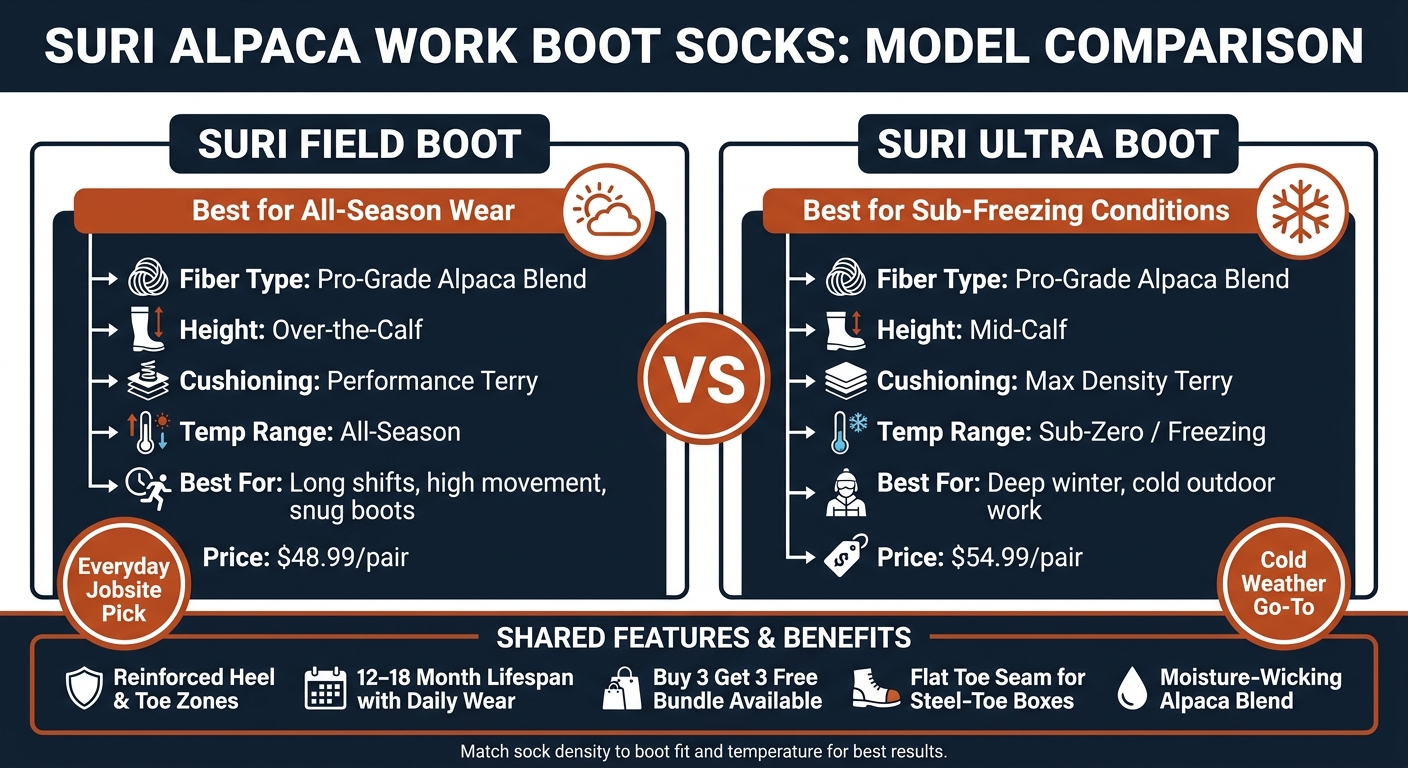
Alpaca Safety Boot Socks: Field Boot vs Ultra Boot Comparison
Comparison Table: Fiber, Cushioning, Height, and Best Work Conditions
These two picks split the job based on temperature and boot fit.
Sock Model
Fiber Type
Height
Cushioning
Temp Range
Best For
Price
Suri Field Boot
Pro-Grade Blend
Over-the-Calf
Performance Terry
All-Season
Long shifts, high movement
$48.99/pair
Suri Ultra Boot
Pro-Grade Blend
Mid-Calf
Max Density Terry
Sub-zero / Freezing
Deep winter, cold outdoor work
$54.99/pair
Use the notes below to pick the better match for your shift.
If your boots already fit snug, max-density socks can feel too tight. That’s where the Field Boot makes more sense. Its Performance Terry cushioning gives you padding without too much bulk.
When the job takes you into freezing weather, the Ultra Boot is the better pick. Its Max Density Terry build is made for deep cold and long hours outside.
Boot height matters too. Over-the-calf socks like the Field Boot help cut down on rubbing from taller boot shafts. For standard 6-inch safety boots, a mid-calf sock usually does the job.
Field Boot works best for snug, all-season boots. Ultra Boot is the go-to for freezing conditions.
Conclusion: Picking the Right Alpaca Socks for Your Job
The choice comes down to three things: temperature, shift length, and boot fit. Those gains show up most when fit, shift length, and temperature are all working against your feet.
For most shifts, go with midweight, over-the-calf work socks with reinforced heel and toe zones. If you're working in freezing weather, pick heavyweight cushioning. For long days on concrete, dense terry underfoot can make a big difference.
Fit matters more than many people think. If the sock feels loose in the boot, go with the snugger size. If your steel-toe box already feels tight, a max-cushion sock might push it too far, so test the fit before you buy multiple pairs.
Wash cold, air dry, and skip bleach or fabric softeners.
That leaves two clear picks from this roundup: Suri Performance Field Boot Socks fit everyday jobsite wear, while Suri Performance Ultra Boot Socks suit sub-freezing conditions and maximum warmth.
FAQs
How do I know if my boots need midweight or heavyweight socks?
Choose heavyweight socks for freezing temperatures or long shifts with lots of walking, such as 15,000 steps or more. The extra padding helps absorb shock and can make a long day feel a little easier on your feet.
For jobs that involve more standing and sitting, midweight socks usually offer a better balance of comfort and breathability. Either way, reinforced heels and toes help the socks last longer.
Will alpaca socks help if my feet sweat in safety boots?
Yes. Alpaca socks can help with sweaty feet in safety boots because they pull moisture away from your skin. That helps keep your feet drier than cotton, which tends to hold onto sweat. Drier feet usually means fewer blisters and less odor too.
Suri’s alpaca blend offers moisture-wicking performance, odor resistance, and thermo-regulating comfort for long shifts. So if you’re wearing cotton socks that stay damp through the day, switching to alpaca can make a noticeable difference.
How should I wash alpaca boot socks to make them last?
Machine wash alpaca boot socks in cold water on a gentle cycle. Before you toss them in, turn them inside out to help protect the outer fibers and the cushioned loops inside.
Skip bleach and fabric softener. For the best outcome, air-dry them or lay them flat to dry. If you need to use a dryer, stick to the lowest heat setting.