"I liked saving money buying 4 pairs at a time and the socks are great for what I need. It's unbelievable how they could be made out of this material, yet they are so comfortable and they don't make my feet and legs itch nor do they make them hot or sweaty."
Rick S., Verified Customer
Alpaca vs Merino Work Socks For Standing Jobs
Share
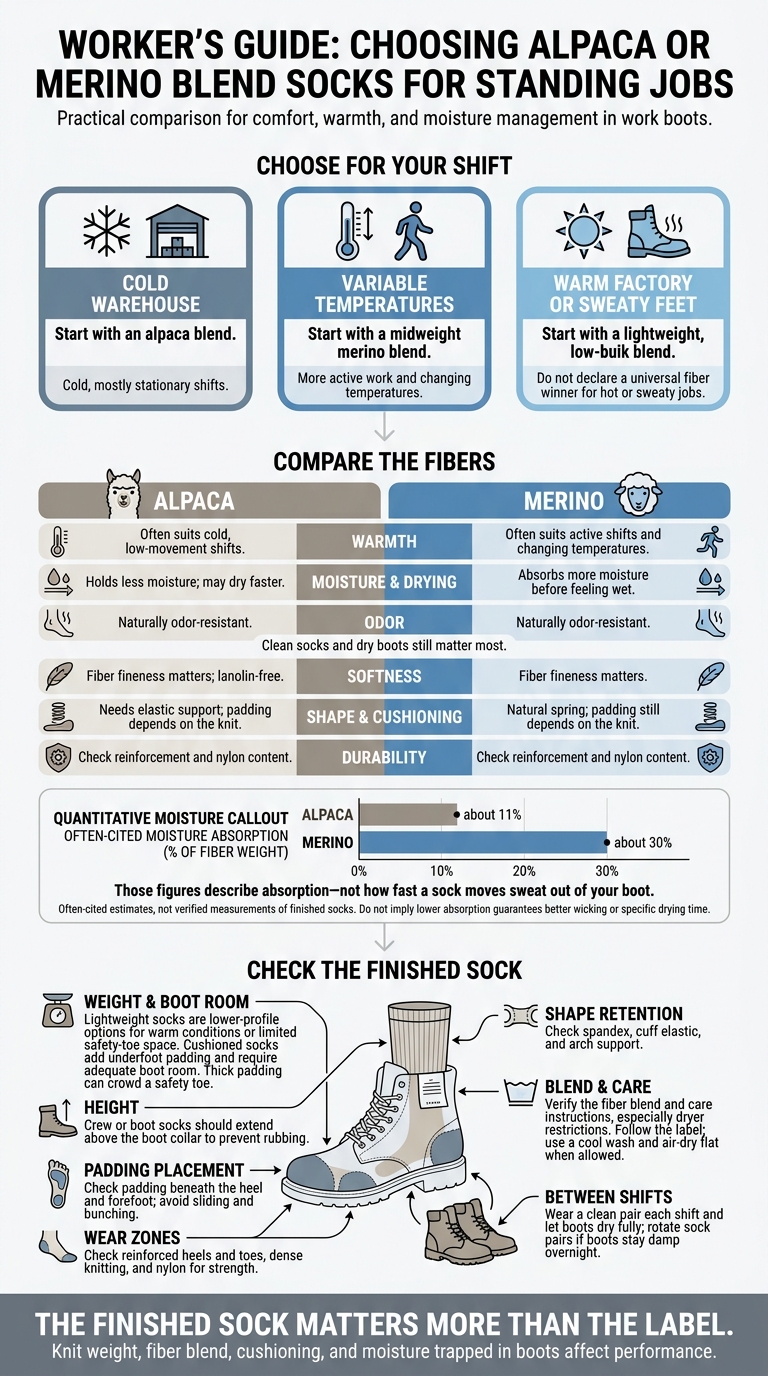
I’d start with an alpaca blend for cold, mostly stationary shifts and a merino blend for more active work. For hot or sweaty jobs, I’d choose a lightweight sock - and check that it leaves enough room inside your safety-toe boots.
My checklist goes beyond the fiber: warmth, sweat handling, drying, odor, softness, cushioning, shape retention, and heel-and-toe wear. The finished sock matters more than the label.
Quick Comparison
What I’d check
Alpaca
Merino
Warmth
Often suits cold, low-movement shifts
Often suits active shifts and changing temperatures
Moisture and drying
Holds less moisture; may dry faster
Absorbs more moisture before feeling wet
Odor
Naturally odor-resistant
Naturally odor-resistant
Softness
Fiber fineness matters; lanolin-free
Fiber fineness matters
Shape and cushioning
Needs elastic support; padding depends on the knit
Natural spring; padding still depends on the knit
Durability
Check reinforcement and nylon content
Check reinforcement and nylon content
Merino is often cited as absorbing about 30% of its weight in moisture, compared with about 11% for alpaca. Those figures describe absorption - not how fast a sock moves sweat out of your boot.
Before buying, I’d check <u>sock thickness, height, blend, reinforcement, and care instructions</u>. That applies to Suri Performance Alpaca Socks, too: choose the build that fits your shift, not just the fiber name.
Alpaca vs Merino Work Socks: Choose for Your Shift
Alpaca vs Merino: Warmth, Moisture, and Odor
Judge the finished sock, not just the fiber. The better choice depends on whether your shift is cold, sweaty, or mostly spent standing still. Knit weight, fiber blend, and moisture trapped in your boots all affect warmth, drying time, and odor control.
Performance factor
Alpaca
Merino
Workplace use
Cold-floor insulation
Air-filled fibers trap heat
Crimped fibers trap air between fibers
Best suited to standing still on cold concrete
Warm-facility comfort
Holds less moisture, staying lighter as sweat builds
Holds moisture without feeling clammy on heated lines
Holds less moisture and wicks faster through the knit
Absorbs moisture before feeling wet
Holding moisture and moving it are different functions
Drying
Generally dries faster
Dries more slowly once saturated
Thick cushioning and damp boot liners slow both fibers
Odor resistance
Naturally odor-resistant; may have a slight edge because it holds less moisture
Naturally odor-resistant
Clean socks and dry boots still matter most
Warmth in Cold Warehouses and Heated Factories
Start with the temperature, then consider how much you sweat during a shift. Alpaca’s air-filled fibers trap heat, while merino’s crimp holds air between fibers. Alpaca-heavy socks often feel warmer when you’re standing still on cold warehouse floors.
Merino is a better fit for warmer, more active factory and line work because it buffers moisture. Alpaca, meanwhile, helps limit that damp, heavy feeling during sweaty shifts.
Sweat Absorption, Movement, and Drying
Absorbing sweat isn’t the same as moisture-wicking. Merino can absorb close to a third of its own weight in moisture before it feels wet. Alpaca is often cited at about 11%.
Inside work boots, merino stores more moisture in the fiber. Alpaca passes more through the knit and typically dries faster. But thick cushioning, synthetic blends, and moisture trapped inside safety-toe boots can change how either sock feels throughout your shift.
Odor Control and Between-Shift Care
Once you’ve addressed moisture, odor is the next difference to consider. Neither fiber’s odor resistance replaces good hygiene.
Wear a clean pair each shift and let your boots dry fully between uses. Rotate sock pairs if your boots stay damp overnight. Follow the sock’s washing instructions; for long, sweaty standing jobs, daily washing is the better routine.
sbb-itb-855989e
Alpaca vs Merino: Comfort and Durability
After warmth and moisture, fit and wear life help determine which sock holds up through a full shift standing on concrete.
Feature
Alpaca fiber tendency
Merino fiber tendency
Construction impact
Softness
Smooth feel; naturally lanolin-free
Fine fibers can feel soft
Finer micron counts matter more than the fiber label alone
Elasticity and shape retention
Less natural recovery; may sag without support
Crimp provides natural spring and recovery
Spandex, cuff elastic, arch support, and knit density limit sliding and bunching
Cushioning
Smooth, less springy feel
Springier feel from crimp
Underfoot padding and knit density determine cushioning
Abrasion resistance
Longer, stronger fibers may resist thinning
Fine fibers can pill or thin at friction points
Reinforced heels and toes matter more than fiber-only claims
Softness, Cushioning, and Safety-Toe Fit
During long standing shifts, softness helps only if the sock stays in place and leaves enough room in the toe box.
Check fineness, not just “alpaca” or “merino.” Finer fibers generally feel softer. Alpaca is also lanolin-free, which can help sensitive skin.
Look for a secure fit with padding beneath the heel and forefoot - and no bunching underfoot. Thick padding can crowd a steel or composite safety toe, causing pressure and restricting circulation. Choose cushioning that fits the toe box, rather than reaching for the thickest sock.
Reinforced wear zones, dense knitting, nylon for strength, and elastic support matter more than fiber percentage alone. Reinforcement and dense knitting help resist thinning where the sock rubs against the boot. Elastic support limits slipping during a standing shift.
Follow the care label, particularly its dryer restrictions. Use a cool wash and air-dry flat when the label allows it; heat and agitation can shrink or felt both fibers. If the sock remains loose or bunched after washing, its shape retention is failing.
Choosing Sock Weight, Height, and Work Features
Once you’ve compared fibers, choose the weight, height, and reinforcement that suit your boots and shift.
Lightweight vs Cushioned Work Socks
Match sock weight to heat during your shift, boot space, and how much you sweat - not just the fiber name. Even on a cold floor, heavy sweating calls for moisture management. Try the sock weight in your work boots before buying several pairs.
Lower-profile option when safety-toe space is limited
Choose only if boots have room for the added thickness
Underfoot padding
Little padding
More padding beneath the foot; check where it sits
Footwear fit
Useful in snug work shoes or boots
Useful in roomier boots, but won’t fix incorrect boot sizing
Next, check the height. Crew or boot socks should extend above the boot collar to prevent rubbing and provide coverage where the collar meets your leg.
Different boot models may call for different sock weights, even for the same job.
Before ordering, verify the fiber blend, cushioning placement, mesh zones, heel and toe reinforcement, size range, and care instructions.
Conclusion: Choose Socks for Your Shift
Choose socks based on your shift temperature, sweat level, and boot fit. Neither alpaca, wool, or cotton fiber makes up for socks that bunch or crowd your toes. For standing jobs, sock construction and boot fit often matter more than fiber alone.
Use the comparison above to narrow your options based on shift conditions and the space inside your boots:
Cold warehouse: Start with an alpaca blend.
Variable temperatures: Start with a midweight merino blend.
Warm factory or sweaty feet: Start with a lightweight, low-bulk blend.
For Suri Performance Alpaca Socks, choose a crew or boot style that suits your boot height and a build that fits your shift. Check for moisture-wicking, odor-resistant, and temperature-regulating properties, plus reinforcement for durability. Factor in your boot’s safety-toe room and your laundry routine, too.
FAQs
Should I change socks during a sweaty shift?
You generally don’t need to change socks during a shift when wearing Suri Performance Alpaca Socks. Alpaca fiber wicks moisture three times more effectively than cotton or wool and absorbs up to 30% of its weight without feeling damp.
By moving sweat away from your skin so it can evaporate, the fiber keeps your feet dry and comfortable through 12- to 14-hour shifts. That helps prevent the dampness that leads to blisters, odors, and discomfort.
Can alpaca or merino socks help prevent blisters?
Yes, alpaca socks can help prevent blisters by reducing moisture and friction. Alpaca fibers wick sweat away from your skin three times more effectively than cotton or wool. This helps keep feet dry and limits the skin softening that can lead to blisters.
Suri Performance Alpaca Socks also have dense cushioning at the heel and forefoot to reduce friction and keep feet more comfortable during long shifts on hard surfaces.
What fiber blend works best for long standing shifts?
For shifts that keep you on your feet, a blend of alpaca fiber, nylon, and spandex works best. Alpaca’s strong moisture-wicking and temperature-regulating properties help keep feet dry and comfortable through 8- to 14-hour shifts.
Pure alpaca may not have enough stretch to hold its shape. Nylon and spandex help socks keep their shape, resist abrasion, and deliver lasting cushioning that won’t flatten under the pressure of standing on hard surfaces like concrete.