"I liked saving money buying 4 pairs at a time and the socks are great for what I need. It's unbelievable how they could be made out of this material, yet they are so comfortable and they don't make my feet and legs itch nor do they make them hot or sweaty."
Rick S., Verified Customer
Alpaca vs Merino: Moisture-Wicking Fiber Test
Share
My take: choose by drying time and boot fit - not fiber name alone. Merino can absorb up to 30% of its dry weight in moisture, compared with about 8–11% for alpaca. That may help alpaca dry sooner, but absorption doesn’t tell you how well a sock moves sweat.
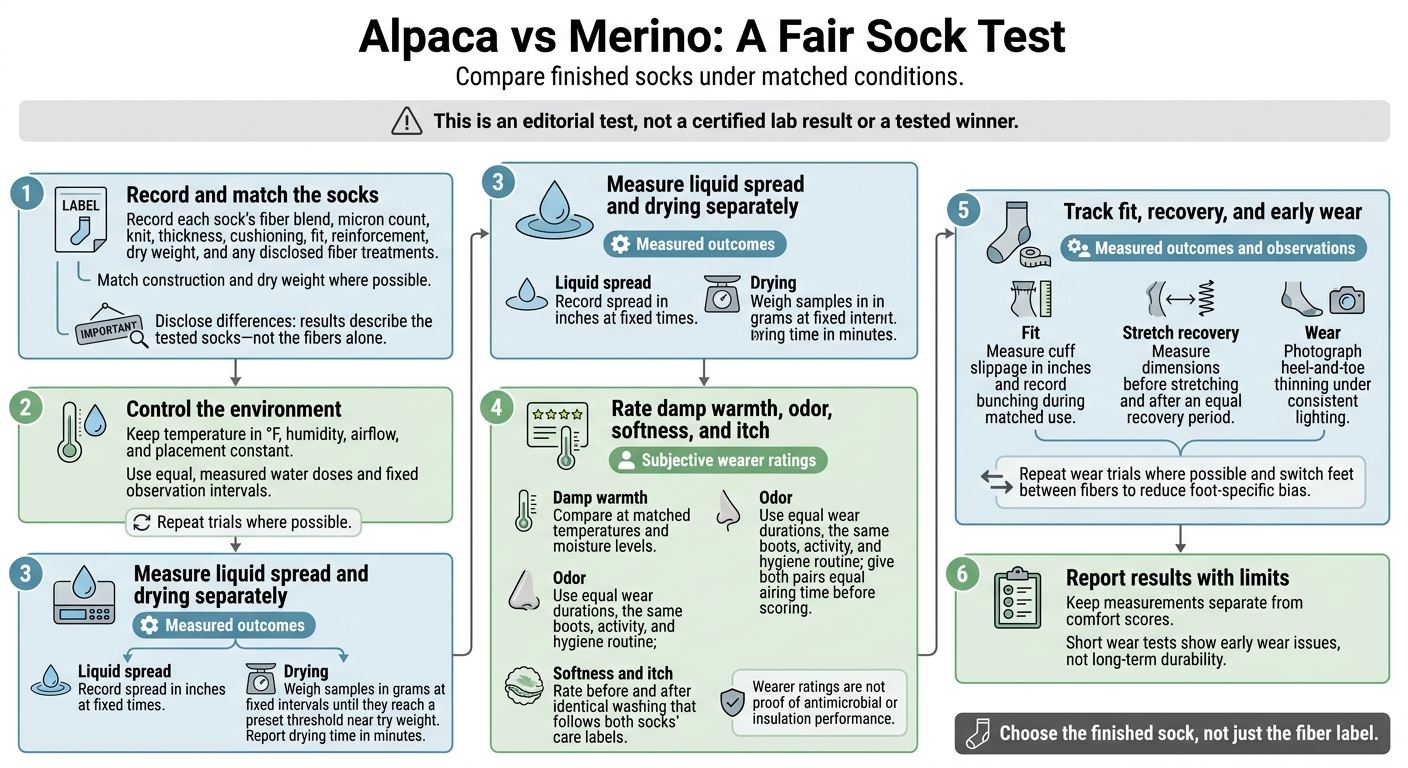
I’d compare both under matched conditions, checking moisture spread, drying, damp warmth, odor, softness, itch, fit, stretch recovery, and heel-and-toe wear. This is a test plan, not a tested winner.
Quick Comparison
What I’d check
Alpaca
Merino
Moisture spread
Depends on knit, thickness, and finish
Depends on knit, thickness, and finish
Absorption and drying
Holds less moisture; may dry sooner
Holds more moisture; may take longer to dry
Damp warmth
Worth considering for cold sits
Worth considering for active use
Odor
Generally low odor buildup
Generally low odor buildup
Softness and itch
Fiber diameter and finish matter
Fiber diameter and finish matter
Fit and stretch recovery
Relies more on blend and construction
Natural crimp helps shape recovery
Heel-and-toe wear
Check reinforcement and knit density
Check reinforcement and knit density
For hiking, I’d weigh drying against warmth. For hunting, I’d carry a dry pair for the sit. For work, I’d check cushioning, cuff slip, and reinforcement in my boots. Heavy-duty ultra boot socks are often the best choice for these high-impact environments. <u>The finished sock matters more than the label.</u>
Test Plan: Compare Socks Under Matched Conditions
Alpaca vs Merino: A Fair Sock Test
Test alpaca and merino socks under matched conditions. This is an editorial test, not a certified lab result. Record each sock’s fiber blend, micron count, knit, thickness, cushioning, fit, reinforcement, and dry weight, along with any disclosed fiber treatments.
Match construction and dry weight where possible. Disclose any differences so the results describe the tested socks - not the fibers alone. These controls help separate fiber behavior from sock design.
Measure Liquid Spread and Drying Time
Apply equal, measured doses of water. Record the spread in inches at fixed times, then weigh samples in grams at fixed intervals until they reach a preset threshold near their dry weight. Report drying time in minutes.
Keep temperature in °F, humidity, airflow, and placement constant. Repeat trials where possible.
Rate Damp Warmth, Odor, and Softness
Compare damp warmth at matched temperatures and moisture levels. Assess odor after equal wear durations using the same boot socks, activity, and hygiene routine. Give each pair equal airing time before scoring.
Rate softness and itch before and after identical washing that follows both socks’ care labels. Label these findings as subjective wearer ratings, not proof of antimicrobial or insulation performance.
Track Fit, Stretch Recovery, and Wear
Measure cuff slippage in inches and record bunching during matched use. Measure dimensions before stretching and after an equal recovery period. Photograph heel-and-toe thinning under consistent lighting.
Repeat wear trials where possible, and switch feet between fibers to reduce foot-specific bias. Keep measurements separate from comfort scores. Short wear tests show early wear issues, not long-term durability.
sbb-itb-855989e
Alpaca vs Merino: Fiber Traits and Sock Performance
These notes compare fiber traits - not measured results or a tested winner. Blend percentages, thickness, knit density, and reinforcement can change how either fiber performs inside a boot. Use these traits to choose socks for long hikes, cold sits, or hard boot wear.
Liquid Spread, Drying Time, and Damp Warmth
Merino absorbs more moisture into the fiber. Alpaca holds less and tends to shed moisture at the surface. But wicking depends more on knit, thickness, and finish than on fiber alone.
For sweat control, focus on drying time and warmth when damp.
Criterion
Alpaca evidence or observation
Merino evidence or observation
Practical meaning
How moisture moves
Moves moisture along the surface rather than into the core.
Absorbs moisture into the inner cortex.
Alpaca retains less moisture; merino buffers humidity better.
Drying time
Holds less water, so it should dry faster overall.
Holds more water, so it can take longer to dry.
Total drying time depends on how much water the sock retains.
Damp warmth
Air-filled fibers help hold warmth when damp.
Can release warmth as it absorbs moisture, but may lose loft when saturated.
Both can feel warm when damp; thickness and moisture level affect the comparison.
Odor Retention, Softness, and Itch
Both fibers limit odor during repeated wear. Alpaca may feel less damp between wears in high-sweat use because it retains less moisture, though odor control is similar overall.
Criterion
Alpaca evidence or observation
Merino evidence or observation
Practical meaning
Odor retention
Low odor buildup; lower moisture retention can help it feel less damp between wears.
Low odor buildup during repeated wear.
Both work well for multi-day use.
Softness
Flatter scales often feel smoother.
Very fine diameters can feel soft.
Softness and itch depend more on diameter and finish than on fiber name.
Itch
Smoother scales can reduce prickle.
Fine fiber diameter can reduce itch.
Judge skin feel in the finished sock.
Fit, Stretch Recovery, and Abrasion
Merino’s natural crimp helps it spring back into shape. Alpaca is more prone to stretching out unless the sock’s blend and construction help it hold its shape.
Fiber strength isn't the same as sock wear life. Heel-and-toe durability depends on reinforcement and knit density, especially when the sock needs to stay snug inside a boot.
Criterion
Alpaca evidence or observation
Merino evidence or observation
Practical meaning
Fit
Depends on sizing and construction.
Depends on sizing and construction.
Neither fiber guarantees a secure fit.
Stretch recovery
Less natural crimp; blend construction matters.
Natural crimp supports recovery.
Merino usually holds its shape better in 100% constructions.
Abrasion
Higher tensile strength; smoother scales can reduce pilling.
More prone to pilling and thinning in high-friction zones.
Check heel and toe reinforcement first; fiber name alone does not predict service life.
Choose Socks for Hiking, Hunting, and Work
Use the test results to match each fiber to the task - and check how the finished sock fits your boots.
Hiking: Balance Warmth and Drying
For cold-weather hiking, alpaca blends offer more warmth with less bulk and dry faster once wet. For high-output hikes, merino or a light merino blend offers cooler wear and better shape retention.
Choose based on dry time, boot fit, and toe room, not just the fiber label.
Activity conditions
Performance priority
Suitable sock characteristics
Best fit
Evidence limits
Cold-weather hiking
Warmth when damp; drying time
Insulating knit, secure fit, enough toe room
Alpaca blend
Warmth and drying time still depend on the finished sock’s knit, thickness, and boot fit.
High-output hiking
Breathability; shape retention
Thin knit, supportive stretch, reinforced wear zones
Merino or light merino blend
Better shape retention does not automatically mean better moisture management.
Hunting: Manage Sweat Before Cold Sits
Carry a dry spare pair. Wear merino for the approach and alpaca for the sit.
Activity conditions
Performance priority
Suitable sock characteristics
Best fit
Evidence limits
Sitting still
Insulation without tight boots
Loft, cushioning, comfortable cuff, adequate toe room
Alpaca blend
Maximum warmth matters more than airflow when you’re sitting still.
Variable-activity hunting
Sweat control during approaches; warmth during sits
Blends vary by manufacturer, so test the finished sock in your boots.
Jobsites: Check Boot Fit and Reinforcement
Test both pairs in the same boots over the same shift. Track cuff slip, bunching, heel-and-toe wear, and dampness at the end of the shift. Score odor separately from dampness.
Activity conditions
Performance priority
Suitable sock characteristics
Best fit
Evidence limits
Cold job sites
Warmth; wear resistance
Boot-height coverage, secure cuff, reinforced heel and toe, room for insulation
Alpaca blend
Reinforcement and fit matter as much as fiber choice.
Mixed indoor/outdoor shifts
Temperature balance; stable fit; less dampness
Lighter cushioning, supportive cuff, ventilation where specified
Merino or high-merino blend
Better stretch recovery helps prevent sagging as activity levels change.
A sock that spreads sweat quickly may not dry first. Compare liquid spread and drying time separately.
Rate warmth when damp, odor, softness, stretch recovery, and wear separately, too. Softness doesn’t predict stretch recovery. At the heel and toe, abrasion resistance often depends more on reinforcement and knit density than on fiber type alone.
Choose the finished sock, not just the fiber label. The blend, knit, thickness, reinforcement, and fit matter more than fiber alone.
FAQs
How can I test sock drying time at home?
Weigh your dry socks to get a baseline weight. Then submerge them in water until fully soaked. Run them through your washing machine’s rinse-and-spin cycle to remove excess water, and weigh them again. The difference between the two weights is the amount of water the socks are holding.
Lay the socks flat on a drying rack or clean towel to air dry. Record how long it takes for them to return to their original dry weight.
What fiber blend is best for sweaty feet?
The best fiber blend depends on what you’re doing and the conditions around you. Merino wool is often the go-to for intense hiking or running. It absorbs moisture vapor, helping the surface feel dry longer.
Alpaca absorbs less water and dries faster. That makes it a better choice for a drier feel during lower-exertion tasks, long work shifts, or cold-weather use.
Blends of alpaca, merino, and nylon balance moisture management with better durability.
Can washing affect moisture-wicking performance?
Washing doesn’t reduce alpaca fiber’s moisture-wicking performance.Suri Performance Alpaca Socks are designed to hold their shape and keep performing through repeated wear and washing. Alpaca fiber is also durable, resisting degradation and pilling even with frequent laundering.