"I liked saving money buying 4 pairs at a time and the socks are great for what I need. It's unbelievable how they could be made out of this material, yet they are so comfortable and they don't make my feet and legs itch nor do they make them hot or sweaty."
Rick S., Verified Customer
Alpaca vs Merino Hunting Socks: Heat Control
Share
If I hike hard, I pick merino. If I sit in deep cold, I pick alpaca. That’s the short answer.
Here’s the whole call in plain terms:
Alpaca runs warmer and can be about 30% warmer per weight than merino.
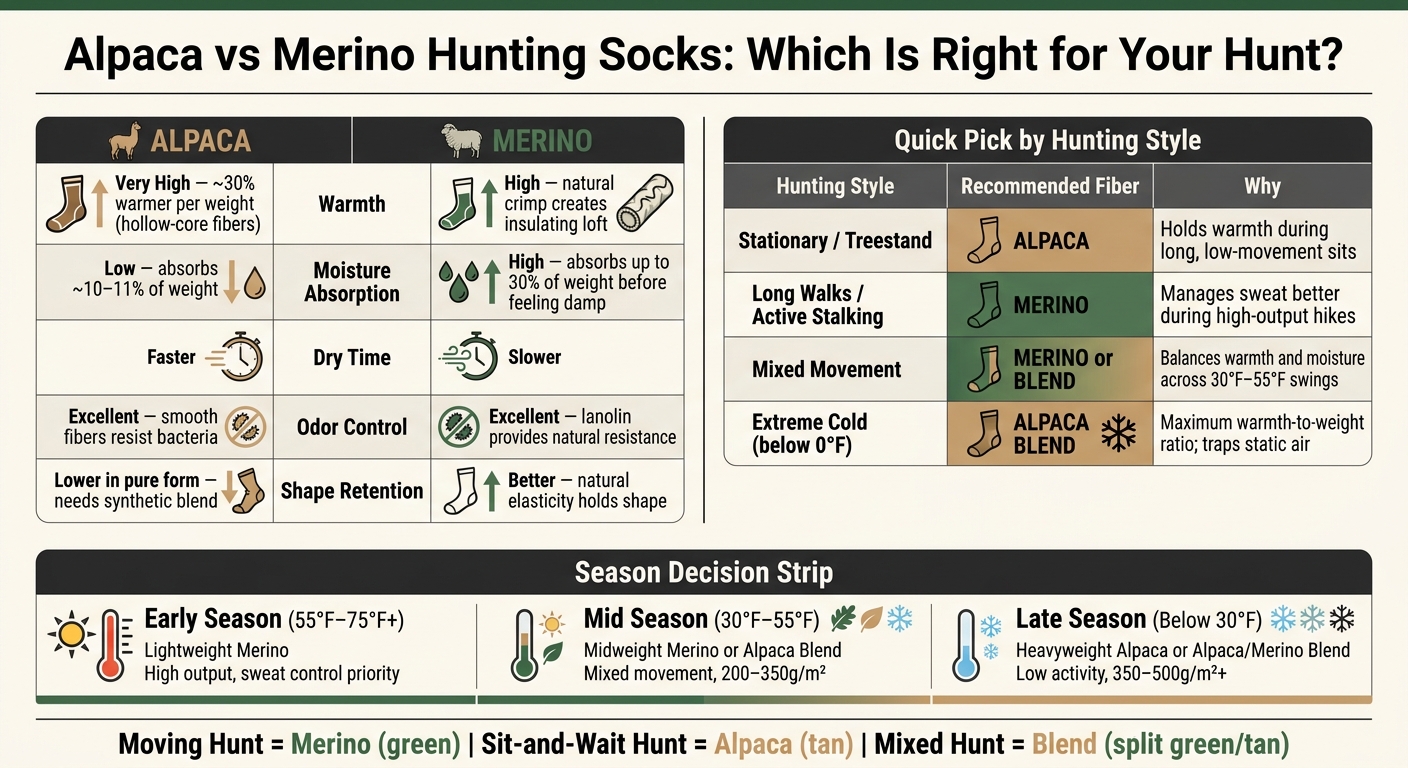
Alpaca vs Merino Hunting Socks: Which Is Right for Your Hunt?
Warmest Hunting Socks TEST | Merino, Alpaca, Electric Heated
sbb-itb-855989e
Quick Comparison
Criteria
Alpaca
Merino
Warmth
Higher
High
Sweat handling
Lower
Better
Dry time
Faster
Slower
Odor control
Strong
Strong
Shape retention
Lower in pure form
Better
Best use
Cold sits, blinds, treestands
Hiking, stalking, mixed movement
What matters most is heat control, not just warmth. I want a sock that keeps my feet warm after the walk in, not one that leaves them cold once sweat cools off. That’s why the best pick comes down to temperature, effort level, and boot fit.
Alpaca vs Merino: Side-by-Side Overview
Alpaca, wool, and cotton handle heat differently. Alpaca is warmer, while merino does a better job with sweat. You’ll notice that most in warmth, moisture handling, and how the sock feels after hours on your feet.
That gap matters even more when a hunt goes from steady hiking to long stretches of standing still. A sock that feels fine on the move can feel very different once your pace drops and the cold starts creeping in.
Feature
Alpaca
Merino
Warmth
Very warm - hollow fibers trap more air
High - natural crimp creates insulating loft
Moisture Handling
Absorbs only about 10–11% of its weight and dries faster
Absorbs up to 30% of its weight before feeling damp
Odor Control
Excellent - naturally antimicrobial
Excellent - natural odor resistance
Dry Time
Faster
Slower
Comfort & Fit
Soft, plush, and better for sensitive skin; may need a blended knit to hold shape
Soft, snug, and better at keeping its shape
You can see the tradeoff more clearly when you match each fiber to the way you hunt. That’s where the choice gets a lot easier.
Quick Pick by Hunting Style
Start with hunting style, then factor in season. That simple approach usually gets you to the right pick faster.
Hunting Style
Recommended Fiber
Why
Stationary / Treestand
Alpaca
Holds warmth during long, low-movement sits
Long Walks / Active Stalking
Merino
Manages sweat better during high-output hikes
Mixed Movement
Merino
Balances warmth and moisture handling across swings from 30°F to 55°F
Extreme Cold (below 0°F)
Alpaca Blend
Maximum warmth-to-weight ratio; traps more static air
How Each Fiber Performs in the Field
Warmth and Moisture Movement
In the field, these fibers shine in different moments. Merino does better when you're moving and sweating. Alpaca does better when you're sitting still in the cold.
Alpaca’s hollow-core fibers hold more air inside each strand, which makes it roughly 30% warmer than merino at the same weight. Merino keeps you warm in a different way. Its natural crimp creates tiny air spaces between fibers, so it still insulates well, just with less warmth per ounce.
That difference shows up fast on the hike in. Merino can absorb up to 30% of its dry weight in moisture before it starts to feel damp. That makes it a better pick for steep climbs, long approaches, and active stalks. Alpaca absorbs only about 10–11%, so it doesn’t handle heavy sweat as well during high-output movement.
Put simply:
Use alpaca for cold sits
Use merino for hard hikes and heavy sweat
That tradeoff gets clearer as hunts move from early-season miles to late-season glassing and long, cold sits.
Odor Control, Dry Time, and Wet Performance
Warmth is only part of the story. Once sweat, snow, or creek water gets into your socks, fabric behavior matters a lot.
Both fibers resist odor well. Merino gets help from lanolin. Alpaca has smoother fibers, which gives odor-causing bacteria less to grab onto.
Where alpaca stands out is dry time. It dries faster after sweat, snow, or a creek crossing, which can make a big difference on cold hunts. Both fibers also keep insulating when wet, unlike cotton. Alpaca has a slight edge in deep cold because its hollow-core fibers keep trapping heat even when damp.
So the split is pretty clear. For creek crossings or wet-weather hunts, alpaca dries faster and keeps more warmth when soaked. For long stalks with heavy sweat, merino manages moisture better at the skin level.
Cushion, Fit, and Boot Comfort
Underfoot, alpaca and merino feel different too. Alpaca feels plush and dense, which helps with pressure relief during long treestand sits. Merino feels springier, which can feel better over rough miles when your feet keep taking a beating. Still hunts and all-day hikes ask for different things.
Fit is where the gap becomes more practical. Merino’s natural elasticity helps it stay put and hold shape against your foot. Alpaca fibers are straighter and less elastic, so a pure alpaca sock can stretch out over long miles. If it doesn’t have synthetic support, it can move inside the boot and cause blisters. That’s why a nylon/spandex blend is a must in an alpaca hunting boot sock.
A seamless or hand-linked toe is also worth checking before you buy. It removes the ridge that can rub on downhill treks. And if your boots already fit snug, don’t go too heavy on sock thickness. When fibers get crushed, they lose insulation and can limit circulation, which leaves your feet colder.
Merino holds shape better over long miles and can help cut blister risk during active hunts. Alpaca gives more pressure relief for stationary sits, but it works best in a well-made blend with synthetic support fibers.
Next, match these traits to early-, mid-, and late-season hunts.
Best Sock Choice by Hunting Season
Start with effort level, then look at temperature.
Use early-, mid-, and late-season conditions as your filter. From there, choose the sock weight that fits how hard you'll be moving and how long you'll be sitting.
Season
Temp Range
Activity Level
Best Fiber
Sock Weight
Early Season
55°F – 75°F+
High output (hiking, stalking)
Lightweight Merino
50–200g/m²
Mid Season
30°F – 55°F
Mixed (walk-in + sit)
Midweight Merino or Alpaca Blend
200–350g/m²
Late Season
Below 30°F
Low (treestand, blind)
Heavyweight Alpaca or Alpaca/Merino Blend
350–500g/m²+
Early Season: Staying Cool and Managing Sweat
When temps stay above 55°F, sweat control matters more than extra insulation. On high-output hunts like hiking and stalking, lightweight merino is the better choice. It handles heavy sweat well and helps your feet avoid that clammy, sticky feeling during long approaches and steep climbs.
Mid Season: One Sock for Cold Mornings and Warm Afternoons
Mid-season hunts are often the trickiest because you're dealing with both movement and stillness. You might hike in cold air, warm up fast, then sit for a while. That's why a midweight performance crew socks in the 200–350g/m² range works so well. It gives you a solid middle ground between warmth and breathability.
Merino also keeps insulating when damp, which matters if your walk-in leaves your feet sweaty before you settle into a sit.
If you're planning a longer stationary stretch, an alpaca or alpaca-merino blend can make more sense. Just watch the fit. If the sock gets too thick for the boot, it can crush the loft and cut down circulation, which works against warmth.
Late Season: Keeping Feet Warm During Long Sits
When movement drops, insulation starts to matter more than breathability.
Once temps fall below 30°F, warmth becomes the main goal, especially for long sits in a treestand or blind. For low-activity hunting, a heavyweight alpaca or alpaca-merino blend in the 350–500g/m² range is the best match.
If you hike in hard, bring a dry heavy pair and swap socks before the sit.
That tradeoff is what makes the final choice.
Conclusion: Alpaca or Merino - Which Sock Fits Your Hunt
After early-, mid-, and late-season conditions, the last thing to weigh is effort level. Pick based on how you hunt: if you’re moving, lean merino. If you’re sitting for long stretches, lean alpaca.
For high-output hunts, merino does a better job with sweat. It can absorb up to 30% of its weight in moisture before it starts to feel damp. That makes it a strong pick when you’re hiking, climbing, or covering ground.
For low-movement sits in deep cold, alpaca has the edge on warmth. Its hollow-core fibers provide about 30% more insulation per gram, and it absorbs only about 10%–11% of its weight in moisture, so it dries faster. Both fibers also do a good job fighting odor.
So the pattern is pretty simple: early season tends to favor merino, late season tends to favor alpaca, and mid season depends on how much you move.
That same rule fits most hunts. Movement leans toward moisture control. Stillness leans toward warmth.
If alpaca sounds like the better fit for your colder hunts, one option is Suri Performance Alpaca Socks, which offers moisture-wicking, odor-resistant, thermo-regulating boot and crew socks made for outdoor use.
Pick for your pace, your season, and your boot fit.
FAQs
How do I choose sock thickness for my boots?
Choose sock thickness based on boot fit, not just warmth. The goal is to match sock weight to your boot’s internal volume.
If you stuff a heavyweight sock into a snug boot, the sock can compress insulation and restrict blood flow. That can leave your feet colder, not warmer.
On the flip side, a thin sock in a roomy boot can let heat escape. It can also lead to foot slide and blisters.
For active hunts or close-fitting boots, start with a lighter sock. Save thicker socks for late-season hunts only if your boots have enough room.
Are alpaca-merino blends better for mixed hunts?
Yes. Alpaca-merino blends are a strong pick for mixed hunts because they pair alpaca’s warmth and softness with merino’s moisture-wicking ability and stretch.
That mix works well when temperatures shift and your activity level changes. It helps keep you comfortable, cuts down on odor, and adds blister protection whether you’re sitting still or on the move.
Should I change socks before a long cold sit?
Yes - if a long, cold sit comes after a warm or sweaty walk-in, change your socks or swap a thin liner for a warmer outer sock so sweat doesn’t leave your feet cold.
A thin liner can help move moisture off your skin during the hike. Then, once you stop and settle in, switch to a thicker, warmer sock for the sit.
On a multi-day hunt, bring at least two pairs and rotate them. Let one pair air-dry while you wear the other.