"I liked saving money buying 4 pairs at a time and the socks are great for what I need. It's unbelievable how they could be made out of this material, yet they are so comfortable and they don't make my feet and legs itch nor do they make them hot or sweaty."
Rick S., Verified Customer
Alpaca vs Merino for Extreme Weather
Share
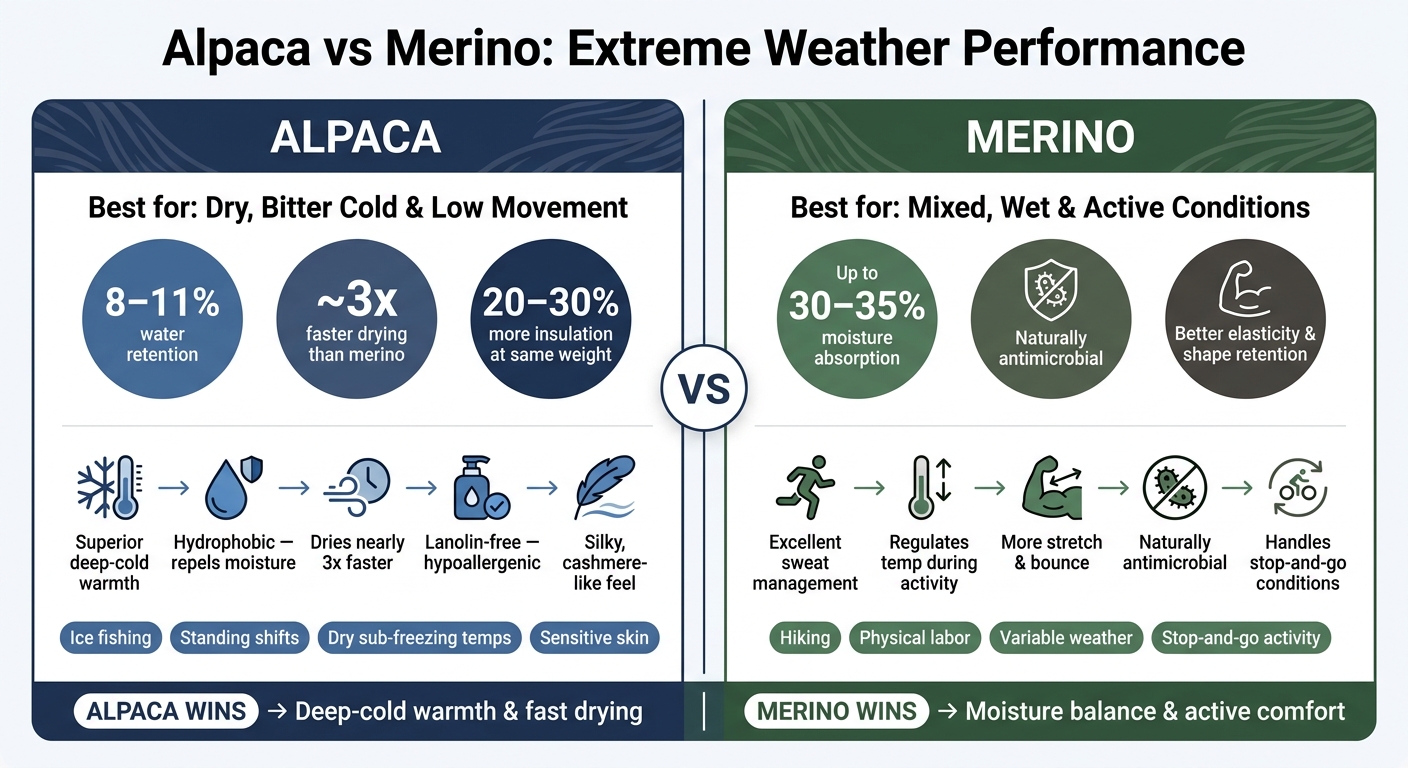
If I need one short answer, it’s this: alpaca is better for deep, dry cold, while merino is better for active days with sweat, slush, and weather swings.
Here’s the plain breakdown:
Alpaca runs warmer in low-movement cold because its fibers trap more air.
Alpaca dries faster and holds less water: about 8%–11% of its weight.
Merino fits active wear well because it has more stretch and bounce.
Alpaca feels smoother and is lanolin-free, which can help if your skin gets irritated by wool.
So if I’m standing outside in single-digit °F weather, I’d lean alpaca. (For these conditions, I recommend ultra boot socks for maximum warmth.) If I’m hiking, working, or moving in wet, cold, stop-and-go conditions, I’d lean merino.
Alpaca vs Merino Wool: Which Is Better for Extreme Weather?
Warmest Hunting Socks TEST | Merino, Alpaca, Electric Heated
sbb-itb-855989e
Quick Comparison
Criteria
Alpaca
Merino
Warmth in deep cold
Better
Good
Moisture handling during activity
Good
Better
Water retention
8%–11%
30%–35%
Drying time
Faster
Slower
Feel on skin
Smoother, lanolin-free
Soft, but contains lanolin
Best use
Dry, bitter cold; low movement
Mixed weather; active wear
Bottom line:alpaca wins on warmth and drying, while merino wins on sweat balance and active comfort. That’s the main tradeoff I’d want to know before buying performance crew socks or base layers for winter.
How alpaca and merino perform in cold weather
Alpaca and merino hold heat in different ways. That difference goes a long way in showing where each one shines.
Alpaca fiber structure and insulation in deep cold
Alpaca fibers have a hollow or semi-hollow core, which lets each fiber trap air inside. They also hold air between fibers. That two-part setup helps alpaca keep in heat, which is why it tends to do so well in extreme cold. In deep cold, alpaca can deliver more warmth without adding as much bulk.
This is where alpaca often stands out during low-output use, like hunting or long shifts outside, where performance alpaca socks provide consistent warmth. It also takes in less water, so it stays lighter when conditions get damp. That edge matters most when the cold is steady and you’re not moving much.
Merino fiber structure and temperature balance
Merino doesn’t have a hollow core. Instead, it depends on its natural crimp, or built-in waviness, to form tiny air pockets that hold heat. Where merino stands apart is moisture handling: it can absorb up to 35% of its own weight in moisture before it feels damp on your skin. As it takes in moisture, it also gives off a small amount of heat, which can help keep you warm as your activity level shifts.
That makes merino a strong pick for stop-and-go days, when sweat control and temperature balance matter most. Once your effort rises and falls through the day, that balance starts to matter a lot more.
Head-to-head performance in cold, damp, and long-wear use
These differences show up most when socks get wet, packed down, and worn for hours.
Warmth in extreme cold
Alpaca fibers have a hollow core, so they hold more air and keep heat in better in deep cold. That edge matters most when you're not moving much, like standing outside for hours.
Feature
Alpaca
Merino
Insulation mechanism
Hollow core traps air
Natural crimp creates air pockets
Warmth-to-weight
High - about 20–30% more insulation than merino at the same weight
Moderate to high
Bulk needed for warmth
Low
Moderate
Best fit
Very cold, mostly stationary use
Mixed conditions and stop-and-go wear
But warmth isn't the whole game, and comparing cotton, wool, and alpaca shows that moisture often makes or breaks comfort. Over a full day, moisture often makes or breaks comfort.
Moisture movement and drying time
Merino does a good job with sweat during hard movement, but once it's soaked, it takes longer to dry. Alpaca holds only about 8–11% of its weight in moisture, while merino can hold up to 30–35%. It also evaporates moisture at nearly three times the rate.
That has a clear payoff in daily use. After a long shift or a wet stretch on the trail, alpaca socks dry faster, which helps feet stay warmer as time goes on.
Feature
Alpaca
Merino
Moisture handling
Hydrophobic - repels water
Moisture-absorbing - takes in vapor
Water retention
~8–11% of weight
Up to 30–35% of weight
Drying speed
Nearly 3x faster than merino
Slower
Feel when wet
Stays lighter and drier
Can feel heavy or clammy
Once sweat gets involved, drying speed becomes a big deal.
Odor control, softness, and comfort over long wear
For long wear, comfort and odor control matter just as much as warmth. Merino is naturally antimicrobial. Alpaca stays fresh mostly because it doesn't hang onto much moisture.
Alpaca also feels smoother against the skin. Its flatter fiber scales give it a silky, cashmere-like feel. And because it's lanolin-free, it's often a better pick for people with sensitive skin or a wool sensitivity.
Feature
Alpaca
Merino
Odor resistance
Excellent - low moisture helps limit odor buildup
Excellent - naturally antimicrobial
Softness
Silky and cashmere-like
Very soft
Itch potential
Very low - lanolin-free
Low - contains lanolin
Long-wear comfort
High - stays dry and light
High - but can feel damp if saturated
For socks, blends with merino, nylon, or spandex help alpaca keep its shape through a full day in boots.
Those tradeoffs make the best-use breakdown below pretty clear.
Which fiber to choose by weather condition
Those tradeoffs come down to two plain rules: alpaca for deep, dry cold and merino for active, damp weather.
Choose alpaca for very cold, mostly dry weather
For very cold, mostly dry weather, alpaca is the better pick. It works well for long shifts spent standing outside or for ice fishing, where warmth matters more than constant sweat control. Alpaca delivers about 20–30% more thermal insulation than merino at the same weight.
It also takes in less moisture, so it tends to stay lighter and dry out faster after damp exposure. That can make a big difference when the air is cold and you don't want wet fabric sitting against your skin.
Choose merino for mixed, damp, and stop-and-go weather
When your day flips between movement and rest, merino usually handles that shift better. It's a strong fit for conditions where your effort level rises and falls, because it helps smooth out changes in moisture and temperature. Merino can absorb up to 35% of its weight in moisture before it feels wet on your skin. That helps during the awkward stretch between working hard and then standing still.
Merino also has more natural crimp, which gives it better elasticity and shape retention during active movement. Put simply, it tends to hold its fit better during a long day. That's a big deal for hiking socks or work socks that need to stay snug hour after hour.
Use this quick guide to match the fiber to the forecast.
Condition
Better Choice
Key Reason
Sub-freezing temps, low movement
Alpaca
Higher insulation; stays lighter when damp
Active hiking or physical labor
Merino
Buffers moisture during effort
Wet, cold conditions
Alpaca
Dries faster; absorbs less water
Stop-and-go activity in variable weather
Merino
Manages sweat-to-chill transition
Sensitive skin or lanolin sensitivity
Alpaca
Lanolin-free and hypoallergenic
Conclusion: Matching the fiber to your conditions
For most readers, the choice is pretty simple:
Choose alpaca ankle socks for sub-freezing, mostly dry conditions and low-output wear. It stays warm in deep cold and dries fast after brief damp exposure. It’s also the better pick for anyone with sensitive skin, since it’s naturally lanolin-free.
Choose merino for mixed, damp, stop-and-go weather. It deals with sweat swings better and keeps its fit during active wear.
Put simply, alpaca wins on deep-cold warmth. Merino wins on moisture balance.
For extended wear when washing isn’t practical, alpaca has a slight edge. It repels moisture instead of absorbing it, which helps it stay fresher longer during multi-day use in dry cold.
Match the fiber to your conditions, and either one will hold up through a hard day outside.
FAQs
Is alpaca too warm for hiking?
No. Alpaca’s hollow-core fibers work like a passive thermostat. They trap warmth when it’s cold, then let air move through and release extra heat as temperatures go up.
It also wicks moisture, which helps sweat evaporate fast and keeps your feet drier and more comfortable during hard hikes and long days on the trail.
Which fiber is better when socks get soaked?
Alpaca is usually the better pick when socks get soaked. It’s naturally hydrophobic, which means it resists water instead of soaking it up.
Here’s the big difference: Merino can absorb up to 30% of its weight in water, while alpaca holds only about 8% to 11%. In plain English, that means alpaca socks tend to stay lighter, dry faster, and keep you warmer even when they’re wet.
Do alpaca socks hold their shape like merino?
Yes. Alpaca fiber is durable and holds its shape well. Its high tensile strength helps alpaca socks keep their shape and cushioning, even after repeated use and regular wear.
That means you get steady comfort, support, and performance over time. For long-term use and tough outdoor activities, alpaca socks are a solid choice.