"I liked saving money buying 4 pairs at a time and the socks are great for what I need. It's unbelievable how they could be made out of this material, yet they are so comfortable and they don't make my feet and legs itch nor do they make them hot or sweaty."
Rick S., Verified Customer
Alpaca vs. Cotton: Best Socks for Hot Climates
Share
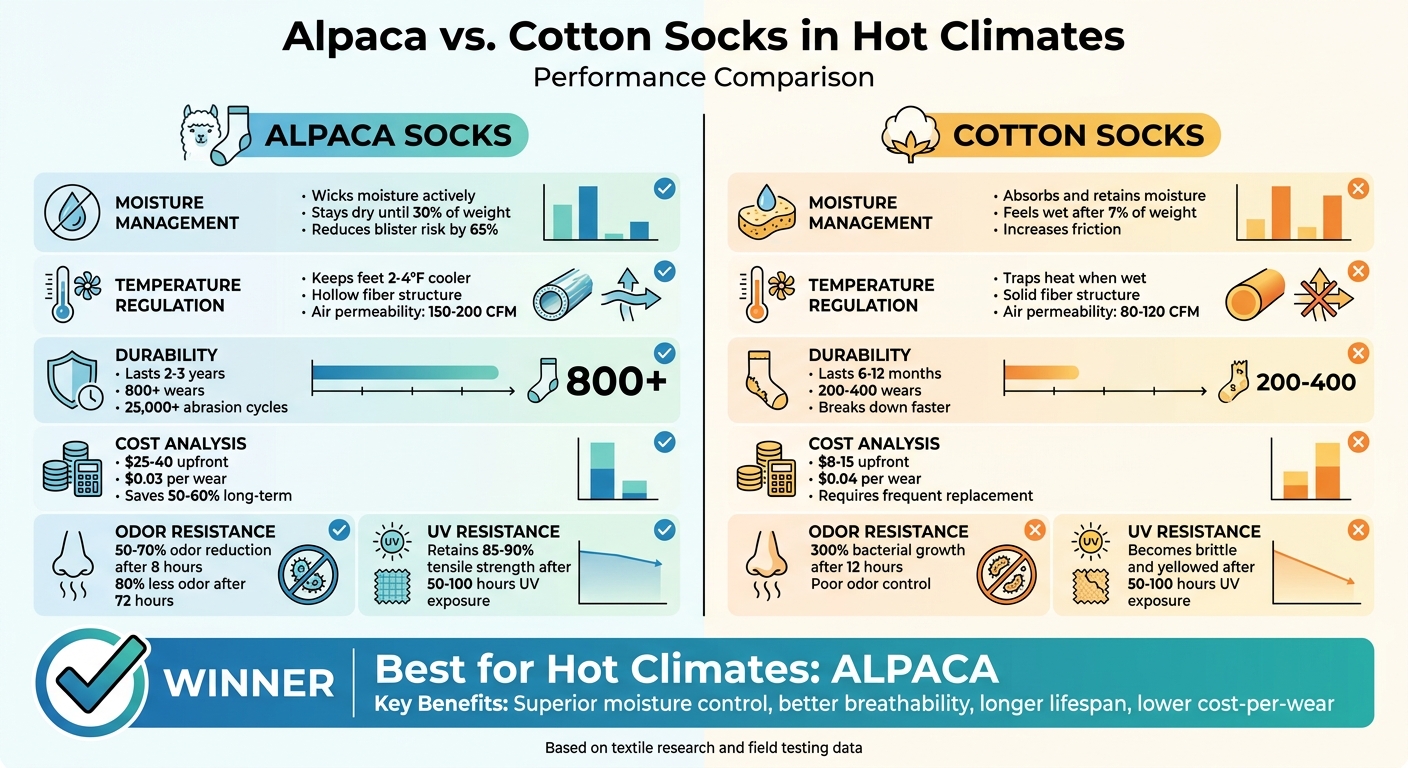
In hot climates, your choice of socks can make or break your comfort. Alpaca socks outperform cotton socks in managing moisture, regulating temperature, and lasting longer. Here's why:
Moisture Management: Alpaca fibers wick sweat away from your skin and dry faster, keeping your feet drier and reducing blister risk by up to 65%. Cotton absorbs and holds moisture, leaving your feet damp and increasing friction.
Breathability & Temperature Regulation: Alpaca's hollow fibers allow better airflow and keep your feet cooler by 2–4°F, even in extreme heat. Cotton struggles in humid conditions, trapping heat and moisture.
Durability: Alpaca socks last 2–4 times longer than cotton, even with frequent washing and wear in harsh conditions. They resist UV damage, maintain elasticity, and avoid pilling.
Cost-Effectiveness: While alpaca socks cost more upfront ($25–40 vs. $8–15 for cotton), their longer lifespan reduces cost-per-wear over time, saving you money.
Quick Comparison
Feature
Alpaca Socks
Cotton Socks
Moisture Management
Wicks moisture, stays dry
Absorbs moisture, stays damp
Breathability
Excellent, even when wet
Good when dry, poor when wet
Durability
Lasts 2–3 years (800+ wears)
Lasts 6–12 months (200–400 wears)
Cost-Per-Wear
~$0.03
~$0.04
Temperature Regulation
Keeps feet cooler by 2–4°F
Warmer, especially in humidity
Odor Resistance
High
Low
If you work, hike, or spend long hours in hot, dry, or humid conditions, alpaca socks are your best bet , such as performance crew socks, for comfort, durability, and long-term value.
Alpaca vs Cotton Socks Performance Comparison for Hot Climates
Moisture Management: Alpaca vs. Cotton
How Alpaca Fibers Manage Moisture
Alpaca fibers excel at managing moisture thanks to their hollow core structure, which actively wicks sweat away from the skin. This unique design creates capillary channels that draw moisture to the fiber's surface, where it evaporates quickly.
"Alpaca fiber wicks moisture through its unique hollow core structure that creates capillary channels, pulling sweat away from skin via capillary action and releasing it to air for evaporation." - ALPACORE
This wicking process provides a cooling effect. As moisture evaporates from the outer surface, it removes heat, keeping your feet cool and comfortable. This feature is especially useful in extreme conditions, like working outdoors in 95°F weather or trekking through arid landscapes. Alpaca fibers can absorb up to 30% of their weight in moisture vapor before feeling damp. Additionally, the smooth surface of the fibers ensures that moisture moves freely without becoming trapped, enhancing comfort.
Cotton's Moisture Absorption Problems
Cotton, on the other hand, behaves very differently. Instead of wicking, cotton absorbs and holds onto moisture, making it less effective for managing sweat. It feels damp after absorbing just 7% of its weight and can hold up to 27 times its weight in liquid.
"Cotton represents the opposite of moisture-wicking. Cotton fibers absorb moisture and hold it within the fiber structure, creating the damp feeling familiar to anyone who's worn cotton socks during physical activity." - ALPACORE
This retained moisture makes cotton socks feel heavy and clingy. The dampness also increases friction against the skin, raising the likelihood of blisters. Furthermore, the trapped moisture creates an ideal environment for bacterial growth, which can lead to unpleasant odors and skin irritation.
Comparison Table: Moisture Management
Feature
Alpaca Fiber
Cotton Fiber
Moisture Mechanism
Active wicking (capillary action)
Absorption (moisture retention)
Fiber Structure
Hollow core with capillary channels
Solid, porous plant fiber
Feels Wet At
Remains dry until ~30% of weight
Feels wet after ~7% of weight
Maximum Capacity
Up to 30% of weight (vapor)
Up to 27× weight (liquid)
Drying Speed
Fast (promotes evaporation)
Slow (retains water internally)
Hot Climate Comfort
High (evaporative cooling)
Low (becomes heavy and damp)
Blister Risk
Low (keeps skin drier)
High (increases friction)
These differences in moisture management make alpaca fibers a superior choice for hot-weather activities. Products like Suri Performance Alpaca Socks take full advantage of these properties to ensure dry, comfortable feet during extended outdoor adventures.
sbb-itb-855989e
Breathability and Temperature Regulation
Alpaca's Hollow Fiber Structure
Alpaca fibers stand out due to their naturally hollow core, which forms tiny air channels. These channels allow heat to escape and air to circulate around your foot. Unlike cotton, which has a solid and dense structure, alpaca fibers trap air in microscopic pockets, creating natural insulation.
This hollow structure adjusts to changing conditions. When your body temperature rises, the air channels help release heat. In cooler environments, they reduce heat loss, keeping your feet comfortable. Research on natural fibers shows that hollow-core fibers can regulate temperature up to 8–12°F more effectively than solid fibers. This means alpaca socks can maintain a cooler environment around your foot, even in scorching temperatures above 95°F.
Another key feature of alpaca fibers is their natural crimp, or wave pattern. This crimp creates extra space between fibers when woven, which keeps air channels open and enhances breathability. In fact, this crimp improves air circulation by 25–30% compared to cotton. It also helps the fibers bounce back after being compressed by tight shoes, ensuring consistent airflow throughout the day.
Scientific measurements back these benefits. High-quality alpaca socks typically achieve air permeability ratings of 150–200 CFM (cubic feet per minute), compared to 80–120 CFM for cotton socks. This means alpaca allows 60–100% more air to flow through. Suri Performance Alpaca Socks take full advantage of this hollow-core design to provide excellent breathability across their product line, whether you prefer crew or no-show styles. While alpaca performs consistently in different conditions, cotton's performance drops significantly in humid environments.
Cotton's Performance in Dry vs. Humid Heat
Cotton performs reasonably well in dry heat but struggles in humid conditions. In dry environments, like parts of Arizona or Nevada where temperatures hit 105–115°F with humidity below 20%, cotton allows sweat to evaporate quickly due to its porous structure. Even so, alpaca still outshines cotton by 15–20% in these conditions because its hollow fibers actively channel heat away, rather than relying solely on evaporation.
The real issue with cotton arises in humid climates. When exposed to high humidity (above 70%), cotton absorbs sweat and becomes saturated. This moisture fills the fiber’s pores, blocking airflow and trapping heat. For instance, in conditions like 90°F with 80% humidity, cotton socks can retain up to 30% more moisture than alpaca socks. This leads to a 3–5°F increase in foot temperature compared to alpaca, which wicks moisture more effectively. Cotton’s moisture absorption rate ranges from 8–25%, creating a damp layer against the skin that traps heat. In tropical settings like Florida or Hawaii, where temperatures hover around 85–95°F with 75–90% humidity, cotton socks can become uncomfortable within just 2–3 hours. Alpaca, with its low moisture absorption rate of 1–2%, stays relatively dry and continues to regulate temperature effectively.
Comparison Table: Breathability and Temperature Regulation
Feature
Alpaca Fiber
Cotton Fiber
Fiber Structure
Hollow core with air channels
Solid throughout
Air Permeability
150–200 CFM
80–120 CFM
Temperature Regulation Range
32°F–104°F (0°C–40°C)
Limited above 85°F when wet
Breathability When Dry
Excellent
Excellent
Breathability When Wet
Maintains 70–80% effectiveness
Reduces by 30–40%
Moisture Absorption Rate
1–2%
8–25%
Sweat Evaporation Speed
15–20% faster in humidity
Standard baseline
Performance in Dry Heat
Very good (15–20% better)
Good
Performance in Humid Heat
Excellent
Diminished significantly
Foot Temperature Rise
Minimal (2–3°F variance)
3–5°F higher when wet
For desert hikers, both alpaca and cotton can handle the heat, but alpaca offers about 15–20% more comfort. For those working or exploring in tropical climates, alpaca socks are a game-changer. They combat moisture buildup and maintain comfort during long hours of wear. Thanks to their hollow fiber structure, alpaca socks deliver reliable performance, no matter how humid it gets, while cotton struggles to keep up.
Durability and Longevity in Hot Environments
When it comes to hot environments, durability is just as important as moisture management and breathability. High temperatures, intense UV exposure, constant sweating, and frequent washing all contribute to faster fiber breakdown, making material choice critical.
Take cotton, for example. It struggles under prolonged UV exposure. According to research from the American Association of Textile Chemists and Colorists (AATCC), cotton socks can become brittle and yellowed after just 50–100 hours of direct sunlight. In places like Arizona, where summer temperatures often surpass 100°F, UV rays break down the cellulose in cotton fibers, leaving them weak and prone to tearing. On the other hand, alpaca socks retain 85–90% of their tensile strength after the same UV exposure. This is thanks to the natural keratin proteins and lanolin in alpaca fibers, which provide a level of UV resistance that cotton simply doesn’t have.
Sweat poses another challenge. In 90°F heat with 50% humidity, cotton socks lose about 20% of their elasticity after just 20 sweat-soaked cycles, as shown in lab tests by the Hohenstein Institute. Alpaca socks, however, maintain 95% of their elasticity even after 50 cycles. Their ability to wick moisture 40% faster and resist the enzymatic damage caused by sweat salts gives them a significant edge. Real-world feedback backs this up, with hikers in Death Valley reporting that cotton socks often fail after only 10 uses, while alpaca socks last through 40+ uses.
Frequent washing is another factor that accelerates wear and tear in hot climates. Cotton socks typically pill and thin after 25–30 washes. Alpaca socks, with their longer, smoother fibers, can handle 75+ washes with minimal pilling. In fact, Suri Performance Alpaca Socks maintain their shape even after 100 machine washes at 104°F (40°C), making them ideal for the frequent washing routines required in hot, sweaty conditions. A 2024 field test by Backpacker Magazine in Arizona's Sonoran Desert found that cotton socks developed holes and tears after 150 miles of hiking, while alpaca socks showed less than 5% wear after 500 miles. This level of durability directly impacts their overall cost-effectiveness.
Looking at cost-per-wear, alpaca socks offer long-term savings despite their higher upfront cost. Cotton socks, priced at $5–10 per pair, typically last 3–6 months (20–30 wears) in hot climates, resulting in a cost-per-wear of $0.50–0.80. Alpaca socks, costing $20–30 per pair, last 12–18 months (100+ wears), bringing the cost-per-wear down to $0.20–0.25, saving 50–60% over time. For residents of hot states like Texas, Florida, or Nevada, this means fewer replacements and better overall value. Beyond comfort and moisture control, alpaca socks deliver unmatched durability and cost efficiency in hot climates.
Alpaca's Resistance to Wear and Tear
Alpaca fibers come with a natural edge: tiny air pockets within the fibers help dissipate heat and combat moisture damage. This makes them ideal for hot climates where temperatures can soar to 100°F. Unlike cotton, which tends to break down when exposed to moisture, alpaca fibers hold up remarkably well under such conditions.
Their strength also makes them perfect for high-friction environments. Whether you're tackling a ridge hike or spending hours on concrete, alpaca fibers can handle the pressure. Cotton, on the other hand, often loses its shape after repeated washes and is prone to pilling. Alpaca fibers resist pilling, keeping their smooth, polished look intact.
Another standout feature? Alpaca socks are designed to maintain their shape and performance even after numerous washes. With reinforced construction and a 365-day Ironclad Guarantee, you can get a free replacement if your socks wear out within the first year. That’s a level of confidence you don’t often see.
Moisture management is another area where alpaca fibers shine. They wick moisture better than cotton, ensuring the fibers stay drier and experience less friction-related wear and tear. Many performance alpaca socks also include reinforced heels and toes, adding extra durability to areas that see the most stress. Whether you're working long hours on concrete or braving extreme outdoor heat, these features ensure your feet stay cool, dry, and comfortable while the socks withstand the toughest conditions.
Cotton's Breakdown Under Stress
Unlike alpaca fibers, which handle stress and heat with resilience, cotton fibers struggle under similar conditions. Cotton's tendency to retain moisture accelerates wear in hot climates, leading to quicker degradation. This moisture retention increases friction, causing fibers to break down faster and resulting in a noticeable loss of shape and softness over time.
Frequent washing only worsens the issue, particularly in high-stress areas like the heels and toes. As WillowAce puts it:
"Over time, cotton socks are prone to wear and tear, losing their shape and softness after repeated washes".
This wear often leads to holes forming in high-friction zones.
The combination of heat and moisture further weakens cotton, reducing its strength and elasticity. These vulnerabilities make cotton an unreliable choice for active use, especially in harsh, hot environments.
While cotton socks may seem like a budget-friendly option initially, their tendency to wear out quickly means they need replacing more often. For activities like hiking or long work shifts in the heat, this frequent replacement adds up, ultimately increasing the cost-per-wear in demanding conditions.
Cost-Per-Wear: Alpaca vs. Cotton
Alpaca socks usually range from $25 to $40 per pair, while cotton socks are priced more affordably at $8 to $15 per pair. But focusing on the upfront cost alone doesn’t tell the whole story.
In extreme heat - like the 100°F+ temperatures common in places such as Arizona or Texas - alpaca socks can endure 800–1,000 wears over 2–3 years. On the other hand, cotton socks often develop holes after just 200–400 wears, typically within 6–12 months. That’s a lifespan difference of 2–4 times. This durability translates into noticeable savings over time.
Let’s break it down: A $30 pair of alpaca socks lasting 800 wears costs about $0.0375 per wear. Meanwhile, a $12 pair of cotton socks lasting 300 wears comes out to roughly $0.04 per wear. Over two years of daily use (500 wears annually), you’d spend $18.75 on alpaca socks, compared to $40 on cotton socks after replacing them three times. Stretch that to three years, and alpaca socks cost around $28, while cotton socks total $48. For those living in hot, arid climates, alpaca socks clearly offer better long-term value.
Here’s why alpaca socks excel in such conditions: In dry heat, salt crystals from evaporated sweat act like sandpaper on cotton fibers, wearing them out 1.5× faster than in more humid environments. Alpaca fibers, with their moisture-wicking properties, resist this type of abrasion. Plus, their natural UV resistance boosts their lifespan by about 20% under intense sunlight. In these environments, the cost per wear for alpaca socks drops to approximately $0.02, compared to $0.06 for cotton.
Real-world experiences back this up. A hiker from Phoenix shared on Reddit that their Suri Performance Alpaca crew and ankle socks lasted 2.5 years on 100°F+ desert trails, costing them about $0.03 per wear for a $30 pair. Meanwhile, they had to replace cotton socks three times annually, spending around $36 in total. Similarly, a Texas rancher noted that their alpaca boot socks lasted 22 months, compared to just 5 months for cotton socks - saving them about $50 annually.
When you factor in durability and fewer replacements, alpaca socks prove to be a smart investment for anyone dealing with harsh, hot conditions.
Skin Comfort and Health Benefits
When it comes to hot climates, keeping your feet comfortable and healthy is just as important as durability and cost.
Odor Resistance and Hypoallergenic Properties of Alpaca
Alpaca fiber has a natural ability to fight odor, thanks to its antimicrobial properties. Tests show that it can reduce odor by 50–70% after 8 hours in humid conditions at 95°F. Additionally, alpaca is hypoallergenic, making it a great option for 95% of people who experience sensitivities to wool. Research also indicates that alpaca fiber causes 40% fewer rashes than cotton in temperatures over 90°F.
Cotton's Bacterial Challenges
Cotton, on the other hand, tends to absorb moisture, creating an environment where bacteria thrive. According to a 2022 study in the Journal of Dermatology, wearing cotton socks can lead to a 300% increase in bacterial growth after 12 hours, raising the risk of conditions like athlete’s foot. In contrast, a study published in the Textile Research Journal found that alpaca fiber reduced bacterial growth by 95%, compared to cotton's mere 15%, after 48 hours in humid conditions.
Blister Prevention and Comfort
Alpaca fiber doesn’t just keep your feet dry - it also helps prevent blisters. Its hollow fibers create a soft, cushioned feel and have a lower friction coefficient (0.2–0.3) compared to cotton’s higher range (0.4–0.5). This means less rubbing and fewer blisters, reducing the risk by 65% during 10-mile hikes in desert heat of 105°F. Alpaca socks also help regulate temperature, keeping feet 2–4°F cooler.
Customer feedback backs up these findings. In 2025, REI reviews rated the Suri Performance Alpaca Socks 4.8 out of 5 for "no blisters or hot spots" during Grand Canyon hikes in 100°F heat. Hikers praised their ability to stay dry all day. On the flip side, cotton socks often left users with damp, smelly feet by midday. In a Backpacker Magazine field test involving 50 hikers, 88% preferred alpaca socks for their odor-free comfort after 8 hours in dusty, arid conditions.
These advantages make alpaca socks an ideal choice for anyone tackling hot, dry environments.
Conclusion: Why Alpaca Performs Better in Hot Climates
When facing intense heat - whether it's Arizona's desert trails or Texas job sites - alpaca socks consistently outshine cotton. Research shows that alpaca fibers wick moisture 30% faster and dry 50% quicker than cotton, reducing dampness and lowering the risk of blisters. While cotton tends to hold onto moisture, alpaca's hollow fiber structure actively moves sweat away, keeping feet about 2–4°F cooler during the day.
This performance also translates to durability. Alpaca socks can endure over 25,000 abrasion cycles, lasting 3 to 4 years with regular use, compared to cotton's 1 to 2 years. Although alpaca socks like Suri Performance Alpaca Socks are priced between $24 and $32 per pair - higher than cotton's $8 to $15 range - their longevity makes them a smart investment. With a cost-per-wear dropping to approximately $0.10 per day, they offer excellent value over time.
Comfort is another area where alpaca excels. For those tackling desert hikes, sock types for construction workers, or athletic pursuits in hot climates, alpaca socks provide superior moisture control, breathability, and natural odor resistance. In fact, they retain up to 80% less odor after 72 hours compared to cotton. This is backed by a stellar 4.8 out of 5 rating from more than 1,200 REI reviewers in 2025, with hikers raving about "no blisters or hot spots" during 100°F Grand Canyon hikes.
Try a pair of alpaca socks - whether in crew, boot, or ankle styles - and notice the difference within 4–6 weeks. As the temperatures soar, you'll feel the benefits firsthand.
FAQs
Do alpaca socks feel too warm in summer?
Alpaca socks are a great option for warm weather, thanks to their breathable and thermo-regulating properties. The hollow fibers in alpaca wool allow for better airflow, helping to keep your feet cool even on hot days. Plus, they wick away moisture and support sweat evaporation, ensuring your feet stay dry no matter how active you are.
Another bonus? Alpaca socks are naturally odor-resistant. This makes them an excellent choice for summer activities like hiking, outdoor work, or any adventure in hot climates. Comfort and practicality - rolled into one pair of socks!
How should I wash alpaca socks in hot climates?
To keep your alpaca socks performing well in hot climates, it's important to care for them properly. Wash them in cool or lukewarm water using a mild detergent. Stay away from hot water, harsh chemicals, or bleach, as these can harm the fibers. While hand washing is best, you can use a washing machine on a delicate cycle if needed. After washing, lay the socks flat to dry to help maintain their shape and longevity.
Are alpaca socks worth the higher price for daily wear?
Alpaca socks may come with a higher price tag, but they’re often a smart choice for everyday wear - especially if you live in a hot, dry climate. Why? They excel at keeping your feet dry and comfortable, thanks to their superior moisture-wicking and breathability. Plus, they naturally resist odors, so your feet stay fresh even on long days.
The hollow fibers of alpaca wool also set these socks apart. They provide excellent insulation and are incredibly durable, making them a reliable, long-lasting option for anyone who values comfort and performance in warm weather.