"I liked saving money buying 4 pairs at a time and the socks are great for what I need. It's unbelievable how they could be made out of this material, yet they are so comfortable and they don't make my feet and legs itch nor do they make them hot or sweaty."
Rick S., Verified Customer
Alpaca Socks for Running and Training
Share
If your socks slide, trap sweat, or bunch up, your run can go bad fast. I’d keep it simple: pick alpaca socks with a snug fit, the right height, the right cushion level, and cold-water care.
Fit matters most: snug, not tight, so the sock stays in place and doesn’t rub.
Height changes the use case: no-show for hot days, ankle or mini-crew for daily training, crew for cold weather or trails.
Cushioning changes shoe fit: light for speed and heat, medium for most sessions, thick for long runs and more impact protection.
Build details matter: mesh zones, heel and toe reinforcement, arch hold, and a smooth toe area can help comfort and wear life.
Heat can ruin the fit: wash cold and air dry.
A few facts stand out from the article: alpaca fiber has a hollow center that helps with warmth without much bulk, and it tends to hold less moisture than merino, which may help cut down on blister risk during long sessions.
Quick Comparison
What to pick
Best use
What I’d watch for
No-show + light cushion
Hot weather, treadmill, racing flats
Heel rub; look for a heel tab
Ankle/mini-crew + medium cushion
Daily runs, mixed training, long sessions
Best all-around pick for most people
Crew + medium/thick cushion
Cold weather, trails, long miles
More bulk inside the shoe
If I were choosing one pair for mixed training, I’d start with ankle or mini-crew socks with medium cushioning. It’s the safest middle ground for comfort, fit, and day-to-day use.
sbb-itb-855989e
Why Alpaca Socks Work for Training
Moisture Control, Breathability, and Odor Resistance
Alpaca does a lot of the small things right during training. It wicks sweat, dries faster than cotton or wool, and helps feet stay fresher when sessions get hard. Its hollow core traps air for insulation while helping the skin stay drier at the same time. That dry, airy feel matters most when your pace picks up and heat starts building.
It also resists odor on its own, so socks stay fresher for longer. Alpaca’s smooth fibers give odor-causing bacteria less surface to build up on. Add keratin, which is naturally present in alpaca fiber, and you get more help against odor buildup.
Many performance alpaca socks also use micro-mesh venting zones across the top of the foot. These open panels let heat escape during high-intensity work.
Temperature Regulation in Hot and Cold Conditions
That same hollow core gives alpaca a high warmth-to-weight ratio. So your feet can stay warm on cold early-morning runs without the thick, bulky feel of a heavy sock. That balance is especially useful in shoulder-season weather, when the temperature can shift in the middle of a run.
In warmer conditions, alpaca’s breathable structure helps excess body heat escape and cuts down on that clammy feeling. And once temperature is under control, the next thing you notice is simple: how the sock feels inside the shoe.
Softness and Friction Reduction During Repetitive Movement
Comfort isn’t just about softness. It’s also about cutting down movement inside the shoe. Friction builds fast during running, rucking, or circuit training, and wet skin makes the problem worse. Alpaca’s smoother fiber surface creates less abrasion against the skin, which can help reduce hot spots during long or repetitive sessions.
A snug, low-bulk fit also helps stop sliding and bunching, which are two common causes of blisters.
How to Choose the Right Fit and Sock Height
Once alpaca handles moisture and friction, fit decides whether the sock keeps doing its job inside the shoe.
How to Size Running Socks for a Snug, No-Bunch Fit
Fit is the starting point for a good performance sock. If a sock is loose, it can bunch up inside the shoe and create pressure points and hot spots. What you want is snug, not tight. The sock should sit close to your skin so it stays put and the heel cup lines up where it should.
If you have fuller feet or you're between sizes, go up a size. That helps avoid cramped toes and heel slip. Suri Performance Alpaca Socks use a simple two-size setup built around that idea:
Size
Men's Shoe Size
Women's Shoe Size
Fit Notes
Large
7–10
8–11
Standard snug fit; helps prevent heel slip
Extra-Large
10.5–15
12+
For high-volume feet; helps prevent toe crowding
It also helps to look for socks with elastic stay-up cuffs and seamless toe construction. The cuff keeps the sock from sliding down in the middle of a run. A seamless toe gets rid of the ridge that can rub during longer efforts.
When to Wear No-Show, Ankle, or Crew Socks
Sock height isn't just a style choice. It changes comfort based on your shoes, the ground you're running on, and the weather. Each height has its place.
No-show socks are a good pick for hot weather, treadmill runs, and low-cut racing flats. Try to find a pair with a blister tab. That's the extra piece at the heel that helps protect your Achilles from rubbing on the shoe collar.
Ankle and mini-crew socks are the go-to option for daily training and long runs. That extra bit of height above the shoe collar helps cut down on skin-on-collar rubbing. It also helps keep small debris, like gravel, out of your shoe.
Crew socks work well in cooler weather or on brush-heavy trails where a little lower-leg coverage matters.
Sock Height
Best For
Key Benefit
No-Show
Hot weather, treadmill, racing flats
Maximum ventilation; minimal bulk
Ankle / Mini-Crew
Daily training, long runs, trails
Helps prevent collar rubbing; keeps debris out
Crew
Cold weather, trail running
Lower-leg coverage and warmth
After height, the next thing to check is cushioning, because that changes how the sock fits inside the shoe.
How Cushioning Level Affects Shoe Volume and Comfort
Cushioning changes how a sock sits inside your shoe, and that can affect everything from lockdown to heat buildup. Light cushioning keeps the sock thin and preserves the shoe's intended fit. It's a smart pick for snug performance trainers, racing flats, and warm-weather runs where heat control matters most.
Medium cushioning fits most daily training needs. It adds enough material underfoot to soften impact without changing shoe volume too much. Thick cushioning gives you the most protection for long runs or hard surfaces, but there's a trade-off: it dries more slowly, can feel warmer, and may mean loosening your laces in some shoes to stay comfortable.
Too much bulk can crowd the forefoot, alter lockdown, and rub the heel. If your toes start to feel squeezed or your heel begins slipping after a sock change, the first thing to check is whether the sock is simply too thick.
Cushion Level
Best For
Shoe Fit Impact
Light / Thin
Warm weather, tight shoes, racing
Minimal; maintains shoe volume
Medium
Daily training, year-round use
Moderate; works in most shoes
Thick
Long runs, hard surfaces, impact protection
High; may require a roomier shoe
Construction Details That Affect Performance and Durability
Once fit and height are dialed in, construction is what decides whether a sock stays put, runs cool, and holds up over time.
Cushioning, Arch Support, and Reinforced Heel and Toe
Terry cushioning adds underfoot protection and stands up to repeated impact. A contoured arch band helps keep the sock locked in place.
The heel and toe are where socks usually break down first. When those areas are reinforced with nylon and spandex, the sock keeps its shape longer and is less likely to thin out in high-wear spots.
Airflow matters too, especially once heat and sweat start building up.
Breathable Mesh Zones and Seam Construction
Mesh panels across the top of the foot help air move through the sock and let heat escape during hard efforts, which can help keep feet drier. Drier skin is less likely to soften and blister during repeated strides.
At the toe box, seamless construction gets rid of the ridge that can turn into a hot spot during long sessions.
Feature Comparison by Performance Outcome
Suri Performance Alpaca Socks offers crew, ankle, and no-show styles that combine moisture-wicking alpaca fiber, odor resistance, mesh panels, and reinforced heel and toe construction. Use the table below to match each build feature to the training result it supports:
Construction Feature
Comfort
Breathability
Durability
Warmth
Shoe Volume
Terry Cushioning
High
Moderate
High
High
High
Reinforced Heel/Toe
Moderate
Low
Very High
Moderate
Low
Mesh Vent Panels
Moderate
Very High
Moderate
Low
Low
Seamless Toe
High
Neutral
Moderate
Neutral
Low
Arch Band
High
Neutral
High
Neutral
Low
Stay-Up Elastic Cuff
High
Neutral
High
Neutral
Low
The simplest way to think about it: use more cushioning and reinforcement for long runs, and go with more mesh and less bulk for speed work.
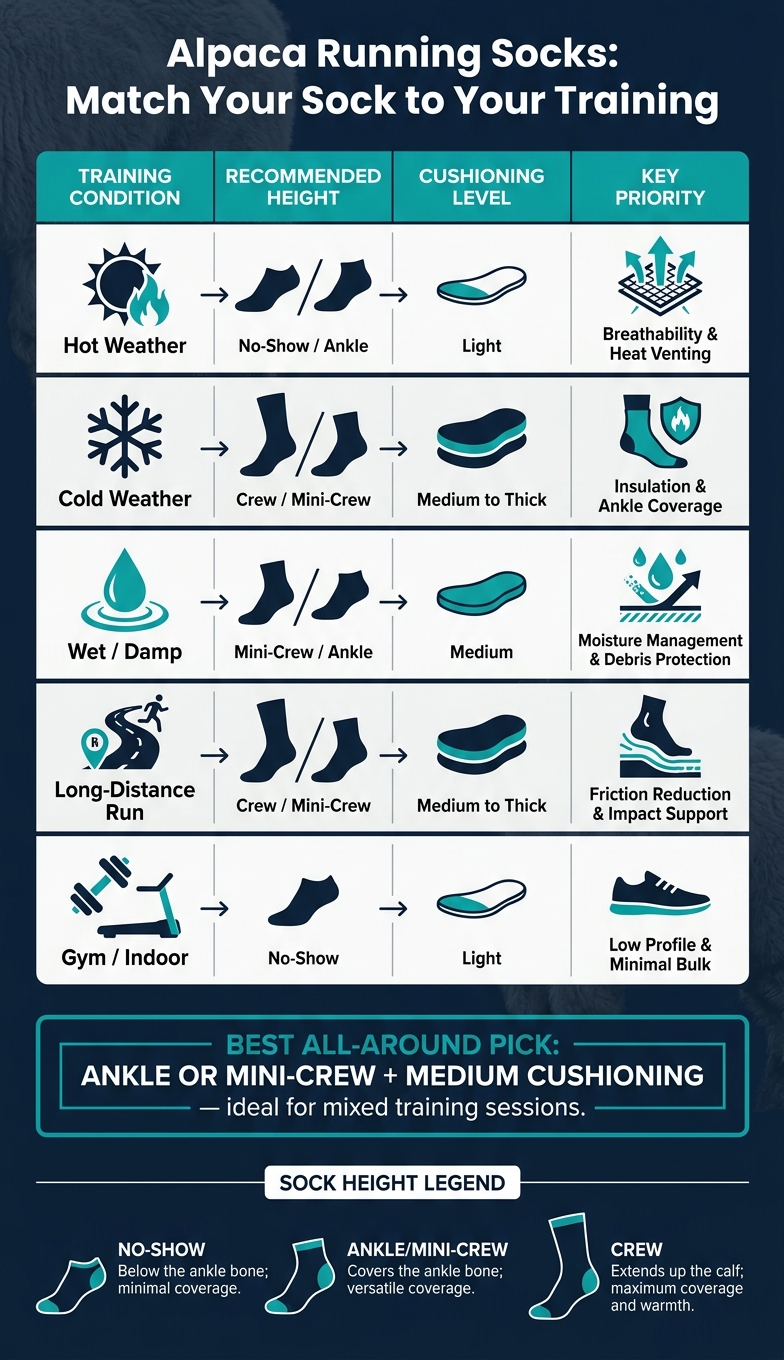
Once fit and build are sorted out, the next step is simple: pick the sock that fits the way you train most often. Height and cushioning should line up with the weather, your mileage, workout intensity, and the ground under your feet. Suri Performance Alpaca Socks comes in no-show, ankle, and crew styles for these different training conditions.
Hot Weather, Cold Weather, and Wet Conditions
In hot weather, go with no-show or ankle socks with light cushioning. They feel less bulky and help heat escape more easily.
When it gets colder, crew or mini-crew socks with medium to thick cushioning give you more warmth and better ankle coverage. That extra fabric can make a big difference on chilly runs.
Wet conditions are a different story, and this is where alpaca stands out. Alpaca keeps its thermal properties even when wet. An ankle or mini-crew height can also help stop road grit, mud, and small debris from getting into your shoes.
Long Runs, Gym Training, and Mixed Use
For long runs, medium to thick cushioning usually makes more sense. Pair that with a mini-crew or crew height for more underfoot protection and a bit more coverage around the shoe collar. On high-mileage days, those small comfort details add up.
Gym training tends to work better with no-show or ankle socks that have light cushioning and very little bulk. You want the sock to stay out of the way, not bunch up or feel heavy.
Condition-by-Condition Comparison Table
Use this quick match-up when the session, not the shoe, is the main variable:
Training Condition
Recommended Height
Cushioning Level
Key Priority
Hot Weather
No-Show / Ankle
Light
Breathability & heat venting
Cold Weather
Crew / Mini-Crew
Medium to Thick
Insulation & ankle coverage
Wet / Damp
Mini-Crew / Ankle
Medium
Moisture management & debris protection
Long-Distance Run
Crew / Mini-Crew
Medium to Thick
Friction reduction & impact support
Gym / Indoor
No-Show
Light
Low profile & minimal bulk
If your training changes from day to day, ankle or mini-crew socks usually give you the best all-around fit for mixed sessions.
How to Care for Alpaca Performance Socks
Fit matters. Construction matters too. But care is what decides how long your socks keep doing their job.
Here’s the big thing: heat is hard on alpaca. If you want alpaca performance socks to last, wash them in cold water and let them air dry.
Wash Cold, Use a Gentle Cycle, and Avoid Bleach
Wash alpaca socks in cold water on a gentle cycle. Use a mild detergent, and skip bleach.
One nice thing about alpaca is its odor resistance. That can mean fewer washes, which is easier on the socks over time. It also helps to rotate pairs instead of wearing the same one for every workout. Giving them a little time between uses can help them hold up better.
After washing, dry them flat. No heat.
Air Dry to Preserve Shape and Extend Wear
Skip the dryer. It’s not worth the risk.
Heat can make alpaca shrink and lose its shape. Lay the socks flat to dry so they keep the fit and feel you bought them for.
Cold washing, a gentle cycle, and flat drying help keep the performance features in place.
Conclusion: Fit, Construction, Conditions, and Care
Fit, construction, conditions, and simple cold-water care all play a big part in how well alpaca performance socks work and how long they last.
FAQs
Are alpaca socks good for preventing blisters?
Yes. Alpaca socks can help prevent blisters because they cut down the main causes: moisture, heat, and friction.
Alpaca fibers pull sweat away from the skin, dry fast, and feel smooth against the foot, which helps reduce rubbing. Suri Performance Alpaca Socks use these moisture-wicking traits to help keep feet dry and comfortable during runs and training.
What sock height should I choose for running?
The best sock height for running comes down to where you run and what feels good on your feet.
For road running, lightweight ankle or no-show socks give you a snug, low-profile fit without extra bulk.
On rough trails, crew-length or boot socks do a better job of keeping out debris and cutting down on friction.
Pick the height that gives you the right amount of coverage while still staying snug as you move.
How do I wash alpaca socks without shrinking them?
Wash alpaca socks in cold or lukewarm water. Heat can make them shrink, felt, or wear out faster.
Hand washing is the safest option. If you use a washing machine, turn the socks inside out, put them in a mesh bag, and run a cold delicate or wool cycle with a low spin setting.
Skip bleach and fabric softener. After washing, press out extra water with a towel instead of wringing them out. Then lay them flat to air dry away from direct sunlight and heat.