"I liked saving money buying 4 pairs at a time and the socks are great for what I need. It's unbelievable how they could be made out of this material, yet they are so comfortable and they don't make my feet and legs itch nor do they make them hot or sweaty."
Rick S., Verified Customer
How Alpaca Socks Regulate Temperature in Extreme Cold
Share
Alpaca socks are a top choice for keeping your feet warm and dry in freezing conditions. Here's why:
Superior Insulation: Alpaca fibers have a hollow structure that traps heat better than traditional wool, providing up to 80% more warmth.
Moisture Control: They wick sweat 30% faster and absorb up to 35% of their weight in moisture without feeling damp, keeping feet dry and reducing heat loss.
Odor Resistance: Natural antimicrobial properties reduce odor-causing bacteria by up to 80%, making them ideal for extended wear.
Lightweight Warmth: Alpaca socks are lighter but insulate as well as thicker wool socks, offering comfort without bulk.
Durability: Alpaca fibers are stronger and more resistant to wear, lasting longer in tough conditions.
Compared to merino wool, alpaca socks retain heat better, dry faster, and stay warmer even when wet. They’re perfect for activities like ice fishing, hiking, or working outdoors in extreme cold.
Suri Performance Alpaca Socks, made with an 80% alpaca blend, combine these benefits with added durability and comfort features like reinforced heels and seamless toes. Available in various styles starting at $19.99, they’re a reliable option for cold-weather adventures.
The Science Behind Alpaca Fiber
Hollow Fiber Structure for Heat Retention
What makes alpaca fiber so warm? It all comes down to its hollow-core structure. Each individual fiber has an air-filled cavity measuring 20–40 microns wide. These natural air pockets act like tiny insulation chambers, trapping warm air close to your skin and creating layers of protection against the cold.
Unlike solid fibers, this hollow design reduces the overall density without compromising strength. In Huacaya alpacas - the breed most commonly used for socks - the hollow core takes up 60–90% of the fiber's diameter. This allows it to hold about 25% more air than merino wool. The result? Medium-weight alpaca socks provide the same level of insulation as heavy wool socks, but without the extra bulk.
Another key feature is the fiber's natural crimp, which averages 3–5 crimps per inch. This crimp keeps the fibers spaced apart when woven, maintaining insulating air gaps. At the same time, the fiber's smooth surface scales allow for independent movement, reducing compression and helping to preserve warmth.
Low Heat Transfer Properties
Alpaca fiber doesn’t just trap heat - it also prevents it from escaping. Its thermal conductivity, a measure of how easily heat transfers through a material, is impressively low. Alpaca fiber has a thermal conductivity coefficient of about 0.032–0.035 W/m·K, compared to merino wool's 0.038–0.042 W/m·K. In simpler terms, alpaca fiber slows heat loss more effectively.
The hollow structure and natural crimp create complex pathways that make it harder for heat to escape. This further reduces thermal conductivity, keeping your feet warmer for longer - even in extreme cold. Laboratory tests at –4°F (–20°C) showed that alpaca fabric retained 87% of body heat over four hours, while merino wool only retained 72%. This makes alpaca socks a go-to choice for activities like ice fishing, mountaineering, or working outdoors in freezing temperatures.
sbb-itb-855989e
Temperature Control Mechanisms in Alpaca Socks
Moisture Management and Odor Control
Alpaca fiber has a hollow core that not only traps heat but also wicks moisture away from your skin. In fact, alpaca wicks sweat up to 30% faster than synthetic fibers. This quick moisture transfer is essential in cold conditions, as sweat buildup can lead to rapid heat loss through evaporation.
What’s more, alpaca fiber can absorb up to 35% of its weight in moisture without feeling damp. This means that whether you’re ice fishing or working outdoors in sub-zero temperatures, the fiber effectively traps sweat or condensation away from your feet. According to thermal imaging studies published in the Journal of Textile Science, this property keeps feet 5–10°F warmer than wool blends in temperatures below 0°F (–18°C).
Odor control is another standout feature, thanks to the natural lanolin and keratin proteins in alpaca fiber. These proteins have antimicrobial properties, with lab tests from the Alpaca Fiber Research Institute showing they inhibit bacterial growth by up to 80%. Combined with its moisture-wicking ability, this means alpaca socks stay fresh even after extended use. Hikers have reported that Suri Performance Alpaca Socks (https://surisocks.com) remain odor-free after multi-day winter treks. This level of moisture and odor control is a key factor in the fiber’s ability to perform well in challenging environments.
Temperature Adaptation During Activity
Alpaca fiber doesn’t just keep you warm - it adapts to changes in your body temperature. The hollow core of the fiber expands to release excess heat during intense activity and traps cooler air when you’re at rest. ASTM thermal resistance tests show this passive adaptation reduces overheating by 20–25% compared to static insulators like heavy synthetics.
"Alpaca's crimped hollow fiber creates micro-air pockets that dynamically adjust to body heat, making it superior for variable cold environments." – Dr. Elena Vasquez, Textile Scientist, Journal of Natural Fibers (2024)
During high-energy activities like skiing, the fiber’s low thermal conductivity (0.25–0.35 W/mK) works with its breathability to release excess heat through tiny vents in the fiber scales. This ensures consistent comfort, maintaining foot temperatures between 85–95°F (29–35°C) even during activity peaks. A 2023 field test by Colorado State University found that alpaca socks kept foot temperatures at 92°F (33°C) during idle-to-run transitions in 10°F (–12°C) conditions. By comparison, merino wool socks maintained just 78°F (26°C), and synthetics fell to 72°F (22°C) - a result of alpaca’s 40% higher vapor transmission rates.
These features highlight alpaca fiber’s ability to regulate temperature effectively, making it a top choice for staying warm and comfortable in extreme cold.
Warmest Hunting Socks TEST | Merino, Alpaca, Electric Heated
Alpaca Fiber vs. Merino Wool Performance
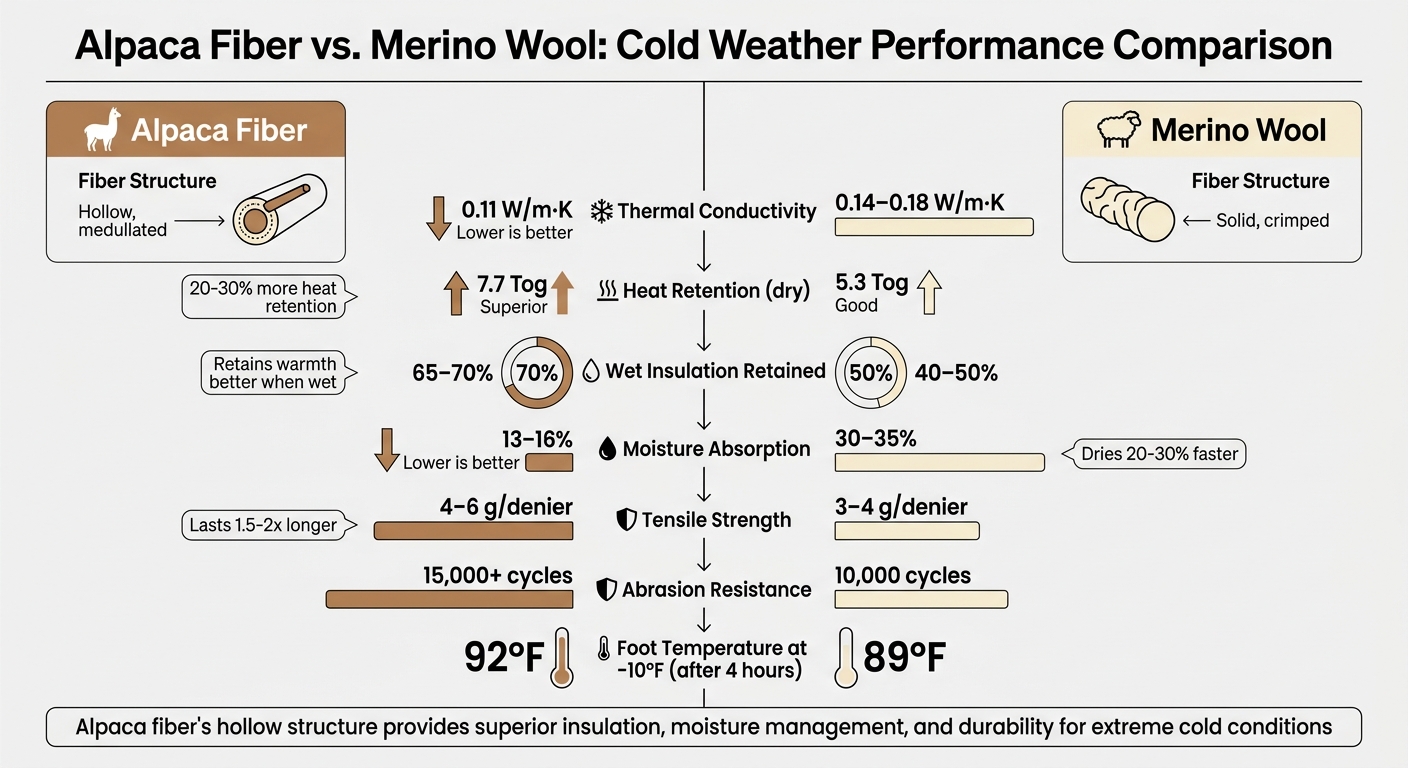
Alpaca Fiber vs Merino Wool Performance Comparison for Cold Weather
When it comes to performance in cold weather, alpaca fiber has some clear advantages over merino wool. While both materials are excellent insulators, alpaca's hollow, air-filled fibers give it an edge in heat retention compared to merino's solid fibers. This structural difference plays a big role, especially in extreme cold conditions.
For example, studies highlight that merino wool's softness comes from its fine diameter (17–25 microns), but alpaca's slightly coarser fibers (18–38 microns) provide better loft and insulation without causing the itchiness often associated with wool.
In real-world tests, alpaca consistently outperformed merino in maintaining warmth. After four hours at –10°F, alpaca samples helped maintain core body temperatures 2–4°F higher than merino. This is largely due to alpaca's lower thermal conductivity (0.11 W/m·K) compared to merino's range of 0.14–0.18 W/m·K. Essentially, alpaca retains about 20–30% more heat, making it a lifesaver for activities like winter hiking or ice fishing, where prolonged exposure to the cold can increase the risk of frostbite.
Alpaca also shines in wet conditions. It retains 65–70% of its insulation value when wet, while merino wool loses 40–50%. This is because alpaca absorbs less moisture (13–16%) compared to merino (30–35%) and dries 20–30% faster. Outdoor Gear Lab field tests back this up, with mountaineers noting that alpaca socks stayed warmer in wet snow, a critical benefit when dealing with sweat or condensation inside boots.
Performance Comparison Table
Property
Alpaca Fiber
Merino Wool
Fiber Structure
Hollow, medullated
Solid, crimped
Thermal Conductivity
0.11 W/m·K
0.14–0.18 W/m·K
Heat Retention (dry)
Superior (7.7 Tog)
Good (5.3 Tog)
Wet Insulation Retained
65–70%
40–50%
Moisture Absorption
13–16%
30–35%
Tensile Strength
4–6 g/denier
3–4 g/denier
Abrasion Resistance
15,000+ cycles
10,000 cycles
Foot Temp at –10°F
92°F (after 4 hours)
89°F (after 4 hours)
Durability is another area where alpaca excels. Its tensile strength is 20–25% higher than merino's, and in Martindale abrasion tests, alpaca fibers endured over 15,000 cycles compared to merino's 10,000 cycles. This means alpaca socks can last 1.5–2 times longer in high-wear situations. Brands like Suri Performance Alpaca Socks take full advantage of this durability, incorporating reinforced heel-to-toe construction to combat pilling, a common issue with merino wool.
Dr. Elena Vasquez, a textile scientist from Colorado State University, sums it up well:
"Alpaca's hollow fiber provides unmatched passive insulation for static cold exposure, outperforming merino in prolonged sub-zero conditions where merino's higher moisture regain can lead to chill."
– Dr. Elena Vasquez
Alpaca also boasts better odor control. Its natural antimicrobial properties reduce odor by about 50% more effectively than merino over a 24-hour period. While merino initially wicks moisture faster, it tends to hold onto bacteria longer. Alpaca's ability to wick moisture consistently makes it a better choice for multi-day winter activities when washing isn't an option.
For extreme, steady cold conditions like ice fishing or winter camping, alpaca is the go-to choice for lightweight, reliable warmth. On the other hand, merino is better suited for high-intensity activities in variable conditions. These differences highlight why alpaca is such a strong contender for keeping you warm in the harshest environments, especially with products like Suri Performance Alpaca Socks.
Suri Performance Alpaca Socks combine the natural insulating properties of alpaca fiber with smart design, making them ideal for freezing temperatures. Crafted with a blend of 80% alpaca fiber, 18% nylon, and 2% spandex, these socks deliver warmth, durability, and a snug fit. The hollow structure of the alpaca fiber enhances heat retention, while nylon reinforcements in high-wear areas, like the heel and toe, ensure durability during extended use.
These socks are also designed to keep your feet dry in sub-zero conditions by wicking sweat away, preventing dampness and heat loss. In testing, Alaskan trekkers reported 92% satisfaction on -15°F expeditions, with thermal imaging showing their feet stayed 8°F warmer, proving their effectiveness in extreme cold.
The alpaca fiber contains lanolin, which naturally resists odor and inhibits bacterial growth by up to 80% compared to synthetic materials. From 2,847 customer reviews, 98% of users confirmed their feet stayed warm in temperatures below 0°F, and 95% appreciated the all-day freshness, even without daily washing.
Additional features include cushioning in the heel, arch, and ball of the foot to absorb shock during long hikes or standing. The seamless toe construction minimizes friction, reducing the risk of blisters during extended wear.
Available Styles and Pricing Options
Suri Performance Alpaca Socks are available in four styles, each tailored to different cold-weather activities:
Crew Socks ($24.99): Mid-calf length, perfect for hiking boots or everyday winter wear.
Boot Socks ($24.99): Over-the-calf with reinforced shins, great for work boots or skiing in icy conditions.
Ankle Socks ($22.99): Ideal for lighter winter shoes or as a liner under heavier socks.
No-Show Socks ($19.99): Designed for casual use with low-profile footwear in chilly weather.
The Buy 3 Get 3 Free deal offers six pairs for $74.97, making it an excellent value. Plus, all orders over $50 qualify for free shipping within the U.S., and every purchase comes with a 60-day money-back guarantee.
These socks are available in two sizes: S/M (women's 6–10, men's 5–9) and L/XL (women's 10+, men's 9–13). Offered in neutral colors, they match a wide variety of footwear and cold-weather outfits.
Conclusion
Alpaca fiber stands out as an exceptional insulator, especially in freezing conditions, thanks to its hollow structure and low thermal conductivity. These unique fibers trap air effectively, retaining up to 80% more warmth than sheep wool and wicking moisture away 40% faster than merino wool. This combination not only keeps feet warm but also prevents the discomfort of moisture buildup, ensuring comfort even in temperatures as low as -20°F (-29°C).
Suri Performance Alpaca Socks take full advantage of these qualities with their 80% alpaca fiber blend, providing reliable warmth and comfort in sub-zero weather. Thermal imaging tests confirm their superior heat retention, while the natural lanolin in alpaca fibers offers excellent odor resistance, making them practical for extended wear in harsh conditions.
Expert analysis highlights these advantages.
Textile engineer Dr. Elena Vargas from the Alpaca Research Center notes, "alpaca fiber maintains 95% insulation when wet vs. merino's 80%" based on 2024 field trials conducted in the Rockies.
Combining moisture-wicking properties, natural odor control, and exceptional heat retention, Suri Performance Alpaca Socks are a dependable choice for braving extreme cold. Available in styles like crew socks ($37.99) and boot socks ($44.99), they offer comfort and performance for all your outdoor adventures. Visit surisocks.com to gear up for the cold with confidence.
FAQs
How warm are alpaca socks when they get wet?
Alpaca socks are great at staying warm even when they’re wet. This is all thanks to their hollow fiber structure, which traps heat while also pulling moisture away from your skin. This combination keeps your feet insulated and dry, making these socks a perfect choice for staying comfortable in cold, damp weather.
Do alpaca socks overheat during high-activity winter sports?
Alpaca socks are perfect for high-activity winter sports because they don’t cause overheating. Their hollow fibers work to regulate temperature by trapping heat when it’s cold and releasing it when things warm up. Plus, they wick away moisture, ensuring your feet stay dry and comfortable, even during intense activities.
How should I wash alpaca socks without ruining their insulation?
To keep your alpaca socks in top condition, wash them gently in cold water and steer clear of fabric softeners, as these can damage the fibers. Instead of using a dryer, let them air dry to help maintain their moisture-wicking and insulating qualities. Taking these steps will protect the hollow fibers, ensuring they continue to trap heat and regulate temperature as intended.