"I liked saving money buying 4 pairs at a time and the socks are great for what I need. It's unbelievable how they could be made out of this material, yet they are so comfortable and they don't make my feet and legs itch nor do they make them hot or sweaty."
Rick S., Verified Customer
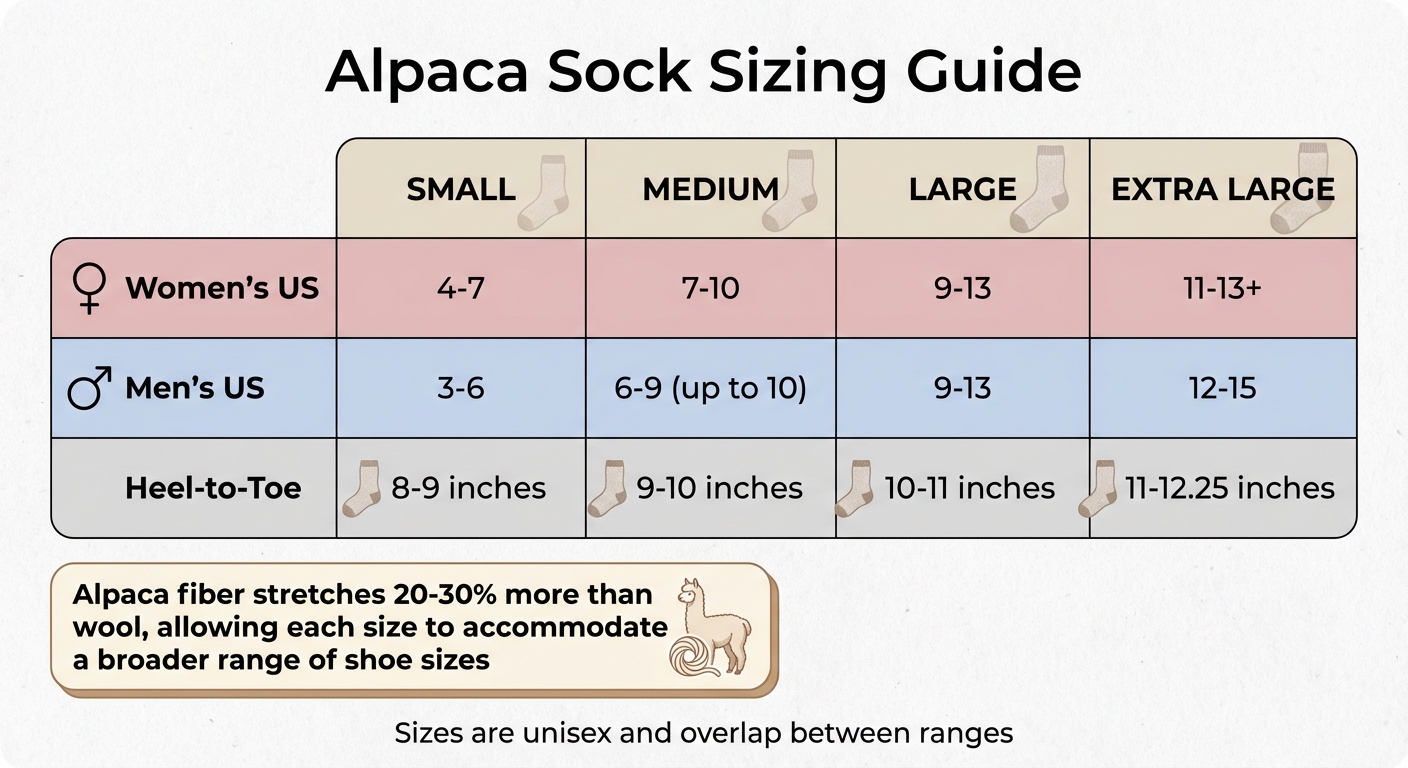
Alpaca Sock Sizing Guide
Share
Finding the right size for alpaca socks is crucial for comfort, performance, and durability. Properly fitted socks prevent blisters, ensure moisture-wicking, and maintain their shape over time. Alpaca socks naturally regulate temperature, resist odors, and stretch more than wool, making accurate sizing essential.
Key Takeaways:
Size Chart: Alpaca socks typically come in Small, Medium, Large, and Extra Large, corresponding to U.S. shoe sizes for men and women.
Natural Stretch: Alpaca fibers stretch 20–30% more than wool, accommodating a wider range of sizes but still requiring a good initial fit.
Activity Matters: For hiking or running, choose a snug fit. For casual wear or swollen feet, consider sizing up.
Common Mistakes: Avoid socks that are too tight (they restrict circulation) or too loose (they bunch and wear out faster).
Sizes: Small (Women 4–6.5, Men 3–5.5) to X-Large (Women 12.5+, Men 13+).
Styles: Crew, boot, ankle, and no-show socks, each suited for specific activities.
Pricing: $28.99–$44.99 per pair, with bundle options reducing per-pair costs.
Measure your feet carefully, compare with the size chart, and consider your intended activity for the best fit. Proper sizing ensures comfort, durability, and maximum benefits from alpaca socks.
Standard Alpaca Sock Size Charts
Alpaca Sock Size Chart: Men's and Women's Sizing Guide
Alpaca socks generally come in four main sizes: Small, Medium, Large, and Extra Large. While some brands may offer additional options like XS or XXL, these four sizes are the most common. They align with U.S. shoe sizes for both men and women, so finding the right fit doesn’t require any tricky conversions.
Here’s a quick breakdown of the typical size ranges across most alpaca sock brands:
Small: Women's U.S. shoe sizes 4–7 and Men's 3–6 (heel-to-toe length: 8–9 inches)
Medium: Women's U.S. shoe sizes 7–10 and Men's 6–9 (sometimes up to 10; heel-to-toe length: 9–10 inches)
Large: Women's U.S. shoe sizes 9–13 and Men's 9–13 (heel-to-toe length: 10–11 inches)
Extra Large: Women's U.S. shoe sizes 11–13+ and Men's 12–15 (heel-to-toe length: 11–12.25 inches).
These sizes are designed to be unisex, making it straightforward to find the right fit for both men and women.
Men's and Women's Size Conversions
Many alpaca sock manufacturers use a single size chart that includes both men's and women's equivalents. For example, if you wear a U.S. women's size 9 or a men's size 10, you’d typically go with a Medium. Leading brands often support these straightforward conversions.
That said, if your size falls near the upper edge of a range - like a women's 9.5–10.5 or a men's 9–11.5 - it’s worth considering sizing up to a Large for added comfort. Some brands also extend their charts to include XXL (Men's sizes 15–18), though others stop at XL for women (13–15).
Since sizing can vary slightly between brands, it’s always a good idea to check the specific chart provided by the manufacturer.
How Alpaca Fiber Affects Fit
One of the standout features of alpaca fiber is its exceptional natural stretch, which can be 20–30% greater than wool. This flexibility allows each size to accommodate a broader range of shoe sizes, ensuring a snug yet comfortable fit. Unlike synthetic materials, which hold a fixed shape, alpaca socks mold to your foot while maintaining their structure. Warrior Alpaca Socks explains that their "unique manufacturing process allows for stretch & comfort", meaning you might find that either of two sizes works for your feet if you fall between ranges.
This natural stretch also explains why some sizes overlap - like a women's 9 appearing in both Medium and Large size charts. However, it’s essential not to choose socks that are too small. A tight fit can restrict the alpaca fiber's moisture-wicking and temperature-regulating benefits. Since alpaca socks tend to feel a bit looser over time compared to cotton, there’s usually no need to size up unless your foot is over 12 inches long, particularly wide, or has a high instep.
Sizing for Suri Performance Alpaca Socks
Suri Performance Alpaca Socks follow a standard unisex sizing system across their various styles. They offer four main sizes - Small, Medium, Large, and X-Large - designed to match U.S. shoe sizes for men and women. Here’s a closer look at the size ranges and details for each sock style.
Size Ranges by Sock Style
The sizing for all styles - crew, boot, ankle, and no-show - is consistent, so you can typically stick to the same size regardless of the sock height. Here's how the sizes align with U.S. shoe sizes:
Women: Small (4–6.5), Medium (6.5–9), Large (9–12), X-Large (12.5+)
Men: Small (3–5.5), Medium (4.5–8.5), Large (9–12.5), X-Large (13+)
Each style is tailored for specific uses:
Crew socks reach mid-calf and include light compression zones, making them ideal for everyday wear or light outdoor activities.
Boot socks are taller and feature extra cushioning at the heel and toe, perfect for hiking or work boots.
Ankle socks (quarter-height) combine targeted cushioning with breathable mesh zones, making them a great match for sneakers and casual wear.
No-show socks are designed as invisible liners for loafers or dress shoes, focusing on a snug fit around the arch without any calf coverage.
If you're considering boot socks and have larger calves or plan to pair them with thick work boots, sizing up to Large or X-Large might provide a more comfortable fit, even if your foot size falls within the Medium range. Thanks to alpaca's natural stretch, those on the edge of a size overlap - like women's size 9 or men's size 8.5 - can choose Medium for a snug fit or Large for a bit more room.
Pricing and Bundle Options
Pricing for individual pairs ranges from $28.99 to $44.99, depending on the style:
No-show socks: $28.99
Ankle socks: $33.33
Crew socks: $37.99
Boot socks: $44.99
The brand also offers a Buy 3 Get 3 Free bundle deal, significantly reducing the per-pair cost:
Ankle socks bundle: $104.97 for six pairs (about $17.50 per pair)
Crew socks bundle: $113.97 for six pairs (around $19.00 per pair)
Boot socks bundle: $140.97 for six pairs (approximately $23.50 per pair)
Additionally, the Fall Bundle - priced at $127.47 - includes three boot socks and three crew socks, bringing the per-pair cost to about $21.25. These bundles let you mix and match styles to suit different activities. For instance, you could use boot socks for hiking adventures and crew socks for daily wear, all while keeping the cost competitive with premium merino or technical hiking socks.
How to Measure Your Feet for the Right Size
To make the most of the size charts, it’s important to accurately measure your feet. This ensures you pick the right size of Suri Performance Alpaca Socks and avoid common issues like socks that slip, pinch, or bunch up during wear.
Measuring both feet is key since they might not be exactly the same size. Always use the larger measurement to ensure a comfortable fit and avoid tightness, especially for extended activities.
Measuring Heel-to-Toe Length
You don’t need fancy tools to measure your feet - just grab a sheet of paper, a pencil, and a ruler or flexible tape measure. Start by placing the paper on a hard floor, making sure it’s snug against a wall. Stand with your heel lightly touching the wall and your full weight on one foot. Trace around your longest toe, then measure from the edge of the paper (where it meets the wall) to the tip of the traced outline. This gives you your heel-to-toe length.
Write down this measurement in both inches and centimeters. It’ll make comparing your size to alpaca sock charts easier, as these often list dimensions or U.S. shoe sizes. Repeat the process with your other foot to ensure an accurate fit. This step is especially important because the natural stretch of the sock fabric should provide a snug, secure fit without being too tight.
Once you’ve got your measurements, think about how sock height and your intended activities might affect your choice.
Factoring in Sock Height and Activity
Sock height plays a big role in how the sock fits and feels on your leg. For no-show or ankle socks, a snug fit at the foot opening is essential to prevent slipping during activities like running or walking. If your measurement is between sizes, going with the smaller size can help keep the sock secure. On the other hand, for crew or boot-height socks, comfort around the calf and ankle is more important. If you have larger calves or plan to layer socks, choosing a larger size can keep the leg portion from feeling too tight.
Your activity level also matters. For high-movement activities like hiking, trail running, or outdoor work, a snug fit helps minimize friction, blisters, and bunching. Performance alpaca socks - like those in the Suri Performance Alpaca Socks collection - are designed to stretch and recover well, so if you’re between sizes and have average-width feet, opting for the smaller size can help keep the heel secure. For casual wear or situations where your feet might swell after long hours, a larger size can provide better comfort. If you’re planning to wear thick winter boots or add sock liners, sizing up is a smart move to account for the extra bulk.
Use the Suri Performance Alpaca Socks size guide to fine-tune your choice, taking into account sock height and how you’ll be using them. This ensures you get the perfect fit for both comfort and performance.
sbb-itb-855989e
Common Sizing Mistakes to Avoid
Even with precise measurements, sizing errors with alpaca socks can still happen. Understanding these common mistakes can save you from discomfort, unnecessary returns, and reduced performance of your socks.
Misjudging Stretch and Fit
Alpaca fiber has impressive elasticity - it can stretch 20–30% more than wool. If you assume alpaca socks behave like cotton, you might pick your exact shoe size. However, alpaca's natural crimp allows up to 25% stretch without sagging, meaning the sock will snugly conform to your foot while maintaining support.
One common mistake is sizing down too much, expecting a tight, synthetic-like fit. Alpaca blends are designed to cover overlapping shoe sizes - like women’s US 6–9.5 in a Medium - so choosing a smaller size can make the sock feel overly tight, restrict circulation, and lead to uneven loosening over time. On the flip side, some people oversize because the socks appear thick, not realizing that alpaca’s stretch and bulk naturally adjust to fill your shoe without needing extra length.
When buying Suri Performance Alpaca Socks, follow the size chart provided. Thanks to alpaca's elasticity, there’s no need to guess or add extra room - the sock will adapt to your foot while offering the right amount of support.
What to Do When Between Sizes
If your foot measurement lands between two sizes, it’s best to size up. Alpaca’s natural stretch handles slight looseness better than tightness, reducing the risk of blisters and poor circulation. For example, if your heel-to-toe length is 10.25 inches - falling between Medium (9–10 inches) and Large (10–11 inches) - go for the Large.
Your activity level can also guide your choice. For activities like hiking or running, opting for the smaller overlapping size (if your feet are average width) can help keep the sock secure and reduce friction. For casual wear or situations where your feet might swell - like long days on your feet - a larger size may provide more comfort. Similarly, if you plan to wear thick boots or add liners, sizing up can prevent cramped toes. Addressing these size nuances is key to avoiding discomfort and performance issues.
Problems with Incorrect Fit
An improper fit can significantly impact how your alpaca socks perform. Socks that are too small compress the fiber’s porous structure, which can trap moisture and bacteria instead of wicking it away. This reduces the sock’s natural odor resistance - typically 40% better than synthetic materials - and increases the risk of blisters and hotspots. Over-stretching the elastic fibers can also cause uneven wear, reducing both durability and thermal regulation.
On the other hand, socks that are too large come with their own problems. Extra fabric can bunch up, leading to friction and instability. While alpaca’s stretch minimizes sagging, it can’t fully counteract the excess volume, which may cause heel slippage and less warmth. If you notice the heel cup riding up or deep marks on your skin, it’s a clear sign the fit is off, and you should exchange for the correct size.
With Suri Performance Alpaca Socks, proper sizing ensures you get the full benefits of their moisture-wicking, odor resistance, and thermal-regulating properties - perfect for extended wear and outdoor adventures.
Conclusion
Getting the right alpaca sock size is a simple process: measure both of your feet, check the brand's specific size chart, and pick socks suited to your activities.
Alpaca fibers are naturally stretchy and excellent at wicking moisture, but these benefits really shine when your socks fit just right. A proper fit means you’ll stay warm even when your socks get wet, enjoy natural odor control, and feel comfortable whether you're hiking, working, or relaxing. The way alpaca fibers perform makes accurate sizing a key part of getting the most out of your socks.
If you’re between sizes, go up a size for casual wear or work boots, where a little extra room can help with foot swelling. For activities that involve a lot of movement, choose the smaller size to minimize friction and keep the sock securely in place. Don’t forget about sock height - crew and boot styles pair well with outdoor footwear, while ankle and no-show options are better for sneakers or warm weather.
Using the size chart ensures your socks perform as intended. For Suri Performance Alpaca Socks, following their specific chart helps you get the most out of their moisture-wicking, odor-resistant, and temperature-regulating qualities, even during long days or tough conditions. Once you’ve nailed down your size, reordering becomes a breeze.
Getting the right size also helps prevent common problems like bunching, blisters, and early wear, letting your alpaca socks deliver the comfort and durability you expect for the long haul.
FAQs
What size alpaca socks should I choose if I’m in between sizes?
If you find yourself between sizes, it’s usually a good idea to choose the larger option. This gives you a more comfortable fit, particularly during activities like hiking, working, or spending extended time outdoors. A bit of extra room in your socks allows for better flexibility and helps prevent discomfort or restricted movement.
How do alpaca socks compare to wool socks?
Alpaca socks are a fantastic choice for keeping your feet cozy during chilly weather. Despite their ability to provide incredible warmth, they remain lightweight and super comfortable to wear. These socks are also excellent at wicking away moisture, which helps keep your feet dry throughout the day. Plus, thanks to their natural odor-resistant properties, they stay fresher even after long periods of use. On top of that, alpaca fibers are highly durable, so you can count on these socks to last a long time without losing their soft, luxurious feel.
Why should you choose the right sock height and style for your activities?
Choosing the right sock height and style can make a big difference in comfort, protection, and performance, no matter the activity. For instance, taller socks, such as boot socks, offer extra coverage and cushioning, making them a great choice for hiking or outdoor tasks. Meanwhile, ankle or no-show socks work best for casual wear or lighter activities where minimal coverage is more suitable.
Matching your sock height to your activity and environment can help prevent blisters, maintain a comfortable temperature, and improve overall comfort. It's all about finding the right balance for your needs.