"I liked saving money buying 4 pairs at a time and the socks are great for what I need. It's unbelievable how they could be made out of this material, yet they are so comfortable and they don't make my feet and legs itch nor do they make them hot or sweaty."
Rick S., Verified Customer
Study Summary: Alpaca Fiber Softness vs Wool
Share
If wool socks make you itch, alpaca is often the softer pick. From what I see in the research, that usually comes down to flatter fiber scales, no lanolin, lower water absorption, and steady warmth.
Here’s the short version:
Alpaca often feels less prickly even though merino can have a lower micron count.
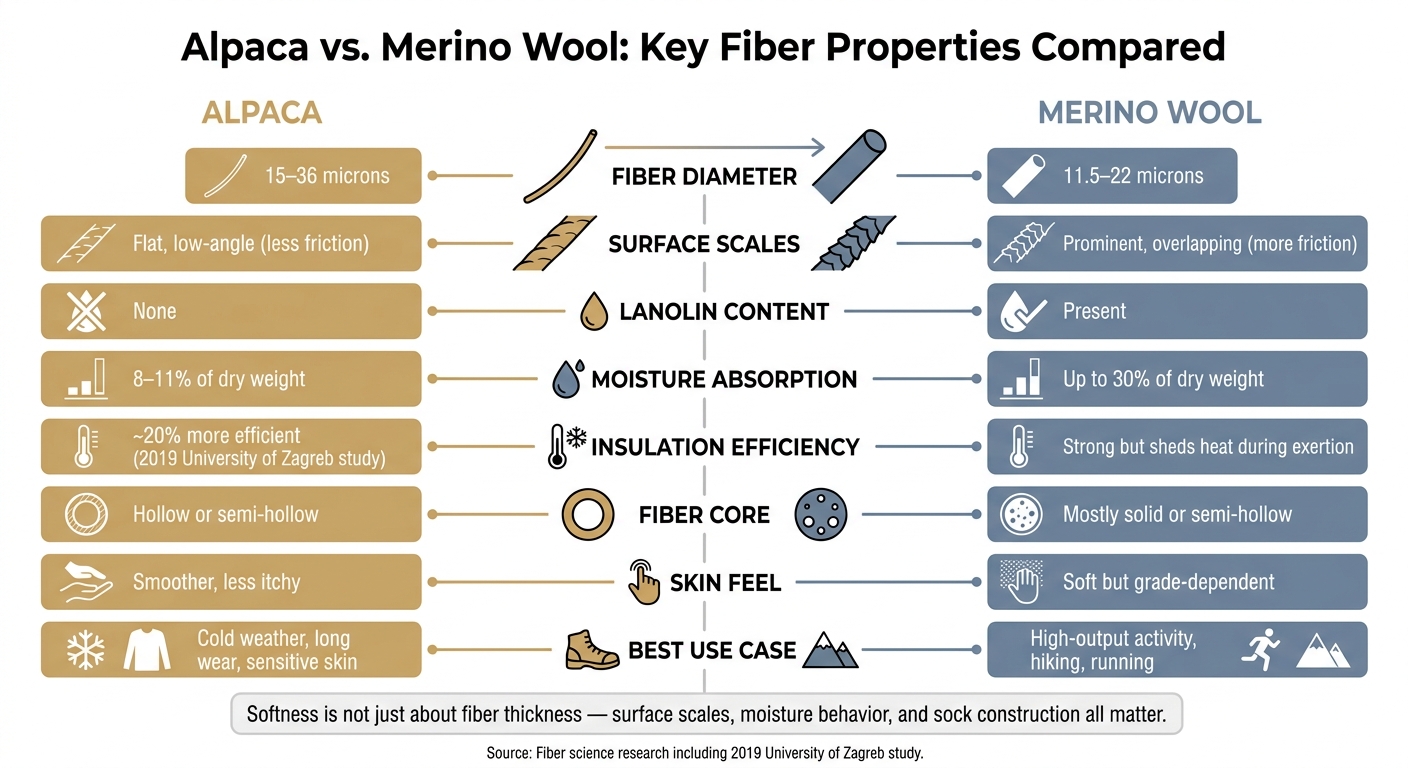
Merino wool usually ranges from 11.5–22 microns, while alpaca runs about 15–36 microns.
Merino can absorb up to 30% of its dry weight in moisture.
Alpaca absorbs about 8–11%, so it often dries faster and feels less damp over time.
A 2019 study cited here found alpaca fleece was about 20% more insulating than merino fleece.
Merino tends to work better for high-sweat activity, while alpaca often feels smoother for long wear and cold conditions.
If I had to boil it down to one line, it’s this: softness is not just about fiber thickness; surface scales, moisture behavior, and sock build matter too.
Alpaca vs. Merino Wool: Key Fiber Properties Compared
Merino vs Alpaca: Which Wool Wins on the Trail?
sbb-itb-855989e
Quick Comparison
Factor
Alpaca
Merino Wool
Skin feel
Often smoother, less itchy
Can feel soft, but grade matters more
Fiber diameter
15–36 microns
11.5–22 microns
Surface scales
Flatter, lower-friction
More prominent
Lanolin
None
Present
Moisture absorption
8–11%
Up to 30%
Dry feel over time
Often less damp
Can hold more sweat before feeling wet
Warmth
Strong insulation, hollow/semi-hollow core
Warm, but sheds heat better during exertion
Best fit
Cold weather, long wear, sensitive skin
Hiking hard, running, high-output use
For me, the main takeaway is simple: don’t buy socks by fiber name alone. Check the grade, blend, stretch fibers, and cushioning, because those details shape how the sock feels after hours on your feet.
How Researchers Measure Softness and Skin Comfort
Researchers don’t have to rely on a simple touch test to judge softness. They can measure it. When fiber scientists study comfort, they use repeatable metrics to see how a material behaves against skin. That’s how they explain why alpaca, cotton, or wool socks feel smoother, itchier, warmer, or drier than others.
Fiber Diameter, Micron Count, and Prickle Risk
A micron is one-millionth of a meter. Researchers measure the thickness of individual fibers in microns to estimate how a fiber may feel on skin. In general, lower micron counts mean finer fibers and less prickle.
Merino wool usually falls between 11.5 and 22 microns, while alpaca fibers range from 15 to 36 microns. That spread matters. Both fibers can vary a lot by grade, so comfort can change from one sock to the next. Fine merino can be thinner than some alpaca. Even so, alpaca often feels smoother, because prickle depends on more than fiber diameter alone.
Thickness matters. But surface shape plays a big role too.
Surface Scales and Why Some Fibers Feel Itchy
Animal fibers have an outer cuticle made of overlapping scales. When those scales catch on skin, you get that familiar prickly or itchy feeling. So micron count doesn’t tell the whole story.
The main difference between alpaca and wool isn’t only diameter. It’s also scale geometry. Alpaca has flatter, lower-angle scales, which create less friction than wool’s more prominent scales. That’s why alpaca usually feels less itchy. Alpaca can even be less flexible than wool and still feel softer, simply because it slides across skin more easily.
Hand Feel vs. Wear Comfort
Hand feel is the quick touch test. Wear comfort is what shows up after hours of sweat, heat, and movement. That’s where moisture absorption starts to matter.
Merino wool can absorb up to 30% of its dry weight in water, while alpaca absorbs only 10% to 11%. That helps explain why alpaca tends to dry faster and feel less damp during wear.
Researchers also use Clo to measure insulation and THL to show how much heat escapes during activity. Those numbers point to what your feet go through in actual use, not just what a fabric feels like when you squeeze it in your hand.
Next, look at how those measurements show up in alpaca and wool fiber structure.
Alpaca and Wool Fiber Structure: What the Data Shows
Those measurements help explain why alpaca and wool can feel so different on your skin.
Why Alpaca Often Feels Less Prickly Than Wool
Alpaca can feel smoother than wool even when its fibers aren't finer than merino. A big reason is the fiber surface. Alpaca has flatter scales, which cut down on itch and let the fiber move more easily against skin. Lower surface friction also helps alpaca feel smoother.
Alpaca is also lanolin-free, so it avoids a common wool irritant. It doesn't need the extra washing that wool sometimes gets to remove lanolin. That gap tends to matter more after you've worn socks for hours, not when you just touch them for a second in a store.
Why Wool Comfort Depends on Fiber Grade
Merino wool usually falls between 11.5 and 22 microns, and grades under 17.7 microns are generally classed as fine. Fiber grade plays a big part in comfort. But it isn't the whole story. Scale shape and lanolin content matter too.
Property
Alpaca Fiber
Merino Wool
Typical Micron Range
15–36 microns
11.5–22 microns
Scale Profile
Flat, low-angle
More prominent, overlapping
Lanolin
None
Present
Core Structure
Hollow or semi-hollow
Mostly solid or semi-hollow
Superwashing
Not usually needed
Sometimes used to remove lanolin
Those same fiber traits also shape how each material handles warmth and moisture in socks. This is a key factor in choosing moisture-wicking socks for active use.
Alpaca vs. Wool in Socks: Softness, Warmth, and Moisture Handling
For most buyers, the difference shows up after hours on your feet, not in the first five seconds of touching the fabric in a store.
Softness and Skin Comfort During Real Wear
Some studies report that alpaca fibers feel much smoother than merino in wear tests. Coarse wool tends to feel itchier than fine merino or alpaca.
Part of that comes from alpaca’s flatter scale profile, which gives it a silky hand feel that tends to last through long wear. Fine merino can feel soft too, but the result depends a lot more on fiber grade and how the sock is built.
For socks, alpaca usually feels smoother over a long day, while fine merino is more hit-or-miss based on grade and construction.
Insulation and Temperature Regulation
Alpaca insulates well for its weight because of its hollow fiber core. That air-filled center works like a natural thermal barrier, trapping heat without adding much bulk.
A 2019 University of Zagreb study found alpaca fleece was about 20% more efficient at insulation than merino fleece. In plain terms, alpaca socks can feel warm without thick padding, though some ultra boot socks use dense cushioning for extreme cold.
Merino works a bit differently. Its crimped structure also traps air, but it releases heat more easily during high-exertion activity. That makes merino a better pick for uphill hiking or trail running, where overheating is a real issue. Alpaca’s insulation is steadier, which suits cold-weather wear and lower-activity use.
Moisture Handling and Damp-Feet Comfort
This is where the two fibers split in a very clear way.
Merino absorbs moisture into the fiber itself - up to 30% of its dry weight. That means it can hold a lot of sweat before your foot starts to feel wet. That’s handy during hard effort. The downside is slower drying and a heavier, colder feel once the fiber is fully soaked.
Alpaca absorbs much less moisture, taking in only about 8–11% of its dry weight in water. Because of that, it dries faster and doesn’t weigh down your foot the same way a soaked wool sock can. The catch is that during heavy sweating, alpaca can feel a bit clammy since it holds less moisture inside the fiber than merino.
Alpaca’s smoother fiber scales may also cut friction against the skin when socks get damp. On long wear days, that can matter if you’re trying to avoid blisters.
That’s why fiber grade and sock construction matter just as much as fiber type when you’re picking performance socks.
What This Means When Buying Performance Socks
When you're buying performance socks, the fiber name alone doesn't tell the whole story. Softness, stretch, and moisture handling usually matter more in day-to-day wear. That’s why the label matters so much.
What to Look for on a Sock Label
A sock label can tell you a lot more than “alpaca” or “wool.” A few details are worth a close look:
Fiber grade is your first clue to softness. If the label lists alpaca grade, go with the finest one you see. In most cases, finer fibers feel softer against the skin.
Blend composition affects fit and hold. Look for nylon, spandex, or elastane in the blend so alpaca socks keep their shape and give the arch some support.
Construction details play a big role in comfort and wear life. Reinforced heels and toes can help socks last longer. If you need more protection for hiking or work boots, check for “cushioned” or “terry loop” construction.
If wool irritates your skin, choose alpaca. Alpaca naturally contains no lanolin.
Suri Performance Alpaca Socks lines up with these findings through alpaca-based styles made for both everyday use and time outdoors. Suri Performance Alpaca Socks offers crew, boot, ankle, and no-show options built around alpaca’s softer feel, moisture management, odor resistance, and temperature regulation.
Key Takeaways
For buyers, the choice comes down to grade, stretch, and activity level. Pick the fiber and construction that fit how you’ll actually use the sock.
FAQs
Why can alpaca feel softer than merino?
Alpaca can feel softer than merino because of its microscopic scale structure. Merino fibers have more pronounced overlapping scales, which can create a prickly sensation on skin.
Alpaca fibers have flatter, lower-angle scales, so the surface feels smoother as it moves against the skin. That smoother feel gives alpaca a hand feel many people compare to cashmere.
Is alpaca better for sensitive skin?
Yes. Alpaca fiber is often a good pick for sensitive skin because it’s naturally free of lanolin, the waxy oil that can irritate some people.
It also has smoother fiber scales than many types of wool. That means less of the prickly, itchy feeling people often complain about. The result is a softer, more comfortable feel against the skin.
Which is better for sweaty feet?
Alpaca fiber is a smart pick for sweaty feet. It naturally repels water, takes in less moisture, and has a low water retention rate of 10% to 11%. That means it dries faster and helps socks feel lighter and drier during long hours of wear.
Because the fiber stays drier, it also helps hold back the moisture-loving bacteria that cause odors.