"I liked saving money buying 4 pairs at a time and the socks are great for what I need. It's unbelievable how they could be made out of this material, yet they are so comfortable and they don't make my feet and legs itch nor do they make them hot or sweaty."
Rick S., Verified Customer
How Alpaca Fiber Moves Sweat in Work Socks
Share
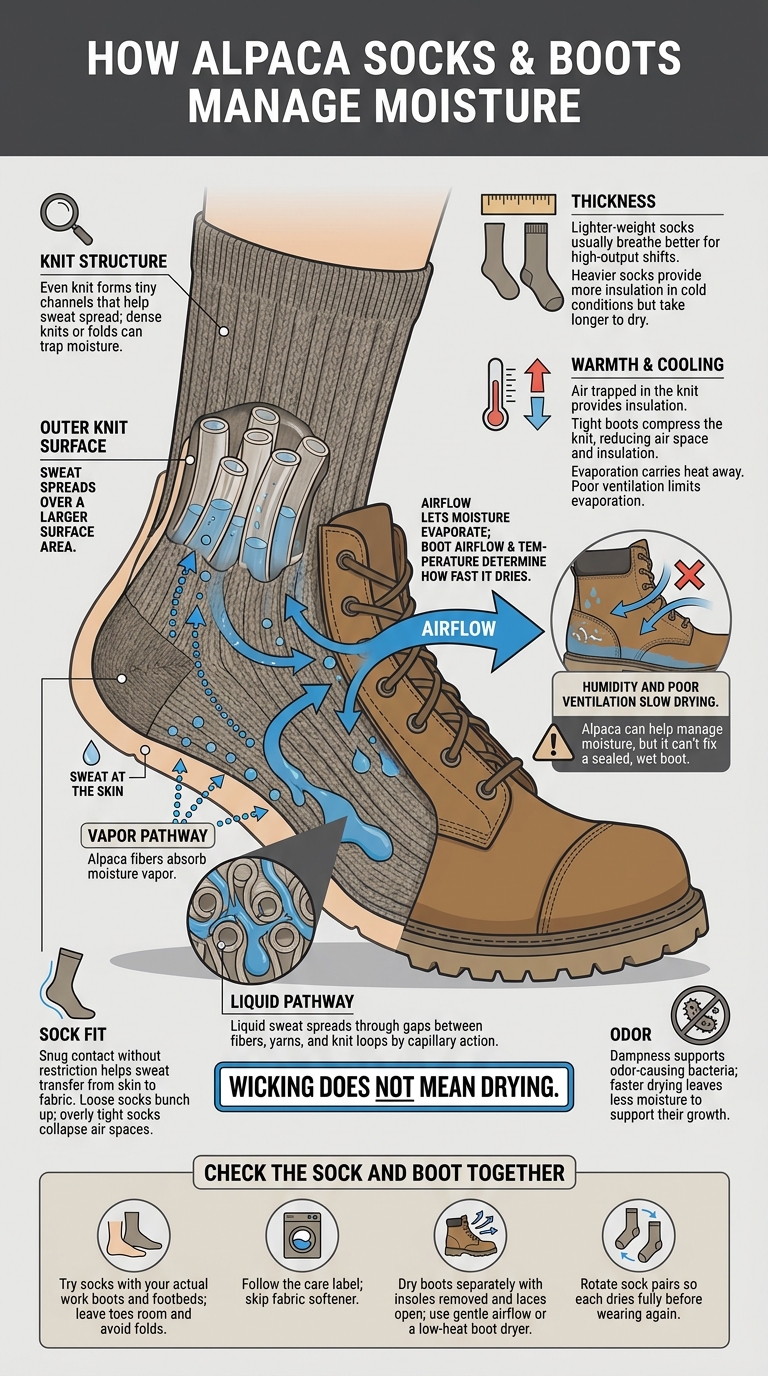
Alpaca can help manage sweat, but it cannot dry out a sealed, wet boot. For an 8-hour shift, I’d start with socks that fit without crowding your boots - and let both socks and boots dry before wearing them again.
Here’s what I look for:
Moisture movement: Alpaca absorbs water vapor; gaps in the knit spread liquid sweat. Wicking does not mean drying.
Warmth and drying: Trapped air helps keep feet warm. Airflow lets moisture evaporate, while damp, poorly vented boots slow drying.
Fit and construction: Choose thickness, cushioning, height, and seams that leave your toes room and keep fabric from bunching.
Odor and care: Dampness supports odor-causing bacteria. Follow the care label, skip fabric softener, rotate pairs, and dry boots separately.
My rule: <u>check the sock and boot together</u>, not just the fiber listed on the label.
How Alpaca Work Socks Manage Sweat
How Alpaca Fiber and Sock Fabric Handle Moisture
Fiber Structure and Moisture Vapor
Alpaca fibers absorb moisture vapor. The spaces in the knit help move liquid sweat away from your skin. Both the fiber and the fabric structure affect moisture control.
How Liquid Sweat Spreads Through the Knit
Liquid sweat moves through small gaps between fibers, yarns, and knit loops by capillary action. An even knit forms tiny channels that help sweat spread, while dense fabric can trap moisture against your skin.
What Helps or Limits Moisture Movement
Sock thickness, knit density, fit, and conditions inside your boots also affect how moisture moves.
Factor
Moisture-management contribution
Limitation
Alpaca fiber
Absorbs moisture vapor into the fiber structure and helps sweat move through capillary channels.
Can still become saturated if moisture cannot evaporate outside the sock.
Knit structure
Provides spaces between yarns that let liquid sweat spread to the surface.
Dense knits or folds can trap moisture.
Sock fit
Snug contact without restriction helps sweat transfer from skin to fabric.
Loose socks bunch up; overly tight socks collapse air spaces.
Boot ventilation
Allows moisture on the sock surface to evaporate into the air.
Humid boots slow drying.
Once sweat reaches the sock’s surface, boot airflow and temperature determine how fast it dries.
Once moisture moves from your skin into the knit, it still needs a way out of the boot. Wicking sweat is not the same as drying it, and alpaca socks surpass cotton and wool in moisture control. After sweat reaches the outer knit, airflow inside the boot determines how fast it evaporates.
Waterproof boots slow evaporation when they don’t vent well. Wet conditions also slow drying, so the boot still needs to let moisture escape.
Temperature Control in Cold, Warm, and Wet Boots
Airflow affects both drying and how warm or cool the boot feels. Air trapped in the knit helps insulate your feet in cold conditions. When moisture evaporates, it carries heat away.
Condition
Mechanism
Main limitation
Cold
Air trapped in the knit provides insulation.
Tight boots compress the knit, reducing air space and insulation—a common issue when wearing ultra boot socks in undersized footwear.
Warm
Evaporation carries heat away from the sock surface.
Poor ventilation limits evaporation, allowing heat to build up.
Humidity and poor ventilation slow drying. Saturated socks feel less comfortable and may provide less insulation. Temperature regulation does not make a sock waterproof.
How Dampness and Microorganisms Affect Foot Odor
Lingering moisture can lead to odor. Odor-causing bacteria thrive in damp socks, while faster drying leaves less moisture to support their growth.
To help control odor during long shifts, rotate pairs and wash them in cold water with a gentle detergent. Skip fabric softeners: they coat fibers and reduce wicking.
Choosing and Caring for Long-Shift Work Socks
How Sweat Moves During a Sample Work Shift
Where sweat collects - and how it moves - affects whether socks stay comfortable throughout a shift.
In an eight-hour shift, sweat builds fastest at the sole and toes. If the knit cannot spread it and the boot cannot vent it, the sock stays damp.
Choosing Sock Height, Cushioning, and Thickness
Try socks with your actual work boots and footbeds, ideally at the end of the day when your feet may be slightly swollen. Your toes should move freely, your heel should stay seated, and the fabric should sit smoothly without folds. The sock should extend above the boot collar, but its cuff shouldn’t hurt.
Fit, height, and thickness need to keep the sock against your skin while leaving room for moisture to escape.
Sealed or tightly laced boots still restrict airflow
Reinforced heel and toe
Resist wear in high-friction areas
Heavier yarns may take longer to dry
Low-profile seams
Reduce toe rubbing and help fabric sit smoothly
Seam placement must suit your foot’s shape
Suri Performance Alpaca Socks offers crew and boot styles with moisture-wicking, odor-resistant, and thermo-regulating claims. Check each model’s fiber blend, cushioning, ventilation zones, seam construction, and care label.
Socks also need to hold their shape and structure through repeated wear and washing to keep performing well.
Washing, Drying, and Rotating Work Socks
Follow the manufacturer’s care label. Too much heat and agitation can cause shrinkage or felting, so use a gentle machine cycle only if the label allows it. Press out water without wringing or twisting. Reshape socks while damp, and dry them flat unless the instructions say otherwise.
Dry boots separately with the insoles removed and laces open. Use gentle airflow or a low-heat boot dryer. Rotate sock pairs so each dries fully before you wear it again; this helps control dampness and odor. Carry spare socks if you sweat heavily or your footwear gets soaked - but deal with the wet boots, too.
Before each long shift, check for thinning fabric, holes, stretched cuffs, and flattened cushioning. Replace socks when wear leads to slipping, bunching, or friction.
Conclusion: Socks and Boots Work Together to Control Moisture
Moisture management depends on the whole system - not just the fiber. Alpaca absorbs water vapor, while the knit spreads liquid sweat over a larger surface area. How well this works depends on the knit structure, sock fit, and conditions inside the boot. The sock needs to move sweat, and the boot needs to let moisture escape.
Sweat also affects warmth and odor. Air held in the knit helps insulate, evaporation reduces clamminess, and drier fabric gives odor-causing microbes less support. Assess the sock alongside fit, ventilation, and drying. If your socks stay damp, check for trapped humidity inside the boots or high sweat output. Alpaca can help manage moisture, but it can’t fix a sealed, wet boot.
FAQs
Why do my feet feel damp even in wicking socks?
Damp feet can be a sign that your socks’ fibers have lost some moisture-wicking ability. Over time, damage to alpaca fibers’ hollow-core structure can make them less effective at pulling sweat away from your skin. The result? Socks that feel heavy or clammy.
But your socks may not be the problem. Footwear that doesn’t breathe can trap moisture and keep it from evaporating, even when your socks work as they should. If your socks no longer keep your feet dry, it may be time to replace them.
How does an alpaca blend affect sweat management?
Alpaca’s semi-hollow fibers draw sweat away from your skin through capillary action, moving it to the sock’s outer surface where it can evaporate. The fibers absorb just 8–11% of their weight in moisture, helping socks stay lightweight and dry to the touch instead of clammy. Moving moisture away also reduces friction and helps prevent blisters and odor-causing bacteria during long shifts.
When should I change socks during a long shift?
Suri Performance Alpaca Socks manage moisture throughout the day, so you generally won’t need to change them during a 10- to 14-hour workday.
Replace them if they stay damp or feel swampy. That may signal blocked fiber channels or mean they’ve reached the end of their 3- to 5-year lifespan. Rotate between multiple pairs, giving each pair at least 24 hours to dry completely between uses.